

LED Downlights: 2026 technical selection guide | Types and applications

David Torres
2026-10-26 09:55:26
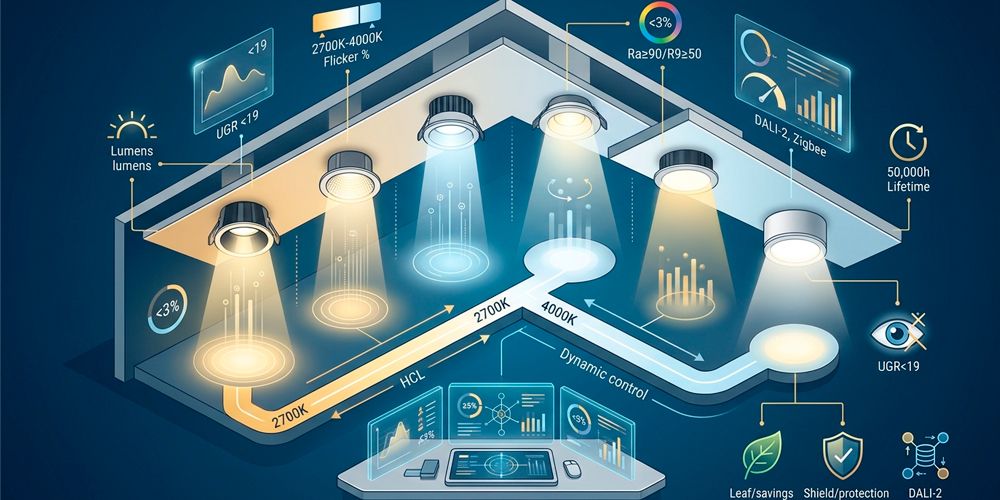
The downlight is the best-selling luminaire on the LED market. It is also the one that generates the most complaints, the one most often specified wrongly and the one that causes the most confusion among those who do not know the difference between watts and lumens, between Ra and R9, or between a TRIAC dimmer and a DALI driver. This guide is the complete reference: the 14 parameters explained, the 8 types described, a selection table for 15 applications and the 7 most frequent mistakes with their solution. With it, an installer has everything needed to specify any downlight project correctly.
1. The 14 parameters that define an LED downlight
Before choosing a downlight you need to understand exactly what each datasheet parameter measures and when it matters. The first principle is simple: light is specified in lumens, not in watts.
Colour temperature scale for downlights
Keep the same colour temperature throughout the space. Mixing 3,000 K and 4,000 K on the same ceiling is immediately noticeable.
- Residential
- Colour temperature + flux + dimming. UGR and Ra matter, but are secondary.
- Retail
- Ra + colour temperature + dimming. The customer's visual experience rules.
- Office
- UGR<19 + flicker + lux level. Productivity and legal compliance come first.
- Medical or educational
- Ra + R9 + flicker. Colour quality and the absence of flicker are critical.
- Wet areas
- IP. Everything else is secondary if the IP rating is wrong.
2. The 8 types of downlight: when to use each one
Not all downlights are the same. This table describes the 8 main types with their characteristics and applications:
| Type | Description | IP | Ideal application | Key advantage |
|---|---|---|---|---|
| Fixed recessed | The most common. Installed in suspended or plasterboard ceilings with a fixed beam angle. | IP20–IP44 | General lighting of offices, shops, corridors and bedrooms. The market standard. | Economical, easy to install, with UGR<19 options. |
| Adjustable recessed | The LED module rotates and tilts (typically ±30°) without moving the housing. | IP20–IP44 | Accent on pictures, product in shops and areas with variable focus. | Direction adjustment without building work. |
| Anti-glare (deep baffle) | Deeply recessed optics that hide the LED module at oblique angles. | IP20–IP44 | Offices, meeting rooms and museums where UGR<19 is mandatory or the luxury finish demands it. | Maximum visual comfort: the LED is not visible from normal viewing angles. |
| With micro-prism lens | Prismatic diffuser that controls dispersion and reduces angular luminance. | IP20–IP44 | Open-plan offices with strict UGR<19; replacement of fluorescent luminaires. | UGR<16 possible, modern look and high efficiency. |
| Waterproof (IP65/IP67) | Standard recessed with hermetic sealing for wet areas. | IP65–IP67 | Bathrooms, kitchens, showers, saunas (with certified temperature) and outdoors under a porch. | IP65 valid for showers (zones 1 and 2); IP67 for temporary immersion. |
| Semi-recessed (spot) | The LED module protrudes from the ceiling plane, allowing greater tilt. | IP20–IP44 | Retail, hospitality and art galleries that need more freedom of orientation. | More accent and rotation options than the standard recessed type. |
| Surface-mounted | Screwed to the ceiling without a recess. | IP20–IP65 | Renovations without building work, garages, basements and concrete ceilings. | No suspended ceiling needed and faster installation. |
| Gimbal / 360° adjustable | The module rotates 360° around the vertical axis and tilts up to 45°. | IP20–IP44 | Luxury retail, museums and galleries with changing product. | Maximum flexibility: millimetre-precise aiming without touching the installation. |
← Swipe the table horizontally to see all columns →
IP rating table for downlights
The IP rating (IEC 60529) combines two digits: the first indicates protection against solids and the second against water. For a downlight, the second digit decides where it can be installed:
| IP rating | Solids (1st digit) | Water (2nd digit) | Where to install it |
|---|---|---|---|
| IP20 | Objects >12.5 mm | No protection | Dry interior: living room, bedroom, office, retail, corridors. |
| IP44 | Objects >1 mm | Splashes from any direction | Kitchen worktop (steam), bathroom zone 2, areas with splashes. |
| IP54 | Dust protected | Splashes | Garages, storage rooms and premises with moderate dust. |
| IP65 | Dust-tight | Water jets | Bathroom zone 1 (shower/bath), outdoors under a porch, areas hosed down for cleaning. |
| IP67 | Dust-tight | Temporary immersion up to 1 m | Areas with a risk of flooding or temporary immersion. |
← Swipe the table horizontally to see all columns →
Downlights with dim-to-warm are a special category: when dimmed they not only reduce intensity, they also warm the colour temperature and mimic the effect of a candle or an incandescent filament.
In restaurants and hotel rooms, this progressive warmth creates a far more natural and luxurious experience than a standard dimmer. The extra cost compared with a conventional dimmable downlight is €15–30 per unit: in a 30-table restaurant with 90 light points, between €1,350 and €2,700. The impact on the customer experience is immediate.
3. Selection guide by application: 15 uses with complete specification
This table gives the correct technical specification for the 15 most common applications. It is the quick answer to "which downlight do I need here?":
| Application | Colour temp. | CRI / UGR | IP | Dimming | Angle | Flux | Key criterion |
|---|---|---|---|---|---|---|---|
| Living room | 2,700 K | Ra≥80 | IP20 | Not essential | 36°–60° | 800–1,200 lm | Warm atmosphere: prioritise warmth over efficiency. |
| Bedroom | 2,700 K | Ra≥80 | IP20 | Recommended | 36°–60° | 500–800 lm | Independent bedside light with dimmer. |
| Bathroom zone 1 (shower) | 3,000 K | Ra≥80 | IP65 | No | 60° | 600–800 lm | IP65 recommended (REBT: IPX4 minimum). No dimmer, for safety. |
| Bathroom zone 2 | 3,000 K | Ra≥80 | IP44 | Optional | 60° | 600–800 lm | IP44 minimum. Ra≥90 recommended at the mirror. |
| Kitchen (worktop) | 4,000 K | Ra≥80 | IP44 | No | 24°–36° | 500–700 lm | IP44 because of steam; 4,000 K to see food properly. |
| Kitchen (island) | 3,000–4,000 K | Ra≥80 | IP20 | Yes | 36° | 800–1,200 lm | Accent on the island, dimmable for atmosphere. |
| Dining room | 2,700–3,000 K | Ra≥80 | IP20 | Yes | 36°–60° | 800–1,000 lm | Accent on the table and lower ambient light elsewhere. |
| Office (workstation) | 4,000 K | Ra≥80 · UGR<19 | IP20 | Optional | 36°–60° | 800–1,000 lm | UGR<19 mandatory. Presence sensor per zone. |
| Retail (shelving) | 3,000 K | Ra≥90 | IP20 | Yes | 24°–36° | 1,000–1,500 lm | Ra≥90 and accent on product with a dimmable driver. |
| Shop window | 2,700–3,000 K | Ra≥95 | IP20 | Yes | 15°–24° | 1,500+ lm | Ra≥95 for maximum fidelity and a narrow beam. |
| Hotel (room) | 2,700 K | Ra≥90 | IP20 | Mandatory | 36°–60° | 600–800 lm | Dim-to-warm ideal. Never fixed without dimming. |
| Hotel (corridor) | 2,700–3,000 K | Ra≥80 | IP20 | Recommended | 60° | 400–600 lm | Presence sensor and dimming to 30% when unoccupied. |
| Hospitality (table) | 2,700 K | Ra≥90 | IP20 | Mandatory | 24° | 1,200–2,000 lm | Accent on the table and Ra≥90 for the dish. |
| Medical consulting room | 4,000 K | Ra≥90 · UGR<19 | IP20 | Yes | 36°–60° | 800–1,000 lm | R9≥50 and Flicker Percent <3%. |
| Museum / gallery | 3,000 K | Ra≥95 | IP20 | Yes, adjustable | 15°–24° | 800–1,500 lm | R9≥50, UV-free. 360° adjustable recommended. |
← Swipe the table horizontally to see all columns →
4. The beam angle: the most ignored and most important variable
The beam angle determines the diameter of the illuminated area on the working plane. A badly chosen angle produces dark zones between downlights or an excessive concentration of light at one point.
D = 2 × H × tan(α / 2)
15° at 2.5 m → D = 0.66 m  ·  precise accent on small product or jewellery
24° at 2.5 m → D = 1.07 m  ·  standard accent in retail and hospitality
36° at 2.5 m → D = 1.63 m  ·  general use in living rooms, offices and circulation
60° at 2.5 m → D = 2.89 m  ·  very diffuse, uniform light with soft shadows
D = illuminated diameter (m) · H = mounting height (m) · α = beam angle (°)
In general lighting, the beams of adjacent downlights should overlap slightly to guarantee uniformity across the space.
To maintain uniformity ≥ 0.7 (minimum recommended ratio): spacing ≤ 1.0 × H with a 36° angle and ≤ 0.8 × H with a 24° angle, where H is the mounting height.
2.5 m ceiling with 36° downlights: maximum spacing 2.5 m. 3 m ceiling with 24° downlights: maximum spacing 2.4 m.
5. Dimming downlights: what works and what doesn't
Dimming is one of the aspects with the most incidents on the market. The main cause is incompatibility between the LED driver and the installed dimmer:
| Dimmer type | Signal | Designed for | LED compatible? | Key remark |
|---|---|---|---|---|
| TRIAC / leading-edge phase cut | 230 V AC | Incandescent / halogen | ❌ No | Causes flicker and harmonics in the LED driver. It can destroy it. |
| LED-compatible TRIAC | 230 V AC | 230 V dimmable LED (on the list) | ⚠️ With list | The manufacturer must publish the list of compatible dimmers. Always check. |
| Trailing-edge phase cut | 230 V AC | 230 V dimmable LED | ⚠️ Depends | Better than leading-edge TRIAC, but also needs verification. |
| DALI (IEC 62386) | 2-wire bus | LED with DALI-2 driver | ✅ Yes | The professional standard: precise digital dimming, interoperable between manufacturers (DALI-2). |
| 0–10 V analogue | 0–10 V signal | LED with 0–10 V driver | ✅ Yes | Reliable analogue dimming, without two-way communication. |
| Zigbee (wireless) | 2.4 GHz | Zigbee modules | ✅ Yes | No additional wiring. Check compatibility with the hub. |
| PWM (low voltage) | 12/24 V DC | DC LED strips and modules | ✅ Yes | For low-voltage luminaires; does not apply to 230 V mains downlights. |
← Swipe the table horizontally to see all columns →
- What it is
- The result of real tests between the downlight and each dimmer. If the customer's dimmer is not listed, there is no guarantee it will work, even if it is sold "for LED".
- What to look for
- Dimmer make and model, minimum and maximum compatible power and expected dimming curve.
- If it is not on the list
- Ask the manufacturer for the updated list. If it still does not appear, replacing the dimmer with a compatible one is the only safe option.
- Minimum load
- Many dimmers require a minimum load (for example 40 W) that is not reached with 7 W LEDs: flicker or no dimming. Use dimmers with a 0 W minimum load or add a compensation load.
6. Downlights and heat: the factor that determines real service life
An LED does not blow like an incandescent bulb: it degrades progressively, and the main cause of degradation is heat. The service life on the datasheet (usually 25,000–50,000 hours) is measured at a controlled ambient temperature, generally 25 °C.
- Only luminaires with the F marking on the datasheet are approved for installation in contact with insulating material.
- Without that marking, installing a downlight in contact with insulation breaches electrical installation regulations and can create a fire risk.
- Most quality LED downlights for homes with plasterboard ceilings include it, but it must be checked before specifying.
7. The 7 most frequent mistakes when choosing and installing downlights
These mistakes appear in thousands of installations every year, and all of them are avoidable:
| Mistake | Typical situation | Consequence | Correct solution |
|---|---|---|---|
| Choosing by watts instead of lumens | The customer asks for a 20 W downlight because they "need a powerful one". | A 20 W LED can give 1,200 or 2,400 lm depending on its efficiency. | Always specify the flux in lumens. An efficient 12 W LED can outperform a low-quality 20 W one. |
| Mixing colour temperatures | 3 downlights at 3,000 K and 2 at 4,000 K on the same ceiling because of emergency purchases. | Immediately noticeable difference and a careless look. | Same colour temperature throughout the space and, if possible, the same production batch. |
| 230 V downlight without IP in the shower | An IP20 downlight on the ceiling of zone 1. | Risk of electrocution. Breach of the REBT (ITC-BT-27); insurance may not cover the damage. | Zone 1: IP65 recommended (IPX4 legal minimum, IPX5 with jets). Zone 2: IP44 minimum. Reference: IEC 60364-7-701. |
| Wrong dimmer | Reusing the TRIAC dimmer from the halogen installation. | Flicker, buzzing, heating and shorter LED service life. | Check the manufacturer's list of compatible dimmers and replace the dimmer if necessary. |
| Recessing without a junction box | Direct wiring without a box in a plasterboard ceiling. | Breach of the REBT; in the event of a fire the installation can be declared non-compliant and the insurer may not pay out. | Accessible junction box in the wiring of every light point. It is an obligation, not a recommendation. |
| Not checking the recess depth | Buying 50 downlights of 90 mm for a ceiling with 70 mm free. | Additional building work or an urgent search for other models: cost and time lost. | Measure the free depth before specifying. Slim models need 30–50 mm. |
| Ignoring heat dissipation | Downlight inside thermal insulation with no dissipation. | The LED junction exceeds its limit: flux drops and service life falls by up to 3 times. | Use models with the F marking or leave free space around them. Check the datasheet. |
← Swipe the table horizontally to see all columns →
A downlight without the right IP in the shower, a light point without a junction box and a downlight without the F marking on insulation are breaches of the REBT. Besides the electrical or fire risk, they can leave the customer without insurance cover and compromise the installer's liability.
8. Pre-purchase checklist: 10 questions that prevent problems
Before confirming any downlight order, this checklist prevents the vast majority of post-installation problems:
- How many lumens do I need on the working plane? TechnicalFlux is the design parameter; watts are a consequence.
- Which colour temperature suits this space? TechnicalSee the guide by application in section 3.
- Does the space require UGR<19? RegulatoryAt workstations with screens, verify the manufacturer's certification for the dimensions of the space.
- Is there humidity or contact with water? What IP do I need? SafetyBathroom zone 1: IP65 recommended. Zone 2: IP44. Outdoors under a porch: IP65 minimum.
- Will there be a dimmer? Is it compatible with the chosen model? TechnicalCheck the manufacturer's list of compatible dimmers.
- Does the ceiling have enough free depth? PracticalSlim models need 30–50 mm; standard models, 70–120 mm.
- Is the installation point on thermal insulation? TechnicalIf so, use a model with the F marking. If not, check the dissipation.
- Is there a CE Declaration of Conformity and a datasheet with Ra and K? LegalWithout that documentation, the luminaire is not correctly certified.
- Does the warranty cover the intended use? CommercialA 2-year warranty in 24 h/day use is worth far less than in residential use.
- Will all the downlights be from the same batch? AestheticIn visible spaces, a change of batch can produce noticeable colour variations.
At Factorled we make this checklist available to our installers as a printable PDF for pre-site visits.
Every downlight in our catalogue comes with a complete datasheet with all the parameters in this guide, a list of compatible dimmers, CE certification and EPREL registration. Write to us at uk@factorled.com.
9. Trends: ultra-slim downlights, tunable white and decoupled driver
The LED downlight market is evolving fast. These are the three trends the installer should know:
Conclusion: the right downlight is the one the installer can justify
The LED downlight is the most specified product on the market and the one with the greatest variation in quality between options at similar prices. The difference between an €8 downlight and a €25 one is not only in durability: it lies in the Ra, the flicker, the UGR, dimmer compatibility, colour temperature accuracy and the technical documentation that backs up those specifications.
The installer who understands these parameters and knows how to explain them to the customer has a real competitive advantage: they compete not only on price, but on technical value. And if a complaint arrives, they have the documentation that protects their work.
Factorled downlights: correct specification guaranteed
Complete range of LED downlights for every application: from basic residential use to medical projects with Ra≥95 and UGR<16.
All our downlights include a complete datasheet with Ra, flicker, UGR, list of compatible dimmers, IP certification, Declaration of Conformity and EPREL registration. Dim-to-warm, tunable white, anti-glare, IP65, 360° adjustable, ultra-slim and DALI-2 driver models.
Factorled downlight range
- Fixed recessed LED downlight Ra≥80Standard range for general use. 7 W, 12 W and 18 W in 2,700 K, 3,000 K and 4,000 K.
- Recessed LED downlight UGR<19For offices and workstations. Available with DALI-2 driver.
- Adjustable 30° LED downlight Ra≥90For accent in retail and hospitality. Dimmable.
- Dim-to-warm LED downlight 2,700–1,800 KFor hotels and restaurants: candle effect when dimmed.
- Tunable white LED downlight2,700–6,500 K. For human-centric lighting in hotels, clinics and libraries.
- Anti-glare LED downlight (deep baffle) Ra≥90Maximum visual comfort for museums, galleries and premium headquarters.
- IP65 LED downlightFor wet areas, showers and outdoors under a porch.
- LED downlight Ra≥95 R9≥50For jewellery, medical consulting rooms and laboratories.
- Ultra-slim LED downlight (30 mm)For renovations with low-profile ceilings.
Have a project with downlights? We help you specify it properly
We advise you on the choice of every light point: flux, colour temperature, UGR, IP rating and dimming compatibility, with the technical documentation that backs up your installation.
Request samples, the printable checklist or the compatible dimmer lists for any model in our range.
Article written by the Factorled technical team · factorled.com