

LED sports lighting: how to choose the best floodlights in 2027

David Torres
2026-11-04 10:04:02
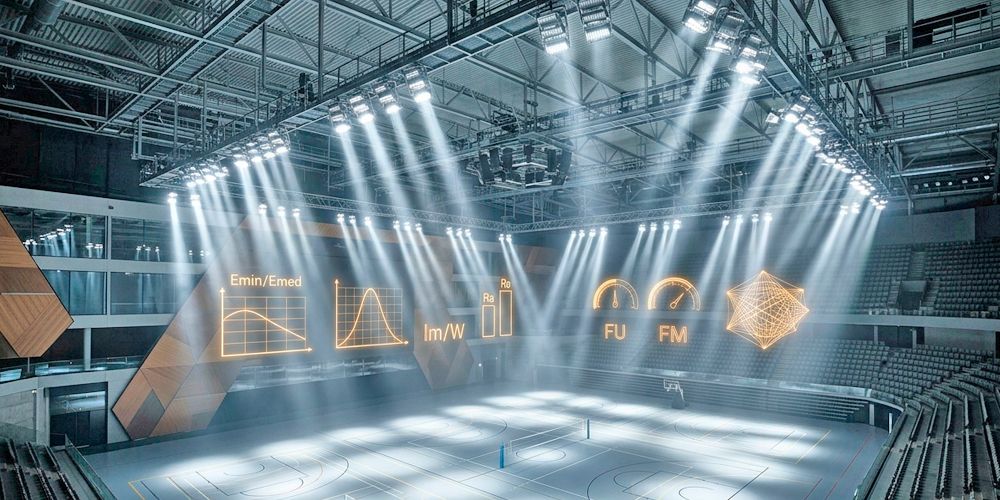
A well-lit sports facility lets you follow the ball, distinguish the players and move around the pitch with good visibility. To achieve it you need to define the lux required, distribute the light uniformly and limit glare. In this guide you will find the criteria for choosing LED floodlights for football pitches, tennis and padel courts and sports halls, plus a calculation example and a checklist before buying.
1. What the lighting of a sports facility must deliver
The first question is which sport will be played and at what level. A training court, a competition venue and a facility with broadcasts need different specifications. The size of the space, the lines of sight and the surroundings also condition the project.
A floodlight with more watts does not guarantee a better court. Ask for a proposal that states model, optics, position, aiming and calculated results. That way you can compare solutions by the useful light they deliver.
2. Standards and lighting levels according to use
In Spain, the technical reference is UNE-EN 12193:2020 on sports lighting, which replaced the 2009 edition. It covers lighting levels and their quality. To define a project you also need to review the requirements of the discipline, the competition and the site.[1]
The NIDE standards of the Spanish Higher Sports Council (CSD) provide references by sport. The table shows examples of average horizontal illuminance and minimum-to-average uniformity for tennis and padel; it does not include the additional requirements for television.[2][3]
| Facility and use | Outdoor · lux / U₀ | Indoor · lux / U₀ |
|---|---|---|
| Tennis · training, school and recreational | 200 / 0,60 | 300 / 0,50 |
| Tennis · regional, local and high-level training | 300 / 0,70 | 500 / 0,70 |
| Tennis · national and international | 500 / 0,70 | 750 / 0,70 |
| Padel · local, training, school and recreational | 200 / 0,60 | 300 / 0,50 |
| Padel · regional and high-level training | 300 / 0,70 | 500 / 0,70 |
| Padel · national and international | 500 / 0,70 | 750 / 0,70 |
← Swipe the table horizontally to see all the columns →
300 lux / 0.70 means an average illuminance of 300 lux and a ratio Emin/Eav of at least 0.70. The values correspond to the categories of the sources cited; the project must also check calculation areas, colour and glare.
Glare and broadcasting
There is no universal UGR 17 that validates any court. The index and evaluation method appropriate to the activity and the mounting must be applied. In sports lighting the GR or RG rating is also used; the result depends on the installation and the observer.[4]
In addition to horizontal illuminance, you must study the light on vertical planes, the camera positions and the temporal behaviour of the LED system. A lux figure on the floor cannot guarantee a quality broadcast.[4]
3. The ten parameters for choosing an LED sports floodlight
Compare the data sheets of the complete luminaires and request the photometric file of the exact reference. The efficacy of the LED chip alone does not tell you the performance of the installed assembly.
| Parameter | What it brings to the project | What you should check |
|---|---|---|
| Illuminance · lux | Amount of light received by a surface. | Maintained level and calculation area according to sport and use. |
| Uniformity · U₀ | Ratio between the minimum and the average value. | Emin/Eav on the calculation grid and in the final measurement. |
| Luminous flux · lm | Light emitted by the complete luminaire. | Flux of the selected model and optics. |
| Power and efficacy | Electrical consumption and lm/W ratio. | Input power with driver and losses of the assembly. |
| Optical distribution | Shape and reach of the light distribution. | IES or LDT file, symmetry, tilt and spill light outside the venue. |
| Glare | Discomfort or loss of visibility. | Evaluation for the observation positions of the sport. |
| Colour temperature | Chromatic appearance of the light. | Consistency between floodlights and the requirements of the venue and the cameras. |
| CRI or Ra | Colour rendering. | Value required by the use and documented for the reference. |
| Driver and dimming | Intensity control and temporal response. | Control compatibility and flicker data if there will be video. |
| Construction and mounting | Suitability for the environment and the supports. | IP, impacts, corrosion, temperature, weight and wind load. |
← Swipe the table horizontally to see all the columns →
What information should accompany the quotation
Protection against dust and water must be assessed together with impact resistance, materials, connections and environmental conditions. In an indoor swimming pool, for example, suitability for the corrosive environment must be expressly checked.
4. Optics and mounting height to distribute the light well
The beam angle is chosen from the distance to the playing plane, the area each unit must cover and the location of the supports. There is no angle or height valid for every court. A narrow optic may serve to reach a distant area; an asymmetric one allows the distribution to be controlled from the side.
D = 2 × H × tan(α / 2)
D = diameter of the circle (m) · H = distance to the plane (m) · α = total beam angle
Valid for an ideal circular beam, perpendicular to the plane. The table illustrates how coverage changes; it does not represent a uniform lux contour.
| Beam angle | At 6 m | At 8 m | At 12 m | Geometric reading |
|---|---|---|---|---|
| 25° | 2.66 m | 3.55 m | 5.32 m | Concentrated beam |
| 40° | 4.37 m | 5.82 m | 8.74 m | Intermediate coverage |
| 60° | 6.93 m | 9.24 m | 13.86 m | Wider beam |
| 90° | 12.00 m | 16.00 m | 24.00 m | Wide coverage |
← Swipe the table horizontally to see all the columns →
A 60° beam at 8 m produces an approximate geometric diameter of 9.24 m if it strikes perpendicularly. When the floodlight is tilted, the footprint changes and the lux are distributed differently; the photometry is needed to evaluate the real result.
How to decide the layout
A round floodlight does not necessarily produce the same distribution as another round one. The distribution depends on the optics and the photometric assembly. Compare curves and IES or LDT files, as well as the external dimensions.
5. Selection guide by sports facility
The study must reflect what happens during play. This matrix summarises the points worth reviewing before specifying the floodlights; the light levels are set separately for each use.
| Facility | Visual priority | Layout to study | Key check |
|---|---|---|---|
| Football and 7-a-side football | Following the ball on the ground and in the air. | Sidelines or towers depending on geometry and surroundings. | Goals, sidelines, uniformity and lines of sight towards the floodlights. |
| Outdoor tennis | Distinguishing the ball in high, fast shots. | Lateral distribution covering the court and the back areas. | Serve, lobs and control of light towards neighbouring courts. |
| Outdoor padel | Seeing the ball next to walls and enclosures. | Units outside the court with lateral distribution. | Reflections on glass, clearance height and outdoor play areas. |
| Indoor tennis and padel | Keeping visibility when looking upwards. | Positions outside the exclusion zones of the sport. | Location of luminaires and contrast with the roof. |
| Basketball and handball | Avoiding annoying floodlights in jumps and shots. | Ceiling or lateral distribution validated in simulation. | Baskets, goals, floor reflections and changes of use. |
| Multi-sport hall | Serving several disciplines in the same venue. | Groups and scenes for the planned configurations. | Validate each sport and each switching scene. |
| Indoor swimming pool | Seeing swimmers and the surface without critical reflections. | Positions and units suited to the environment. | Corrosion, maintenance and reflections on the water. |
← Swipe the table horizontally to see all the columns →
In football, the location of the supports must respect the safety margins and avoid aiming that harms the goalkeepers' vision. The layout of another pitch should not be copied without reviewing dimensions and heights.[5]
In outdoor padel, the NIDE standard cited places the floodlights outside the court and sets a minimum height of 6 m. That height does not replace checking uniformity, glare and the particular conditions of the facility.[3]
Training, competition and cleaning can be managed with groups or dimming. Each scene intended for play must maintain the requirements of its use: switching off a row of floodlights without calculating the result can create dark areas.
6. How to prepare a sports lighting project
Complete data collection avoids buying luminaires that later force you to modify supports, wiring or aiming. Before requesting a proposal, gather this information.
- Define the useSports, competition category, schedules and recording or broadcasting needs.
- Measure the venuePlaying surface, safety margins, enclosures, roof and obstacles. Include photographs.
- Document the supportsPosition, height, load capacity, accessibility and the possibility of changing their orientation.
- Set the targetsMaintained illuminance, uniformity, glare and colour requirements for each scene.
- Simulate with the real referenceInclude its photometry and aim each unit. Review spill light outside the pitch and towards the surroundings.
- Coordinate the installationCheck power supply, protections, control and fixings with the professionals in charge.
- Verify after assemblyMeasure on the agreed grid, adjust the aiming and record the results for maintenance.
Indicative lumen calculation example
For a first estimate the total flux formula can be used. The utilisation and maintenance factors must be justified in the project.
Φ total ≈ E × A / (FU × FM)
E = maintained average illuminance (lux) · A = surface (m²) · FU = utilisation factor · FM = maintenance factor
With a hypothetical target of 300 lux, FU = 0.60 and FM = 0.80: 300 × 200 / (0.60 × 0.80) = 125,000 lm.
If each luminaire delivered 20,000 lm, the division would give 6.25 units. Rounding up to 7 only offers a starting point: the distribution, uniformity and glare may require a different solution. These figures are assumptions of the example.
This calculation does not determine the power nor guarantee that the target is met at every point. Simulation and subsequent measurement are what allow the proposed installation to be verified.
7. Consumption and maintenance to compare solutions
The economic comparison must be made between alternatives that deliver the required light quality. Include luminaires, installation, control, access at height, cleaning and replacements. Do not assign a saving percentage to LED without calculating the hours and power of both solutions.
Annual energy (kWh) = total power (kW) × hours of use
Example: going from 6 kW to 3 kW with 1,500 hours a year reduces consumption from 9,000 to 4,500 kWh. At an assumed price of €0.20/kWh, the difference would be €900 a year. It does not include investment, maintenance or other electrical costs.
8. Six common mistakes when choosing sports floodlights
| Mistake | What happens | How to avoid it |
|---|---|---|
| Choosing by watts alone | Power is bought without knowing the useful light. | Compare photometry and results on the pitch. |
| Using one fixed beam angle for everything | Dark areas or excess light outside appear. | Adjust optics, positions and aiming. |
| Looking only at average lux | A good average can hide low minimums. | Review uniformity and the grid point by point. |
| Demanding UGR 17 on any court | A criterion is used that may not apply. | Apply the relevant glare method. |
| Assuming it works for video | Banding or poor results may appear. | Check driver, cameras and vertical illuminance. |
| Forgetting maintenance | Dirt and degradation reduce the light. | Justify the MF and plan access, cleaning and spare parts. |
← Swipe the table horizontally to see all the columns →
Keep the aiming plan and the initial measurements. If an optic, the position of a support or the type of luminaire changes, review its effect before accepting the whole.
9. Frequently asked questions about LED sports lighting
How many lux does a sports court need?
It depends on the sport, the use, the level of competition and whether the venue is indoor or outdoor. For example, the padel NIDE standard cited specifies 200 lux for local or recreational outdoor use and 300 lux for that use indoors. Uniformity and the other requirements must also be checked.[3]
How many floodlights do I need for my pitch?
It cannot be deduced from the square metres alone. You need the geometry, the mounting positions, the targets and the photometry. The number is validated through simulation.
What is the difference between lumens and lux?
Lumens express the flux emitted; lux describe the light that reaches a surface. One lux equals one lumen per square metre. Two installations with the same flux can produce different illuminances.
At what height should the floodlights be installed?
The height is decided by the geometry, the conditions of the sport, the supports and glare control. The minimum heights of a discipline are not a universal solution for every facility.
Can I reuse the poles from the previous installation?
It may be viable after checking their condition, load capacity, fixings, orientation and access. The change of technology also requires reviewing the lighting design and the electrical installation.
Conclusion for choosing sports lighting
The choice starts with the requirements of the playing surface and ends with its verification. Lux, uniformity, glare and light distribution must fit together before deciding how many floodlights to buy. A documented proposal makes it easier to compare quotations and keep the installation in good condition.
🏟️ Factorled floodlights for sports lighting
The sports category brings together different families of floodlights and accessories. The choice must be made on the data sheet of the specific reference and its optical distribution.[6]
See the range at factorled.com/es/profesional/deportiva or write to info@factorled.com.
Factorled products for sports lighting
- MAGNUM and MAGNUM PROModular options with different optics to adapt the distribution to the project.
- DOB MAGNUMAlternatives in the family with electronics integrated on the board; check the dimming and usage conditions.
- STADIUMHigh-power ranges for facilities that require greater reach and flux.
- MAXLITE and accessoriesCompact options and mounting elements for compatible configurations.
The numerical levels cited correspond to the documents indicated and to the use described. For facilities outside Spain, check the national adoption of the European standard and the requirements of the federation and the site.
- AENOR · UNE-EN 12193:2020 standard sheet
- CSD · NIDE Tennis 2024 · lighting section
- CSD · NIDE Padel 2021 · lighting section
- FIFA · Technical systems and services · lighting
- CSD · NIDE 7-a-side Football · lighting section
- Factorled · LED sports lighting
References consulted on 3 November 2026.
Prepare your sports lighting enquiry with Factorled
Send us the sport, the dimensions of the venue, the height and position of the supports and the intended use. With that data we can guide the selection of floodlights and review the needs of the project.
MAGNUM, MAGNUM PRO, DOB MAGNUM, STADIUM and MAXLITE floodlights with mounting accessories for pitches, courts and sports halls.
Factorled · Lighting blog · factorled.com