
What Is Circadian Lighting (Human-Centric Lighting)? Specifications and Conclusions

David Torres
2026-06-08 09:29:41
Blog · Trends · Wellbeing and productivity
Circadian lighting (Human Centric Lighting): what it is, why all your clients will ask for it, and how to specify it
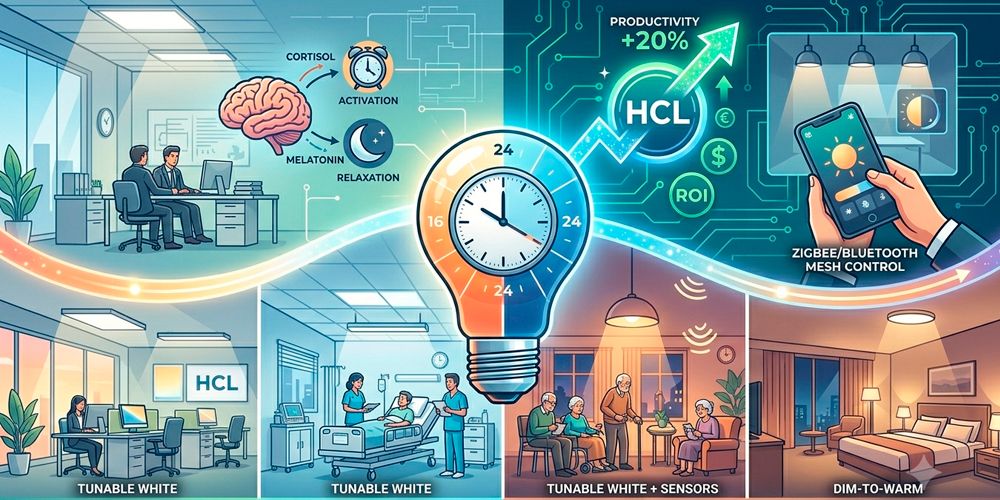
Light is not just illumination. It is the main regulator of the human body clock — the one that determines when we sleep, when we are alert, when we perform at our best and when the body prepares to rest. Circadian lighting, also known as Human Centric Lighting (HCL), applies this knowledge to the design of installations that change colour temperature and intensity throughout the day to synchronise with the body's natural rhythm. In 2026 it is no longer a cutting-edge trend: it is a growing demand in offices, hospitals, hotels and care homes, and the installers who know how to specify it will gain a real competitive advantage.
1The science behind light: the circadian rhythm
The circadian rhythm is the roughly 24-hour cycle that regulates virtually all of the human body's physiological functions: sleep, body temperature, blood pressure, hormone production and cognitive performance. Its main external regulator is sunlight, specifically the blue wavelength (450–490 nm), captured by the retina's ipRGC cells (intrinsically photosensitive retinal ganglion cells).
These cells send signals directly to the suprachiasmatic nucleus (SCN) in the hypothalamus, the body's master clock, which in turn regulates the production of cortisol (the activation hormone) and melatonin (the sleep hormone).
The problem with conventional artificial lighting
Conventional artificial lighting has a fixed colour temperature all day long. This means:
Fixed cool light all day
Blocks melatonin production even at night, disrupting sleep and causing chronic fatigue.
Fixed warm light all day
Does not provide enough stimulation during the hours of greatest cognitive demand, reducing productivity.
Circadian desynchronisation
Living and working under constant artificial light without adapting to the time of day is a form of continuous jet lag that affects health in the long term.
The World Health Organization classifies night-shift work with exposure to artificial light as a probable carcinogen (Group 2A). Studies from the Max Planck Institute for Chronobiology show that circadian desynchronisation is associated with a higher risk of type 2 diabetes, cardiovascular disease and depression. HCL that mimics the natural solar cycle significantly reduces these risks in working environments.
The colour temperature scale in HCL
Every circadian system plays with three lighting registers throughout the day. This is the visual representation of the reference temperatures:
2The ideal light cycle throughout the day
This table shows how lighting should adapt across the 24 hours to synchronise with the human biological rhythm. It is the basis of any well-designed HCL system:
| Time | Phase | Ideal colour temp. | Intensity | Tone | Physiological effect |
|---|---|---|---|---|---|
| 06:00–08:00 | Waking / activation | 2,700–3,000 K | Low | Warm | Cortisol begins to rise. Soft warm light eases waking without harming the rhythm. |
| 08:00–10:00 | Transition to work | 3,000–4,000 K | Medium | Neutral | Gradual increase in colour temperature. The brain enters alert mode. |
| 10:00–14:00 | Peak performance | 4,000–5,000 K | High | Cool | Peak cortisol and attention. Cool, bright light maximises concentration and precision. |
| 14:00–16:00 | Post-lunch dip | 4,000 K | High | Neutral | Bright neutral light counters post-meal drowsiness. |
| 16:00–18:00 | Second activation | 4,000–4,500 K | Medium-high | Neutral | Second productivity peak. Maintain a neutral temperature. |
| 18:00–20:00 | Gradual wind-down | 3,000–3,500 K | Medium | Warm | Progressive reduction of intensity and temperature. The body prepares to relax. |
| 20:00–22:00 | Relaxation | 2,700 K | Low | Very warm | Melatonin begins to be secreted. Warm, dim light eases the transition to sleep. |
| 22:00–06:00 | Sleep | < 2,700 K | Minimal | Amber | If night light is needed, amber/red only. Blue light fully suppresses melatonin. |
Just 30 minutes of exposure to 6,500 K light (cool white) before bed delays melatonin production by 90 to 120 minutes, equivalent to crossing 2 time zones. Phone and computer screens in night mode only partly reduce this effect: the ambient lighting is just as decisive.
3The sectors that benefit most: cases and data
Circadian lighting is not just for cutting-edge tech offices. These are the sectors where the benefits are documented with real clinical and business data:
| Sector | Documented benefits | Lighting strategy | Recommended technology |
|---|---|---|---|
| Offices and coworking | +12–20% productivity · −25% errors in concentration tasks · −30% reported headaches | Tunable white systems 2,700–6,500 K with automatic scheduling by time of day | Linear LED luminaires tunable white + DALI or Zigbee controller |
| Hospitals and clinics | ICU stay reduced by up to 10% · better rhythm synchronisation during long stays · less night-time agitation in elderly patients | Differentiated sequences for treatment zones (cool light) and rest zones (warm night light) | Medical LED CCT panels + zone-based control |
| Care homes | −40% night-time falls with dynamic lighting · better sleep and reduced dementia in clinical studies · less use of sedatives | Emphasis on daytime stimulation (high intensity and cool light), gentle transition to warm light in the evening | LED strips tunable white + presence sensors + time controller |
| Hotels | Better 'sleep quality' reviews · greater perception of luxury · competitive differentiation | Sequences customisable per guest: 'welcome', 'relax', 'work' and 'wake-up' scenes | Dim-to-warm LED downlights + tunable white LED strips + app control |
| Schools and universities | Better attention and lower absence · better exam results with cool light · less hyperactivity in ADHD | Cool, bright light for lessons and exams; warmer and dimmer for creativity and rest | LED panels UGR<19 tunable white + scene controller |
| Industry and night shifts | −20% errors on night shift · less fatigue on 12-hour shifts · better adaptation to shift changes | Cool, bright light at the start of the shift to activate alertness; transition to warmer light in the final hours | LED high bays tunable white IP65 + scene controller per shift |
According to data from MarketsandMarkets, the global Human Centric Lighting market will reach 4.8 billion dollars in 2027, with an annual growth rate of 27%. In Europe, Germany, the Netherlands and the Nordic countries are leading adoption. The UK, France and Belgium are in an early adoption phase, which represents a significant commercial opportunity for installers who position themselves now. The most dynamic sector in 2025–2026 is the post-COVID refurbishment of offices, where employee wellbeing has become a criterion for choosing a corporate headquarters.
4The LED technologies for implementing HCL
Not all LED luminaires are compatible with circadian lighting. These are the available technologies, from least to most complex:
| Technology | How it works | Flexibility | Rel. cost | Ideal application |
|---|---|---|---|---|
| Tunable White (TW) | A single channel that varies from 2,700 K to 6,500 K | High | Medium | Offices, hospitals, hotels. The most complete solution for HCL. |
| Dim-to-Warm (DTW) | As intensity is reduced, the temperature drops (mimics a candle) | Medium | Low | Hospitality, care homes, bedrooms. Very natural candle effect. |
| Fixed CCT 4,000 K + 2,700 K | Two independent circuits that combine | Medium | Low-medium | Economical solution for projects on a tight budget. |
| RGBW LED | RGB + white. Full control of colour and temperature | Very high | High | Retail, shop windows, premium hospitality. Maximum flexibility. |
| LED + decorative OLED | Combination of direct and indirect coloured light planes | Very high | Very high | Luxury spaces, museums, exclusive design installations. |
Tunable White: the recommended technology for full HCL
Tunable White (TW) luminaires contain two types of LED chip: warm-temperature ones (2,700 K) and cool-temperature ones (6,500 K). The controller mixes both channels in variable proportions to obtain any intermediate temperature while keeping the total luminous flux constant.
- Adjustment range: from 2,700 K to 6,500 K with smooth, programmable transitions.
- Compatibility: requires a DALI, Zigbee, Bluetooth Mesh or two-channel 0-10V controller.
- Colour rendering index: Ra > 90 on most quality TW luminaires, above the standard's minimum of Ra > 80.
- Energy efficiency: intelligent dimming reduces consumption by 8–15% compared with a fixed installation at 100%.
5Control systems: how to automate the circadian rhythm
Tunable White LED technology is only half of the system. The other essential component is the control system that programmes and automates the changes throughout the day:
| Control system | Description | Complexity | Best for |
|---|---|---|---|
| DALI (IEC 62386) | Professional protocol over a 2-wire cable | Very high | Hospitals, large office buildings, public installations with a certification requirement |
| KNX | European standard building automation bus (ISO 14543) | Very high | Smart buildings, luxury hotels, large installations with full services integration |
| Zigbee | Low-power wireless mesh protocol | High | Medium-sized offices, hotels, installations where additional cabling is a problem |
| Bluetooth Mesh | Wireless protocol, control from a smartphone | High | Residences, boutique hotels, residential projects. Easy installation without infrastructure |
| 0-10V analogue | Analogue control signal, compatible with almost everything | Medium | Projects on a tight budget where automation is basic (intensity only) |
| Astronomical time clock | Scheduling by time of day, without external sensors | Medium | The most economical solution for basic HCL. Shops and small offices |
| Daylight sensor | Automatic adjustment according to available outdoor light | High | Complement to any system. Essential for meeting EN 15232 (building efficiency) |
🔧 Astronomical time clock + Tunable White: HCL made accessible
For projects where the client wants HCL without the complexity and cost of a full DALI or Zigbee system, the combination of Tunable White luminaires with an astronomical time clock controller is the most economical solution. The controller automatically adjusts colour temperature and intensity according to the time of day, with no manual operation or network infrastructure.
- Compatible with TW LED strips and TW LED panels
- Supports installations of up to 300 W per channel
- Available from Factorled from £40 per unit
6The economic argument: ROI of HCL versus fixed lighting
The main objection you will face when specifying HCL is the upfront extra cost. This table dismantles that objection with figures:
| Item | Upfront extra cost | Annual benefit | Note |
|---|---|---|---|
| Standard LED luminaire 4,000 K | Baseline | — | No ability to adapt to the circadian rhythm |
| Tunable white LED luminaire | +20–40% | — | Additional price for the dual LED chip and two-channel driver |
| Basic control system | +15–25% | — | Astronomical time clock or simple Zigbee controller |
| Additional energy savings (intelligent dimming) | — | 8–15%/yr | Dimming during lower-activity hours reduces consumption compared with fixed lighting at 100% |
| Improved office productivity | — | +12–20% | Measured in fewer errors and faster cognitive tasks |
| Reduced absenteeism (visual fatigue) | — | −15–25% | Fewer sick days linked to headaches and eye strain |
| Total ROI of HCL project vs standard | — | 18–36 months | Considering energy savings + productivity + reduced absence |
The most common mistake when selling HCL is to argue only on energy savings, which account for just 20–30% of the total return. The most powerful argument is productivity: in a company with 20 employees and an average salary of £35,000/year, a 10% increase in productivity is worth £70,000/year. Compared with that value, the extra cost of the HCL system (typically £3,000–8,000 in a standard office) is almost negligible. Always present the ROI by combining the three benefits: energy + productivity + reduced absenteeism.
7How to specify an HCL project step by step
These are the steps to correctly specify a circadian lighting system from scratch:
Analysis of the user and the space
Who uses the space? At what times? What activities take place? Is there daylight available? The answers determine the optimal light sequence.
Defining the light sequence
Based on the table in section 2, design the colour temperature and intensity curve for the user's typical day.
Selecting the LED technology
For full HCL, Tunable White. For projects on a tight budget, Dim-to-Warm or a combination of two CCT circuits.
Selecting the control system
DALI for professional projects, Zigbee or Bluetooth for medium projects, an astronomical time clock for tight budgets.
Calculating illuminance and UGR
HCL does not exempt you from meeting 500 lux and UGR<19 in work areas (BS EN 12464-1 and the Workplace (Health, Safety and Welfare) Regulations 1992). Verify with simulation software.
Programming the scenes
Define at least 4 base scenes: morning (activation), midday (concentration), afternoon (transition) and evening (relaxation).
Documentation and user training
Hand over the guide to the programmed scenes and the option for manual adjustment. A system the user does not understand will not be used.
HCL does not replace regulatory compliance: meeting 500 lux and UGR<19 in work areas (BS EN 12464-1 and the Workplace (Health, Safety and Welfare) Regulations 1992) remains mandatory. The circadian system is added on top of an installation that already meets the standard, never at its expense. Design the technical compliance first and the circadian curve second.
8The regulation that is coming: why HCL will become mandatory
Circadian lighting is moving from trend to standard in Europe:
- BS EN 12464-1 (2027 revision): the next revision of the standard for lighting in workplaces will introduce, for the first time, specific recommendations on colour temperature variation and melanopic illuminance (the illuminance that specifically affects the circadian rhythm).
- WELL Building Standard certification: the most internationally recognised standard for healthy buildings already includes HCL as a mandatory criterion in the 'Light' category. WELL Premium buildings require colour temperature control systems and minimum melanopic illuminance levels.
- LEED v4.1: the most widespread sustainable construction standard includes specific credits for the quality of interior lighting, including circadian light criteria.
- Energy performance of buildings legislation (EPBD-aligned): new builds and major refurbishments are increasingly required to incorporate intelligent lighting control systems, which directly favours HCL systems with sensors and automation.
Installers who master the specification and installation of HCL systems over the next 12–24 months will gain a significant competitive advantage when regulation makes these systems mandatory or highly sought after. The technical learning curve is moderate: most of the knowledge required is about control systems (DALI, Zigbee) and programming sequences, not the luminaire itself. At Factorled we are developing specific technical training for installers on HCL.
Conclusion: the light that cares for people, sets installers apart and delivers ROI
Circadian lighting is neither a design whim nor a passing fad. It is the application of decades of biomedical research to a product that any installer can specify and install today.
Its three arguments are unbeatable: it improves users' health and wellbeing, has a demonstrable economic ROI and, within a few years, will be a regulatory requirement. The installer who reaches their clients first with this proposition is not just selling luminaires: they are selling a result.
Factorled products for circadian lighting
- LED panel 60×60 Tunable White UGR<19 — 2,700 K–6,500 K, Ra>90, compatible with DALI and Zigbee
- LED panel 60×120 Tunable White — for offices with a rectangular suspended ceiling
- Suspended linear LED luminaire Tunable White — direct/indirect, for open-plan spaces and meeting rooms
- LED strips Tunable White 24V — 2,700 K–6,500 K, high COB density, for recessed installation in profile
- Dim-to-Warm LED downlights — for hospitality and residential areas. Candle effect when dimmed
- Astronomical time clock controller for TW LED — economical solution for basic HCL without network infrastructure
- Zigbee controller module for TW LED — for medium-sized projects with control from a smartphone or tablet
- DALI controller for Tunable White LED — for professional installations with KNX or BMS integration
Discover Factorled's HCL product catalogue
A complete range for circadian lighting: Tunable White LED panels UGR<19, high-quality TW LED strips, astronomical time clock controllers, DALI modules and Zigbee plug-and-play systems. All our TW products include a datasheet with emission spectrum and melanopic factor for compliance with WELL and LEED standards.
Article written by the Factorled technical team · factorled.com · info@factorled.com · Professional LED lighting for the whole of Europe