

Lighting Guide for the Hospitality Industry: Standout Lighting for Restaurants, Hotels, and Bars

David Torres
2026-06-15 09:48:02
Blog · Design guide · Hospitality and retail
Hospitality lighting: restaurants, hotels and bars that sell more with the right light
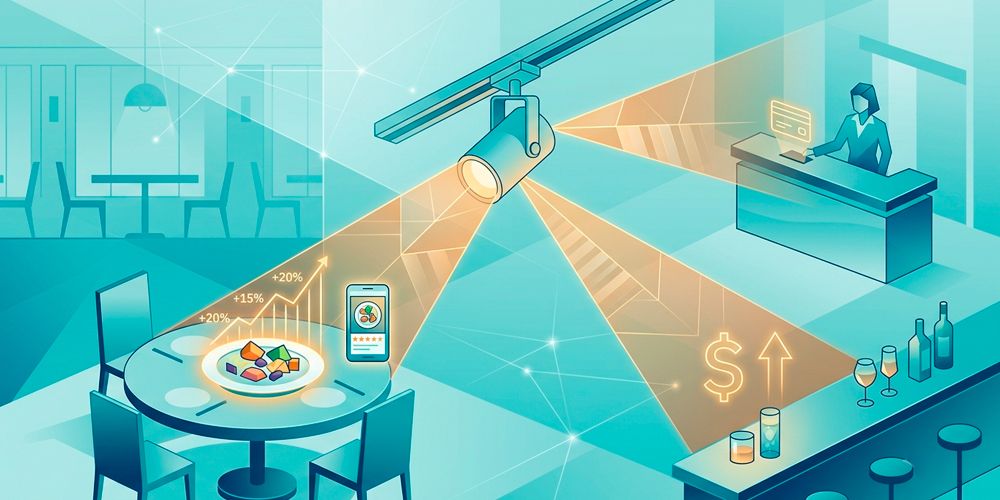
In hospitality, light doesn't illuminate: it sells. It sells the experience before the first plate arrives, extends the conversation at the table that ends in one more glass, makes the guest's photo look so good that it lands on Instagram, and turns a visit into a memory worth recommending. Studies of consumer behaviour are unanimous: lighting is the environmental factor with the greatest impact on the perception of quality and the willingness to return. Across northern Europe, where long, dark winters mean guests spend much of the season in artificial light, the quality of that light becomes even more decisive. This guide brings together everything an installer, interior designer or hospitality owner needs to know to turn light into a genuine asset for the business.
1. The psychology of light in hospitality: what the studies say
In 2013 Cornell University published a study that became an industry benchmark: reducing light intensity and colour temperature in restaurants increases spend per customer by 18 to 20%. The mechanism is simple: warm, low light lowers the customer's state of alertness, slows their pace, makes them feel more relaxed and, as a result, more receptive to ordering a dessert, a second bottle of wine or a coffee.
What light does without the customer knowing
🍖 Appetite appeal of food
A low CRI (Ra) makes the colours of food look dull. An Ra≥90 with light at 2,700 K makes meats glow red, salads an intense green and desserts irresistible. Food tastes better when it looks good.
⏱️ Dwell time
Warm, low light extends the average dwell time by 10 to 15%. In business terms: more orders, a higher average spend.
💷 Price perception
A University of Leiden study (2019) showed that in environments with carefully designed lighting, customers perceive prices as more justified and have a higher price tolerance per cover.
📸 Photography for social media
The 30–40 age group partly chooses where to eat based on how the photos look on Instagram. Lighting at 2,700 K Ra≥90 with accent over the tables produces photos the customer wants to share. That's free marketing.
If a restaurant with 30 tables and an average spend of £30 increases dwell time by 15%, it can turn over an extra 4–5 tables per evening across a 4-hour service. 4 tables × 2 people × £30 × 250 evenings/year = £60,000 in additional revenue per year. The lighting investment for a 150 m² restaurant is between £2,500 and £7,000. The ROI is 3 to 6 weeks.
2. Technical parameters by type of venue
Each type of venue has its own lighting requirements. This table brings together the reference values for the most common spaces:
| Type of venue / zone | Lux | Colour temp. | CRI (Ra) | UGR | Aesthetic importance |
|---|---|---|---|---|---|
| Fine-dining restaurant | 50–120 | 2,700–3,000 K | Ra≥90 | < 22 | Very high |
| Casual / family restaurant | 100–200 | 3,000 K | Ra≥80 | < 25 | Medium-high |
| Tapas bar / gastrobar | 80–150 | 2,700–3,000 K | Ra≥80 | < 25 | High |
| Café / coffee shop | 150–300 | 3,000–4,000 K | Ra≥80 | < 25 | Medium |
| Hotel — lobby and reception | 100–200 | 2,700–3,000 K | Ra≥90 | < 22 | Very high |
| Hotel — guest room (general) | 100–150 | 2,700 K | Ra≥90 | < 22 | High |
| Hotel — en-suite bathroom | 200–300 | 3,000 K | Ra≥90 | < 19 | High |
| Hotel — breakfast room | 150–250 | 3,000 K | Ra≥80 | < 22 | High |
| Hotel — meeting room | 300–500 | 4,000 K | Ra≥80 | < 19 | Medium |
| Nightclub / club | < 50 | Variable (RGB) | Ra≥60 | N/A | Very high |
| Cocktail bar | 30–80 | 2,000–2,700 K | Ra≥80 | < 28 | Very high |
| Outdoor terrace | 30–80 | 2,700–3,000 K | Ra≥80 | N/A | High |
The standard BS EN 12464-1 requires Ra≥80 for most interiors. In hospitality, Ra≥90 is the real minimum for food to look the way it should. A grilled steak under light with Ra=75 looks undefined in colour, almost greyish. The same steak under Ra=95 glows an intense red and looks perfectly cooked. In jewellery, the difference is even greater: Ra≥95 is mandatory for gold and precious stones to show their true colour.
The colour temperature scale in hospitality
Understanding colour temperature is the foundation of any hospitality project. This is the visual reference for the three key tones:
3. Zone-by-zone design: a complete restaurant
4. The 7 deadly sins of hospitality lighting
These are the lighting mistakes that destroy the customer experience in hospitality. All are avoidable with knowledge and the right product:
| The sin | How it shows up | Impact on customer and business | The right solution |
|---|---|---|---|
| Cool white light in the dining room | Colour temperature >4,000 K in a dining zone. | Food loses its appetite appeal; colours look dull or unnatural and customers feel an unconscious discomfort. | Always 2,700–3,000 K in dining rooms. Warm light makes the reds (meats, sauces, wines) glow. |
| Uniform light with no accents | The whole room at the same level, with no visual hierarchy. | The space looks like a staff canteen. Without hierarchy there is no atmosphere or design. | The 3:1 rule. The accent must be 3 times stronger than the general ambient light. |
| Too much light (>200 lux) | An excessive level for a hospitality space. | Customers feel exposed and can't relax. Dwell time and spend fall. | The best restaurants have 30–100 lux on the table. Controlled intimacy increases spend. |
| Spotlights in the eyes | Track spotlights or downlights that dazzle the seated customer. | Immediate physical discomfort. The customer looks down and associates the venue with discomfort. | Correct beam angle (24–36°) and spotlights at 30–45° from vertical, never in the line of sight. |
| Visible kitchen light | Work lighting (4,000–6,500 K, >500 lux) is visible from the dining room. | A brutal visual clash that completely breaks the dining-room atmosphere. | Visual separation with a partition or controlled sightline. Open kitchen: independent circuits. |
| Not adapting to the time of day | The same level at lunch and dinner service. | Lunch can take more light; dinner demands intimacy. Without dimming, one service is lost. | Dimmers on every circuit and at least two scenes: 'lunch' and 'dinner'. |
| Ignoring the bathroom | Bathrooms with uniform cool white light. | A drastic shift in mood; cool mirror light is unflattering and creates a poor impression. | The second most important impression point. Warm 3,000 K light and mirror lighting at Ra≥90. |
If you can fix only one fault in a restaurant, make it this one. A dining room at 4,000 K or more destroys the appetite appeal of every plate leaving the kitchen, however good the food is. It's the equivalent of serving a fine wine in a plastic cup. Never exceed 3,000 K in a zone where the customer eats.
5. Light scenes: programme the atmosphere by time of day
The biggest qualitative leap in hospitality isn't changing the luminaires: it's installing dimmers and programming light scenes. A basic dimming system, costing between £700 and £1,700 in a mid-sized restaurant, completely transforms the customer experience throughout the day:
| Scene | Time | Colour temp. | Ambient | Accent | Objective |
|---|---|---|---|---|---|
| Preparation / mise en place | 07:00–12:00 | 4,000 K | 80–100% | 100% | Work light for cleaning and prep. No atmosphere. |
| Lunch | 12:00–16:00 | 3,000 K | 60–70% | 70% | More light than at dinner. Casual, lively. Allows conversation at normal volume. |
| Between services | 16:00–20:00 | 3,000 K | 40–50% | 50% | Half-empty venue. Intimate light to prepare for dinner. |
| Dinner (start) | 20:00–21:00 | 2,700 K | 30–40% | 30% | Transition to dinner mode. The customer arrives to an atmosphere already created. |
| Dinner (full service) | 21:00–23:00 | 2,700 K | 20–30% | 20% | Maximum atmosphere. Accent over the tables to the fore. |
| Closing / cleaning | 23:00+ | 4,000 K | 100% | 100% | Back to full light for cleaning. A circuit separate from the rest. |
A dimmer compatible with the existing luminaires is the highest-ROI improvement in hospitality. Installation cost of dimmers in an 80 m² restaurant: £350–£700. Impact on average spend and dwell time: documented at +10–15%. Payback: within the first 15–20 days of service after installation.
6. Luminaire guide by zone
This is the technical reference for specifying the right luminaires in each zone of a hospitality venue:
| Zone | Recommended luminaire / solution | Key design criterion |
|---|---|---|
| Dining-room ceiling | Recessed dimmable downlight 2,700K | Uniform base light. Dimmable at least down to 10%. |
| Accent over the tables | Track spotlight 24°/36° 2,700K Ra≥90 | Focus on the plate. Narrow beam for greater drama. |
| Bar counter | LED COB strip 2,700K under the worktop + aluminium profile | Lights drinks and surfaces. Highly photogenic. |
| Backbar and shelving | LED strip 2,700K in aluminium profile, internal light | Make the glass of the bottles glow. Display-case effect. |
| Lighting for art / décor | Narrow track spotlight (15°) 3,000K Ra≥95 | High Ra is critical for art. Flicker-free. |
| Waiting area / lounge | Wall light 2,700K + LED floor lamp | Create intimacy and a human scale. |
| Outdoor terrace | LED floodlight IP65 2,700K + LED strip IP65 under the pergola | IP65 mandatory. 2,700 K maintains the atmosphere. |
| Professional kitchen (work) | Sealed LED batten IP65 4,000–5,000K 500 lux | Work zone: standard BS EN 12464-1, UGR<19. |
| Corridor and circulation zones | Recessed downlight or floor marker light 3,000K | 100–150 lux. Mark the route without breaking the atmosphere. |
| Bathrooms | Downlight 3,000K + mirror lighting Ra≥90 | Mirror light always from the side or diffuse from above. |
| External façade | LED floodlight IP65 2,700–3,000K + marker lights | The façade sells before the customer steps inside. |
| Meeting room / event | Dimmable LED panel 4,000K UGR<19 | Flexible for daytime (4,000 K) and evening (dim to 2,700 K if TW). |
Sealed LED batten Osram — UGR<19 for kitchen and back office
For the kitchen work zone, where the standard BS EN 12464-1 requires visual comfort without glare, the sealed Osram batten with controlled UGR delivers neutral, uniform light with full sealing against steam, grease and high-pressure cleaning. Separating the circuits from the dining room keeps the dining-room atmosphere intact.
7. The lighting project: how to present it to the owner
If you are an installer or interior designer, these are the arguments and the order of presentation that work best with hospitality owners:
Start with ROI, not with the technology
"With this proposal, your average spend can rise by 10 to 20%." That opens the conversation far better than talking about lumens.
Show visual references
Photos of restaurants with quality lighting vs. without. The visual difference is immediate and needs no technical explanation.
Separate the essential from the optional
Dimming (dimmers) is essential; Tunable White is optional. Present it that way so as not to overwhelm with cost.
Talk about zones, not products
"For the bar we need a warm accent and strips under the backbar" is easier to understand than "2,700K spotlights Ra90 with a dimmable driver".
Quantify the energy saving too
A restaurant with 60 fluorescent light points that switches to LED saves between £1,000 and £1,700 a year. A secondary argument that reinforces the decision.
Propose a phased budget
On a limited budget, prioritise: dining room > bar > bathrooms > exterior. The dining room is where the money is made.
8. The impact on reviews: the light that isn't mentioned but is felt
There is a curious phenomenon in Google reviews of restaurants: almost no one mentions the lighting explicitly, but it appears, hidden, in the most positive comments:
"Incredible atmosphere", "intimate and cosy", "the photos came out brilliantly", "you forget about everything": all of these adjectives are the direct consequence of well-designed lighting. The customer doesn't know it, but it's the light that creates the atmosphere that makes them return.
According to OpenTable data (2023), 30% of diners aged 18 to 35 choose a restaurant based on the photos on social media. Lighting at 2,700 K Ra≥90 with accent over the table produces photos with warm, natural and highly photogenic colours, with no filters needed. A restaurant where customers take good photos becomes a destination. Every shared photo is a free advertising impact with the customer's personal endorsement.
Conclusion: light is the ingredient that isn't on the menu
In hospitality, light is not an element of the electrical installation. It is part of the gastronomic offer and the customer experience. A restaurant with an 8/10 kitchen and 5/10 lighting will sell its experience as a 6/10. The same restaurant with 9/10 lighting will sell an experience of 8/10 or more.
The lighting investment in hospitality is not a cost, it's a multiplier of the bill, of dwell time, of the perception of quality and of customer loyalty. And its ROI is measured in weeks, not years.
Design the lighting project for your venue with Factorled
We work with installers and interior designers who specialise in hospitality to define the right lighting proposal for each space: luminaire selection, colour temperature and CRI by zone, dimming system and an estimate of energy savings. A complete range for hospitality: dimmable downlights, track spotlights Ra≥90, LED strips 2,700K IP44 for bars and Zigbee and RF control systems.
Factorled products for hospitality
- Dimmable LED downlights 2,700K Ra≥90 — for the dining room and ambience zones
- LED track spotlights 2,700K Ra≥90 — accent over tables, the bar and artworks
- LED strips 2,700K Ra≥90 IP44 — under the bar, in the backbar and in decorative elements
- Aluminium profiles for LED strips — a professional finish on the bar and linear elements
- PWM dimmers and intensity controllers — to create dimmable light scenes
- Outdoor LED floodlights IP65 2,700K — for terraces, façades and entrances
- LED wall lights 2,700K — for waiting areas, lobbies and lounge zones
- Sealed luminaires IP65 4,000K — for professional kitchens and work zones
Article written by the Factorled technical team · factorled.com
factorled.com · info@factorled.com · Professional LED lighting for the whole of Europe