

LED Lighting for Industrial Warehouses and Logistics Facilities | Technical guide

David Torres
2026-10-19 09:04:34
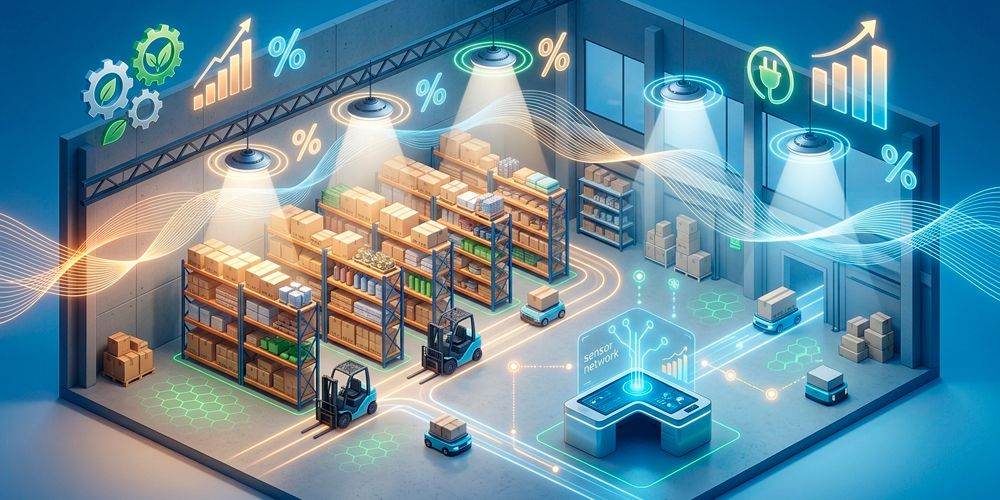
Industrial buildings and logistics warehouses are the facilities with the greatest energy-saving potential in lighting across the whole sector. A 5,000 m² facility with metal halide lamps switched on 16 hours a day can pay more than €68,000 a year in lighting energy alone. With LED high bays and microwave sensors, that cost drops to around 13.600 €, and the payback period stays below 12 months for practically any size of building. This guide covers everything from regulations to the most demanding cases: cold rooms, ATEX zones, the food industry and automated distribution centres.
1. The technical particularities of an industrial building
An industrial building is neither an office nor a car park. Its environmental conditions, safety requirements and usage pattern demand a completely different product selection.
Heights of 4 to 20 metres: the decisive factor
The clear height of the building determines the wattage, luminous flux and beam angle of the LED high bay. A high bay designed for 6 m will not light correctly at 12 m. The high bay selection table by height (section 5) is the most widely used tool in the design of any industrial building.
Demanding environmental conditions
ATEX zones: any area where an explosive atmosphere may form (dust silos, solvent areas, LPG storage, chemical industry) requires ATEX-certified luminaires. Without that certification the installation is illegal and the risk of explosion is real.
Food industry: IP66 or IP69K in pressure-washing areas, Ra≥90 for visual inspection, food-contact-safe materials and a design without corners or grooves where dirt can accumulate.
Cold and freezer rooms: LED designed specifically for low temperatures. Standard LED can suffer start-up problems and flux loss below −10 °C.
- A standard IP65 LED luminaire is NOT an ATEX luminaire. The IP65 rating indicates protection against water and dust, not protection against explosion.
- An ATEX luminaire is designed so that, in the event of an internal electrical fault, the spark, arc or surface temperature cannot ignite the surrounding atmosphere.
- The zone classification (Zone 0, 1 and 2 for gases; Zone 20, 21 and 22 for dust) must be carried out by a competent technician before designing the installation.
- Installing a non-ATEX luminaire in a classified zone is a serious offence that can lead to the activity being halted and, in the event of an accident, criminal liability.
2. Applicable regulations: lighting levels by zone
The reference standard is EN 12464-1:2021 (indoor workplaces), complemented by EN 12464-2:2014 for outdoor areas such as docks and loading bays. For occupational health and safety, Spain's Royal Decree 486/1997 on workplaces applies. Explosive atmospheres are governed by the ATEX Directive 2014/34/EU (equipment), Directive 1999/92/EC (worker protection, transposed in Spain by RD 681/2003) and the IEC/EN 60079 series of standards.
| Zone / space | Lux | Colour temp. | CRI | UGR | Special criterion |
|---|---|---|---|---|---|
| Production hall / general manufacturing | 300 | 4,000K | Ra≥80 | <25 | Work with machinery. Uniformity ≥0.6. Presence sensor per zone recommended. |
| Precision production / visual inspection | 750–1.000 | 4,000–5,000K | Ra≥90 | <19 | Detailed work. Ra≥90 for colour quality inspection. |
| High-density warehouse (racking >6 m) | 200 | 4,000K | Ra≥60 | <25 | LED high bay >100 W. 60°–90° optics. Aisle sensor recommended. |
| Medium-height warehouse (4–6 m) | 200 | 4,000K | Ra≥60 | <25 | 60–100 W LED high bay. 90°–120° optics for lateral racking coverage. |
| Loading area / dock | 150–200 | 4,000K | Ra≥60 | <28 | Forklift traffic. High mechanical resistance. IP65. |
| Dispatch / packing area | 300–500 | 4,000K | Ra≥80 | <22 | Reading labels and delivery notes. Ra≥80 for document legibility. |
| Quality control / laboratory | 750–1.000 | 4,000–5,000K | Ra≥90 | <19 | Ra≥90 and R9≥50 for finished product inspection. |
| Cold room (0 °C to +8 °C) | 200 | 4,000K | Ra≥60 | <25 | LED designed for cold. Working range −20 °C to +50 °C. Instant start. |
| Freezer room (−18 °C to −25 °C) | 200 | 4,000K | Ra≥60 | <25 | Low-temperature LED. Working range −40 °C to +50 °C. IP65 mandatory. |
| ATEX zone (explosive atmosphere) | 200–300 | 4,000K | Ra≥60 | <25 | Only ATEX-certified luminaires with Ex marking. Never standard LED. |
| Shop-floor offices / control room | 500 | 4,000K | Ra≥80 | <19 | Same standard as an office. UGR<19 where there are screens. |
| Staff changing rooms and toilets | 200 | 4,000K | Ra≥80 | <25 | Presence sensor. IP44. Mirror lighting Ra≥80. |
| Corridors and pedestrian circulation | 100–150 | 4,000K | Ra≥40 | <28 | Presence sensor with automatic dimming when unoccupied. |
| Maintenance area / workshop | 500 | 4,000K | Ra≥80 | <22 | High visual demand for repairs. Localised lighting recommended. |
← Swipe the table horizontally to see all columns →
Which colour temperature to choose in an industrial building?
The table makes one trend clear: 4,000K is the industrial standard. Warm light is reserved for rest areas and cool light only makes sense at very specific inspection stations:
Colour temperature scale applied to the industrial building: warm, neutral and cool.
3. IP ratings in industry: what protection each zone needs
The IP rating (EN 60529) indicates protection against solids (first digit) and liquids (second digit). Choosing an insufficient IP rating is one of the most frequent causes of premature failure in industrial buildings:
| Rating | Protection against dust | Protection against water | Typical industrial application |
|---|---|---|---|
| IP44 | Solids >1 mm | Splashes from any direction | Changing rooms, toilets and staff areas without process dust. |
| IP65 | Dust-tight | Low-pressure water jets | Minimum in any building with a production process, warehouses, docks and freezer rooms. |
| IP66 | Dust-tight | Powerful water jets | Food industry with pressure washing, cold rooms with washing and condensation. |
| IP69K | Dust-tight | High-pressure, high-temperature water (steam) | CIP cleaning (Clean-In-Place) in the meat, dairy and processing industries. |
| ⚠️ IP ≠ ATEX | No IP rating certifies protection against explosion | In classified zones, only luminaires with Ex marking and ATEX certification. | |
← Swipe the table horizontally to see all columns →
4. Special zones: the 3 most demanding environments
- Temperature range
- Chilled: 0 °C to +8 °C. Frozen: −18 °C to −25 °C. Deep-frozen: −40 °C or below. The LED must work correctly across the whole range.
- Guaranteed start-up
- Standard LED may fail to start or lose flux at −20 °C. Always demand guaranteed start-up at the minimum working temperature in the datasheet.
- IP65 minimum, IP66 recommended
- Cold rooms suffer washing and daily condensation when the door opens. IP66 where there are water jets, with silicone gaskets verified for sub-zero operation.
- Mercury-free
- LED contains no mercury, unlike the fluorescent lamps the EU is progressively phasing out under RoHS. Verify RoHS compliance in food installations.
- Presence sensor
- Essential. Without operators, the cold room can sit at 0 lux. Here the saving is greater than in a standard building because the light is also a thermal load on the refrigeration system.
- Impact on refrigeration
- A 60 W high bay generates heat that the compressor has to remove. With the sensor at 10%, that load is cut by 90%: you save on lighting and on refrigeration.
- What ATEX is
- Potentially explosive atmospheres. They are classified by frequency and persistence: Zone 0/1/2 for gases and Zone 20/21/22 for dust.
- Examples
- Flour and sugar silos (dust), distilleries (alcohol vapours), battery charging rooms (hydrogen), LPG stores and paint shops (solvents).
- Mandatory certification
- Only luminaires with Ex marking and the appropriate ATEX category (e.g. II 2G/2D), with protection modes such as Ex d, Ex e or Ex ec for gases and Ex tb/tc for dust. The certification must match the zone classification.
- Correct process
- 1) Zone classification by a competent technician. 2) Selection of a certified luminaire. 3) Installation by an ATEX-qualified electrician. 4) Recording in the explosion protection document.
- ATEX LED available
- Yes: there is a growing range of ATEX-certified LED high bays. They cost 2 to 4 times more than a standard high bay, but they are the only legal option.
- ATEX maintenance
- Qualified personnel only. Any unauthorised modification or repair voids the certification and creates legal and safety risk.
- IP69K versus IP65
- IP65 withstands low-pressure jets; CIP cleaning uses hot water at high pressure. IP66 as a minimum and IP69K as the ideal option.
- Materials
- 316L stainless steel or food-grade anodised aluminium. No grooves or recesses. Reinforced polycarbonate diffuser (IK10 recommended).
- No glass splinters
- In many processing areas the diffuser must retain fragments in the event of breakage. Check the standard applicable to the facility (IFS, BRCGS or others).
- Ra≥90 for inspection
- Inspection lines for meat, fruit or processed product require Ra≥90 with R9≥50 to detect colour defects and contaminants.
- Colour temperature
- 4,000–5,000K in production and inspection: it makes defects easier to detect and keeps operators alert on fast lines.
- Machine vision
- The lighting of automatic inspection cameras is a critical component of the system. Always coordinate it with the vision system supplier.
5. LED high bay selection guide by height
The first technical decision in any industrial project is the clear height and the high bay optics. This table is the quick reference:
| Clear height | Typical application | Wattage | Luminous flux | Optics | Min. IP | Key remark |
|---|---|---|---|---|---|---|
| 2.5–4 m | Small warehouse, mezzanine | 40 W | 5,000–6,000 lm | 120°–150° | IP65 | Flat high bay or weatherproof batten. Very wide optics for low height. |
| 4–6 m | Medium-height warehouse, small building | 60–80 W | 8,000–11,000 lm | 90°–120° | IP65 | Standard UFO high bay, the most common in logistics. Integrated sensor highly recommended. |
| 6–8 m | Medium industrial building, picking warehouse | 100 W | 13,000–15,000 lm | 90° | IP65 | Optimal power/coverage ratio at this height. |
| 8–10 m | Large building, cross-docking | 150 W | 20,000–22,500 lm | 60°–90° | IP65 | Narrower optics to compensate for the distance. |
| 10–14 m | Very large building, distribution centre | 200 W | 27,000–30,000 lm | 60° | IP65 | High power. Consider linear high bays to improve uniformity. |
| >14 m | High-rack warehouse, automated ASRS | 300 W+ | 40,000+ lm | 40°–60° | IP65 | High-power industrial floodlights with narrow optics. Point-by-point calculation. |
← Swipe the table horizontally to see all columns →
No. of high bays = (Target lux × Area m²) ÷ (High bay flux lm × Utilisation factor)
Typical utilisation factor in an industrial building: 0,55–0,70, depending on wall colour, floor reflectance and height.
Example: 2,000 m², 200 lux, 150 W / 22,500 lm high bay, UF = 0.60
(200 × 2,000) ÷ (22,500 × 0.60) = 400,000 ÷ 13,500 ≈ 30 high bays
Always verify the result with a photometric calculation in DIALux to confirm uniformity (≥0.40 as the regulatory minimum).
6. Real case: 5,000 m² building, before and after
We apply the numbers to a 5,000 m² metal components manufacturing facility lit with 400 W metal halide lamps:
| Parameter | ❌ Before — MH 400 W | ✅ After — LED UFO 150 W + sensor |
|---|---|---|
| Area | 5,000 m² (clear height 8 m) | No structural changes |
| Luminaires | 180 MH 400 W high bays | 120 UFO LED 150 W high bays with sensor |
| Installed load | 79,200 W (79.2 kW) | 18,000 W nominal / 1,800 W idle (10%) |
| Annual consumption (16 h/day, 300 days) | 380,160 kWh/year | 75,600 kWh/year (with sensor, conservative estimate) |
| Lighting level | 180–220 lux, uneven and degraded with age | 250–300 lux uniform across the whole building |
| Colour temperature | 3,800–4,500K, varying with ageing | 4,000K constant over the whole service life |
| CRI | Ra ≈ 65 (aged MH) | Ra ≥ 80 |
| Start-up time | 3–5 minutes | Instant |
| Service life | 10,000–15,000 h (replacement every 18–24 months) | 50,000 h (no replacement in 8 years at 16 h/day) |
| Annual energy cost (€0.18/kWh) | €68,429/year | €13,608/year |
| Annual maintenance cost | ≈ €9,000/year (180 lamps + platform) | €0/year for the first 8 years |
| Total annual TCO | €77,429/year | €13,608/year |
← Swipe the table horizontally to see all columns →
📉 From €77,429 to €13,608 a year: a saving of 82.4%
ROI = 18,000 ÷ 63,821 × 12 ≈ 3.4 months counting energy and maintenance savings. With the energy saving alone (€54,821/year), payback is still under 4 months.
The TCO reduction is maintained every year over the 8 years of maintenance-free service life, with more light, better uniformity and instant start.
7. Smart saving strategies in industry
LED is the first step in saving. Sensors and intelligent control are the second and, in industrial installations, can triple the saving compared with fixed LED:
| Strategy | How it works | Additional saving | Ideal application |
|---|---|---|---|
| Microwave sensor per aisle | 10% when idle, 100% when a forklift or person is detected. Response <1 s. | 50–70% | Racking warehouses, buildings with forklift aisles, distribution centres. |
| Mesh sensors (light wave effect) | Adjacent luminaires switch on in advance when one detects movement. | 50–65% | Aisles longer than 30 m. Pick & pack with fast forklifts. No dark zones. |
| Shift-based dimming | 100% in production, 30% in maintenance, 10% at weekends. | 20–35% | Buildings with well-defined shifts. DALI or Zigbee control per zone. |
| Daylight sensor | The luminaire dims automatically when daylight enters through the rooflights. | 15–35% | Buildings with rooflights and metal-sheet roofs. Especially effective in summer. |
| DALI with consumption reporting | Centralised control that measures real consumption per zone and detects luminaire failures. | Continuous optimisation | Facilities over 5,000 m² with mandatory energy management. |
| Combination: sensor + shifts + daylight | The three strategies integrated into a single system. | 60–80% total vs. fixed MH or fluorescent | Distribution centres, automated buildings, buildings targeting BACS class A. |
← Swipe the table horizontally to see all columns →
8. The 7 critical mistakes in industrial installations
In an industrial environment, a lighting mistake can range from an electrical fault to a risk of explosion:
| Mistake | How it happens | Consequence | Correct solution |
|---|---|---|---|
| Generic high bay in an ATEX zone | Installing a standard IP65 LED high bay in an explosive atmosphere (flour, solvents, gas). | Real risk of explosion from a spark or surface temperature. | Only ATEX luminaires with Ex marking, after zone classification by a competent technician. |
| Insufficient IP in a washing area | IP44 high bay in a food plant with daily high-pressure, high-temperature cleaning. | Failure within days or weeks and risk of electrocution for cleaning staff. | IP66 minimum; IP69K for equipment with steam jets. |
| Optics unsuitable for the height | 60° high bays in a 5 m building. | Over-lit centre, dark side aisles and failure to meet uniformity ≥0.4 (EN 12464-1). | 120°–150° optics at 4–6 m. Distribution calculated in DIALux. |
| Low power factor | 200 high bays with PF 0.6 and no correction. | Reactive energy penalty: €2,000–5,000/year on the industrial bill. | PF ≥0.9 in all drivers. In installations >100 kW, centralised compensation. |
| Insufficient CRI for inspection | Ra 80 luminaires in quality control of coloured product. | With Ra<90 and low R9, colour defects go unnoticed. | Ra≥90, R9≥50 and 4,000–5,000K in all visual inspection areas. |
| Unplanned maintenance | High bays at 12 m with no platform or lowering system. | Every intervention requires hiring a platform (€500–800 per day) and sends the TCO soaring. | Maintenance plan in advance. Above 8 m, lowering systems or permanent access. |
| "Cold-rated" LED in freezer rooms | Installing a cold-room luminaire without checking its minimum temperature. | An LED specified from 0 °C to +50 °C fails within days at −20 °C; condensation makes the problem worse. | Minimum range −40 °C, IP65 with hermetic sealing and guaranteed start-up at minimum temperature. |
← Swipe the table horizontally to see all columns →
9. ROI by type of building: the numbers that close the project
The payback of around 8 months in industrial buildings is the most consistent in the sector: high previous consumption, many hours of use, costly maintenance and sensors that multiply the saving. In no other type of installation do all the factors line up so well:
| Type / size | Investment | TCO saving/year | ROI | Remarks |
|---|---|---|---|---|
| Small building 1,000 m² / 8 m | 15.000 € | 22.000 € | 8 months | 40 UFO 150 W high bays with sensor. TCO from €28,000 to €6,000/year. |
| Medium building 3,000 m² / 8 m | 45.000 € | 66.000 € | 8 months | 120 high bays. Economies of scale improve the unit cost. |
| Large building 10,000 m² / 10 m | 150.000 € | 220.000 € | 8 months | 400 high bays with DALI. With a 40% grant: net investment ≈ €90,000 and ROI ≈ 5 months. |
| Distribution centre 20,000 m² / 12 m | 300.000 € | 440.000 € | 8 months | 800 high bays with sensor mesh. 24/7 use. |
| Food industry 2,000 m² | 35.000 € | 46.000 € | 9 months | IP66 + Ra≥90. Higher unit cost due to special requirements. |
| Cold room 500 m² | 12.000 € | 14.500 € | 10 months | Cold-rated LED down to −40 °C. Higher unit cost, still a very fast ROI. |
← Swipe the table horizontally to see all columns →
Don't talk about watts or lumens: talk about the profit and loss account. In the medium 3,000 m² building, the saving is €66,000 a year. If the company's EBITDA is €500,000, the new lighting increases it by 13% without touching a single production process.
And add the continuity argument: with metal halide, the first high bays will start failing within 12–18 months, and every failure in production means a line stoppage and an urgent call to the electrician. LED eliminates that risk for 8 years.
10. How the specialised installer wins industrial projects
The industrial market is more directly accessible than the public sector, but it demands specific technical knowledge. These are the five keys to positioning yourself:
- Consumption audit with real dataMeasure consumption with a power analyser or estimate it from the installed load and hours of use. How much the building spends today is the starting point of any conversation.
- Proposal in finance director formatInvestment, annual saving and ROI in months. The industrial manager decides in terms of return, not technology.
- Mastery of the special casesThe installer who can talk about ATEX, cold rooms and the food industry gains access to projects that generalists cannot tackle.
- Grant and financing managementBuildings over 1,000 m² fit well into the energy efficiency programmes of the IDAE and the regional governments in Spain, and into the Energy Saving Certificates (CAE) scheme. With a 30% grant, the ROI drops from around 8 months to under 6. Check our guide to regulations and grants for LED lighting and always verify the calls currently open.
- Preventive maintenance contractInclude it in the proposal: annual review of the DALI system, preventive driver replacement and emergency lighting checks. It is your recurring income after the installation.
Conclusion: no sector offers a faster, safer ROI
Industrial buildings and warehouses are, together with car parks, the segment with the most predictable and fastest payback in the whole LED lighting market. The numbers are consistent: the saving always comfortably exceeds the investment, and payback arrives in under 12 months.
The difficulty is not in the numbers, but in getting there first, in knowing the technical particularities of each environment and in presenting the proposal in the language of the industrial manager. The installer who masters these three elements gains access to one of the most active markets in Europe over the coming years, driven by the EPBD Directive and the industrial decarbonisation targets of the European Green Deal.
Frequently asked questions about industrial warehouse lighting
How many lux does an industrial warehouse need?
According to EN 12464-1:2021: 300 lux in general production (Ra≥80, UGR<25), 200 lux in a warehouse with racking (Ra≥60), 300–500 lux in dispatch and packing, and 750–1,000 lux with Ra≥90 in visual inspection and quality control. Pedestrian corridors require 100–150 lux.
What LED high bay wattage do I need for the height?
As a reference: 40 W for 2.5–4 m, 60–80 W for 4–6 m, 100 W for 6–8 m, 150 W for 8–10 m, 200 W for 10–14 m and 300 W or more above 14 m, narrowing the optics as the height increases. Always IP65 as a minimum and verification in DIALux.
How do I calculate the number of LED high bays?
No. of high bays = (lux × m²) ÷ (high bay lm × utilisation factor). With 2,000 m², 200 lux, 22,500 lm high bays and a factor of 0.60 you get around 30 high bays. Confirm it in DIALux with uniformity ≥0.40.
Is an IP65 luminaire suitable for an ATEX zone?
No. IP65 only protects against dust and water. In classified zones only luminaires with Ex marking and ATEX certification (Directive 2014/34/EU) matching the zone classification may be installed.
What IP do I need in the food industry and cold rooms?
IP66 as a minimum in pressure-washing areas and IP69K with high-temperature CIP cleaning. In freezer rooms, IP65 minimum with hermetic sealing, IP66 if there is washing, and guaranteed start-up down to −40 °C.
How much is saved by switching from metal halide to LED?
In a real 5,000 m² building, the total annual cost dropped from €77,429 to €13,608 (−82.4%) with an investment of €18,000 and a payback of around 3.4 months. In most buildings the ROI sits between 8 and 12 months.
Which sensors should be used in a warehouse with forklifts?
Microwave sensors per aisle (10% when idle, 100% in under a second), with an additional saving of 50–70%. In aisles longer than 30 m, mesh sensors that switch on the neighbouring luminaires in advance.
Factorled products for industry and logistics
- UFO LED high bay 60 W IP65 with microwave sensorFor heights of 4–6 m. 8,400 lm, 140 lm/W.
- UFO LED high bay 100 W IP65 with microwave sensorFor heights of 6–8 m. 13,000 lm.
- UFO LED high bay 150 W IP65 with microwave sensorFor heights of 8–10 m. 22,500 lm, 150 lm/W, PF≥0.9 driver.
- UFO LED high bay 200 W IP65For great heights and areas with high visual demands.
- Cold-rated LED high bay −40 °C IP65For cold and freezer rooms.
- Weatherproof LED luminaire IP66 Ra≥90For the food industry with pressure washing.
- LED high bay with mesh sensorLight wave effect in warehouse aisles with forklifts.
- Weatherproof LED batten IP65 2×22 WFor work areas, changing rooms and shop-floor offices.
- DALI controller for industryCentralised management with consumption reporting per zone.
- Advice on the ATEX rangeWe guide you on the certified luminaires available for each zone classification.
Factorled industrial range: power, reliability and complete documentation
UFO LED high bays from 40 to 300 W with IP65, PF≥0.9 drivers, integrated and mesh microwave sensors, with efficiencies of up to 150 lm/W. Also solutions for special environments: cold-rated luminaires down to −40 °C, IP66 weatherproof luminaires for the food industry and ATEX advice.
The whole industrial range includes a datasheet with certified efficiency, verified IP, Declaration of Conformity, LM-79 report and the documentation needed to apply for energy efficiency grants.
Article written by the Factorled technical team · factorled.com