

Real-Life Success Story: Industrial Facility with Metal Halide Lighting in Barcelona

Team Factorled
2026-05-11 12:30:05
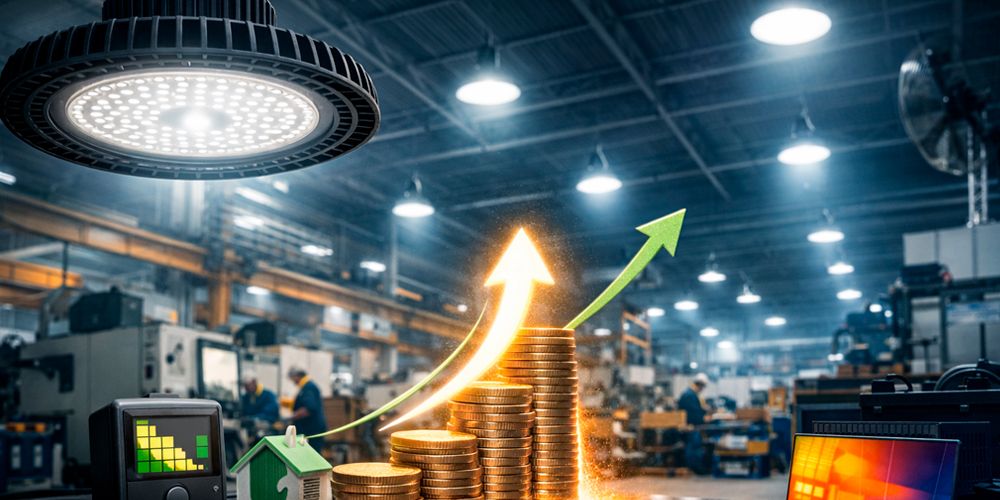
Industrial unit of 2,400 m²: from metal halide to LED in 3 days
— €22,284 saved per year
When the maintenance manager of a metal components manufacturing company in Barcelona got in touch, he had a specific complaint: the unit's electricity bill was running at nearly €29,000 a year, and the metal halide high bay luminaires took 4 minutes to reach full output. What he didn't realise was that the installation was also non-compliant with industrial lighting standards. In 3 days — without stopping production — we replaced everything. This is the full account, with every figure.
1 The project: full technical data sheet
All project data so you can compare it directly against your own installation:
Industrial Mecánica Berga, S.L. (fictitious name)
68 metal halide high bay luminaires 400W + 24 fluorescent fittings 2×58W T8
Metal components manufacturing (CNC machining and stamping)
68 UFO LED high bay luminaires 150W + 24 LED weatherproof batten fittings 2×22W T8
Industrial estate — Barcelona (Catalonia, Spain)
September 2024 — 3 days on site
2,400 m² (single storey, clear height 9 m)
Electrotécnica Pons (Factorled authorised distributor)
2 shifts — 16 hours/day, 300 days/year
UFO LED high bay 150W IP65 + LED weatherproof batten 2×22W
2 The diagnosis: 5 problems the client hadn't quantified
Before proposing any solution, the installation team carried out a full survey of the existing installation. The problems identified went well beyond electricity consumption:
| Problem identified | Previous situation | Result with LED |
|---|---|---|
| Start-up time 3–5 min | ❌ Before 20-minute warm-up required. Additional consumption of ~1,400 kWh/year. |
✅ Solution LED at 100% from the first second. The warm-up routine is completely eliminated. |
| Flicker and instability | ❌ Before 14 of 68 luminaires had visible flicker causing eye strain and visual fatigue. |
✅ Solution Zero flicker. Electronic driver at frequency >1,000 Hz, imperceptible to the human eye. |
| Insufficient illuminance level | ❌ Before BS EN 12464-1 requires 300 lux in CNC machining areas. The installation reached only 180–220 lux. |
✅ Solution 350 lux uniformly across the entire unit. Standard exceeded with a comfortable margin. |
| Excessive heat in summer | ❌ Before 400W MH luminaires forced increased air conditioning loads during hot months. |
✅ Solution LED 150W generates 62% less heat. Estimated cooling reduction: 8–12% in summer. |
| High maintenance costs | ❌ Before Every maintenance cycle (18 months): ~€4,800 in MH lamps and labour. |
✅ Solution No maintenance planned until 2032. Budget reallocated to other areas. |
The survey revealed that the true cost of the old installation was not €28,809/year on the electricity bill, but €32,009/year including maintenance. A figure that completely changed the conversation about the required investment.
3 The solution: what was installed and why
UFO LED high bay luminaires 150W — production area
UFO LED High Bay 150W IP65
LED weatherproof batten fittings 2×22W — warehouse and corridor areas
- Direct saving per fitting: from 116W to 44W. Reduction of 62%.
- IP65 with impact-resistant polycarbonate: suitable for goods handling environments and industrial dust.
- Colour temperature 4,000K: consistent with the UFO high bays in the production area. No colour variation between zones.
The ballast wiring of the old MH 400W luminaires was not reused: LED luminaires connect directly to 230V AC without a control gear. The existing cable (2.5 mm² cross-section, insulation inspected and in good condition) was retained after testing. This eliminated almost all cabling costs and reduced the project to 3 days with only 2 electricians, fully compliant with BS 7671.
4 The results: before and after with real data
Full comparison of technical and financial parameters measured before installation (August 2024) and after (November 2024, at 60 days of operation):
| Parameter | ❌ BEFORE — Metal halide + T8 | ✅ AFTER — LED Factorled |
|---|---|---|
| Number of luminaires | 68 MH high bays 400W + 24 fluorescent 2×58W | 68 UFO LED high bays 150W + 24 batten fittings 2×22W |
| Total installed wattage | 33,344W (33.3 kW) | 11,256W (11.3 kW) |
| Annual consumption (kWh) | 160,051 kWh/year | 54,029 kWh/year |
| Illuminance level (lux) | 180–220 lux (uneven) | 300–350 lux (uniform) |
| Colour temperature | 3,800–4,200K (varies with lamp age) | 4,000K (constant throughout rated life) |
| Colour rendering index | Ra > 65 (typical MH) | Ra > 80 (quality LED) |
| Average rated life | 10,000h (MH) / 8,000h (T8) | 50,000h (LED Factorled) |
| Maintenance interval | Every 18 months (MH lamp replacement) | No maintenance planned until 2036 |
| Switch-on / start-up | 3–5 min warm-up (MH) | Instant 100% output from first second |
| Annual energy cost | €28,809/year (at €0.18/kWh) | €9,725/year (at €0.18/kWh) |
| Annual maintenance cost | ≈€3,200/year (lamps + labour) | €0/year for the first 8 years |
| Total annual cost (TCO) | €32,009/year | €9,725/year |
The most striking figure: from €32,009 to €9,725 per year
The reduction in total operating cost (energy + maintenance) was 69.6%. In absolute terms: €22,284 less every year. That money was previously going on the electricity bill and on the engineer who came to swap lamps every eighteen months.
5 The return on investment: year by year
The total project investment was €16,800 (inc. VAT): 68 UFO LED high bays at €180/unit + 24 weatherproof batten fittings at €65/unit + installation labour (2 electricians × 3 days).
| Year | Item | Annual saving | Cumulative balance | Note |
|---|---|---|---|---|
| 0 | Initial investment | −€16,800 | −€16,800 | Purchase and installation of LED luminaires |
| 1 | Energy + maintenance saving | + €22,284 | + €5,484 | 19,084 kWh × €0.18 + €3,200 maintenance |
| 2 | Cumulative saving | + €22,284 | +€10,968 | Full investment recovery at month 9 |
| 3 | Cumulative net profit | + €22,284 | +€27,852 | Each euro invested returns €1.66 |
| 5 | Cumulative net profit | + €22,284 | +€94,620 | Cumulative ROI: 563% on the investment |
| 10 | Cumulative net profit | + €22,284 | +€205,440 | Luminaires still in full operation (rated life: 50,000h) |
The short payback period is explained by three factors working in combination:
- High number of operating hours: 16h/day × 300 days = 4,800 hours/year. The more hours the system runs, the faster the investment is recovered.
- High wattage replaced: going from 33.3 kW to 11.3 kW installed load represents a constant saving of 22 kW across all operating hours.
- Inclusion of maintenance savings: the €3,200/year no longer spent on lamps and labour accelerates the payback by almost 17%.
6 The impact that doesn't appear on the bill: the human factor
Beyond the numbers, there is one result the maintenance manager hadn't anticipated: the response from the operators.
"The lads on the morning shift no longer have to wait before they can start work. The light is at full output the moment you flick the switch. And the unit looks completely different — much brighter. Several operators have told me their eyes feel less tired when working at the CNC machines." — Maintenance Manager, Industrial Mecánica Berga
A correct illuminance level (300+ lux uniformly distributed) reduces visual inspection error rates and eye fatigue during long shifts — with a measurable impact on productivity and defect prevention in precision environments such as CNC machining. These requirements are underpinned by BS EN 12464-1 and the Workplace (Health, Safety and Welfare) Regulations 1992, supported by HSE guidance document INDG173 (Lighting at Work).
Other documented benefits at 60 days of operation
−1.8 °C ambient temperature
The unit's temperature sensors recorded an average reduction of 1.8 °C during warm months, thanks to the elimination of radiant heat from the MH luminaires.
Zero failures in 60 days
With the old system there were 2–3 failures per month (ignitors, capacitors, lamps). With LED: no incidents whatsoever.
H&S audit point closed
The health and safety report logged the lighting improvement as a completed corrective action, closing an open item that had been outstanding since 2022.
7 Lessons learnt from the project
Measure the real consumption, not the nameplate rating
Aged MH luminaires draw more than their rated wattage (the electromagnetic control gear adds 10–15%). Measure with a clamp meter before calculating savings.
Always include maintenance costs in the TCO
30–40% of the financial improvement in this project came from eliminated maintenance, not from electricity consumption. Many proposals fail because this item is missing.
Plan the works to avoid production downtime
LED luminaires were replaced one by one without isolating the whole unit. Production continued without interruption throughout.
Test the existing wiring before deciding to replace it
Reusing serviceable wiring is the single decision that most reduces installation cost. On this project it saved approximately €4,000 in materials and labour.
Document before and after for the client
Before-and-after photographs, lux meter readings and a side-by-side comparison of electricity bills are the most compelling argument for the next project.
Conclusion: does this make sense for your unit or installation?
This case is representative of dozens of industrial projects we complete every year across Europe. The variables change (size, type of industry, operating hours), but the outcome is always the same: ROI between 9 and 24 months and sustained savings for over 10 years.
If your unit or installation still has metal halide high bays, industrial fluorescent fittings or high-pressure sodium (HPS/SON) lighting, the savings potential very likely exceeds €15,000–€20,000 per year. The only step is to run the numbers. We'll do that for you — free of charge.
Factorled products used in this project
Production area in this project
Warehouse area in this project
Frequently asked questions
Does your unit still have metal halide or fluorescent industrial lighting?
Factorled carries out free industrial lighting surveys for contractors and end clients across Europe. We provide an LED equivalence study, annual savings calculation, personalised ROI analysis and product proposal. We respond within 24 hours.
📋 To carry out the survey we need
Floor plan or unit dimensions · Number and type of existing luminaires · Daily operating hours · Most recent electricity bill
📊 We provide you with
LED equivalence study · Annual savings calculation · Personalised ROI · Product proposal with pricing