

IP20, IP44, IP65, IP67, IP68: What Each Protection Rating Means and When to Use It

David Torres
2026-04-27 13:30:13
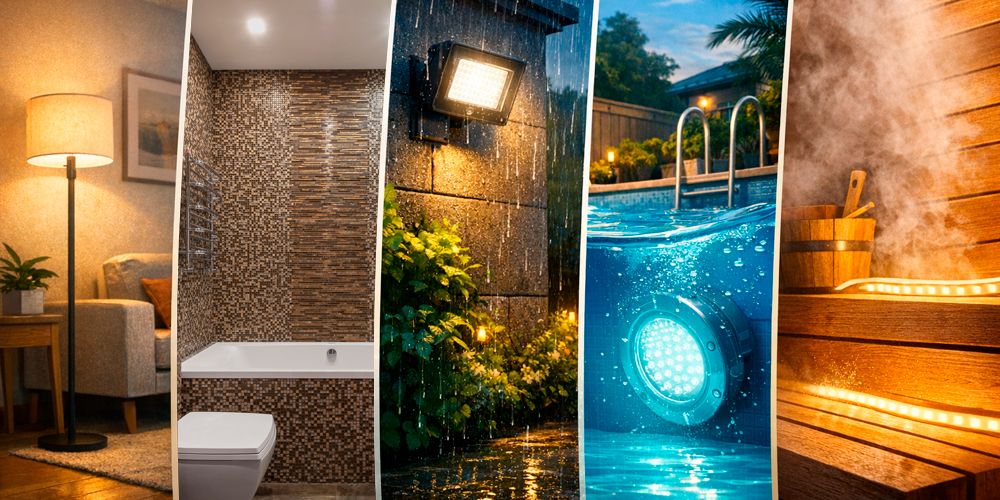
IP20, IP44, IP65, IP67, IP68: what does each IP rating mean and when should it be used?
Choosing a LED luminaire with the wrong IP rating can cause anything from a short circuit to a fire. Yet many installers and homeowners still select luminaires based solely on price or aesthetics, paying no attention to this fundamental technical specification. In this guide, we explain precisely what each IP digit means, how to read the code, and which rating you need in each location — from the living room to the bottom of a swimming pool.
01 What is the IP code and where does it come from?
IP stands for Ingress Protection. It is an international standard defined in BS EN 60529 (the British Standard adoption of IEC 60529, published by the British Standards Institution) that classifies the degree of protection provided by the enclosures of electrical equipment against the ingress of solid particles and liquids.
The IP code always consists of two digits: the first indicates protection against solid objects (dust, particles), and the second indicates protection against liquids (water, moisture). A higher number means greater protection.
| Digit | 1st digit — Protection against solids | 2nd digit — Protection against liquids |
|---|---|---|
| 0 | No protection | No protection |
| 1 | Solid objects > 50 mm (hand) | Vertically falling water drops |
| 2 | Solid objects > 12 mm (finger) | Drops up to 15° from vertical |
| 3 | Solid objects > 2.5 mm (tool) | Spraying water up to 60° from vertical |
| 4 | Solid objects > 1 mm (wire) | Splashing water from any direction |
| 5 | Dust (partial protection) | Low-pressure water jet |
| 6 | Dust: fully dust-tight | High-pressure water jet |
| 7 | — | Immersion up to 1 m for 30 min |
| 8 | — | Continuous immersion (specified depth) |
When you see an X in place of a digit, it means that particular parameter has not been tested or is not applicable. For example, IPX5 indicates that only protection against low-pressure water jets has been certified, but not protection against solid particles.
02 The most common IP ratings in LED lighting
Standard dry indoor locations
Basic protection against contactThe minimum protection rating, for completely dry indoor locations only. Protects solely against accidental finger contact (objects > 12 mm), with no water protection whatsoever.
Basic protection against splashing
Minimum for damp indoor zonesProtects against solid objects > 1 mm and against splashing water from any direction. Recommended minimum for areas with ambient moisture or occasional splashing.
Full protection: dust + water jets
Standard for outdoor installationsFirst level of total protection: fully dust-tight (digit 6) and resistant to low-pressure water jets from any direction (digit 5).
Withstands temporary immersion
Up to 1 m for 30 minutesAdds to IP65 the ability to withstand temporary immersion to a depth of 1 metre for 30 minutes. Minimum standard for luminaires in direct contact with water.
Continuous immersion
Maximum liquid protectionThe highest liquid protection rating. Withstands permanent immersion to the depth and under the conditions specified by the manufacturer (typically between 1 and 3 metres).
03 Full comparison table of IP ratings
All the differences at a glance for the five most widely used IP ratings in LED lighting:
| Characteristic | IP20 | IP44 | IP65 | IP67 | IP68 |
|---|---|---|---|---|---|
| Dust | Not protected | Partial | Dust-tight | Dust-tight | Dust-tight |
| Splashing water | No | Yes (any direction) | Yes | Yes | Yes |
| Water jets | No | No | Yes (low pressure) | Yes (high pressure) | Yes |
| Temporary immersion | No | No | No | Yes (1 m / 30 min) | Yes (continuous) |
| Condensation / moisture | No | Yes (light) | Yes | Yes | Yes |
| Outdoor use | No | With caution | Yes | Yes | Yes |
| Pools / fountains | No | No | No | Limited (surround) | Yes (submerged) |
| Relative price | Budget | Moderate | Moderate | Moderate–high | High |
04 Quick guide: which IP rating do you need and where?
The definitive reference table to ensure you never choose the wrong rating for any installation:
| Location type / zone | Recommended minimum IP | Reason |
|---|---|---|
| Living room / bedroom | IP20 | Dry indoor location, no water risk |
| Kitchen (above worktop) | IP44 | Possible water or grease splashes |
| Bathroom — Zone 1 (shower/bath) BS 7671 | IP65 min. | Direct water jets |
| Bathroom — Zone 2 (surrounding area) BS 7671 | IP44 | Moisture and occasional splashing |
| Covered terrace or canopy | IP44–IP65 | Ambient moisture, wind-driven rain possible |
| Garden / exposed outdoor area | IP65 | Direct rain, hosepipe water jets |
| Illuminated façade (floodlights) | IP65–IP66 | Rain and pressure-washing jets |
| Swimming pool — surround and coping | IP67 | Splashing and temporary immersion |
| Swimming pool — underwater | IP68 | Permanent immersion |
| Ornamental fountains | IP68 | Continuous immersion |
| Sauna and steam rooms | IP65 + high T° | Steam, extreme moisture and heat |
| Industrial unit / warehouse | IP65 | Dust, dirt and pressure washing |
| Indoor commercial premises | IP20–IP44 | No direct water exposure |
05 IP ratings and temperature: the factor nobody mentions
The IP rating indicates protection against solids and liquids, but not against heat. In locations such as saunas, areas adjacent to industrial ovens, or façade floodlights exposed to direct sunlight, you must also consider the maximum operating temperature stated in the luminaire's datasheet.
LED luminaires generate heat at the heat sink. In outdoor IP65/IP68 installations, the sealing can reduce heat dissipation and shorten service life if the product has not been correctly specified. Always verify the maximum ambient operating temperature (Ta) stated by the manufacturer.
06 IP ratings on LED strips: differences from conventional luminaires
LED strips have their own IP classification according to their coating type. Here are the four main categories:
No coating
Bare LED strip, for dry indoor use only. The most common type, used in furniture, cabinets and living room decoration.
Lateral resin coating
Protects the sides but not the underside. Suitable for areas with moderate ambient moisture.
Silicone sleeve
The strip is enclosed in an extruded silicone sleeve. Resistant to water jets. Ideal for outdoor use and professional kitchens.
Fully silicone-encapsulated
The strip is completely embedded in silicone. Maximum protection, suitable for immersion. Used in pools, fountains and harsh outdoor environments.
07 The 5 most common mistakes with IP ratings
- Using IP20 above a kitchen worktop. Grease and steam from cooking rapidly degrade any unprotected luminaire and can cause faults or short circuits.
- Confusing IP65 with "suitable for swimming pools". IP65 withstands water jets, not immersion. In pools: minimum IP67 at the surround and IP68 for submerged installations.
- Not resealing the ends of IP68 strips after cutting. If the end of an encapsulated strip is not resealed with silicone or an end cap, the waterproofing is completely compromised.
- Installing IP44 luminaires on exposed terraces. IP44 only withstands splashing. Wind-driven or heavy rain requires at minimum IP54 or IP65.
- Trusting the luminaire's IP rating without checking the connector. An IP67 strip is useless if the connector or power supply is IP20 and is exposed to moisture.
✓ Summary
The IP rating is not a minor technical footnote — it is a safety requirement. Choosing the correct rating ensures the installation complies with current regulations, achieves its expected service life, and poses no risk to people.
IP20 for dry indoor locations · IP44 for areas with occasional moisture · IP65 for outdoors and water jets · IP67 for brief water contact · IP68 for permanent immersion. Anything else means choosing the wrong product.
→ Related products at Factorled
Need help choosing the right IP rating?
At Factorled, our entire range is correctly classified with a verified IP rating — from IP20 LED strips for interior decoration to IP68 luminaires for pools and fountains.