

LED Car Park Lighting: Standards, Lux and ROI | Factorled

David Torres
2026-09-08 11:12:19
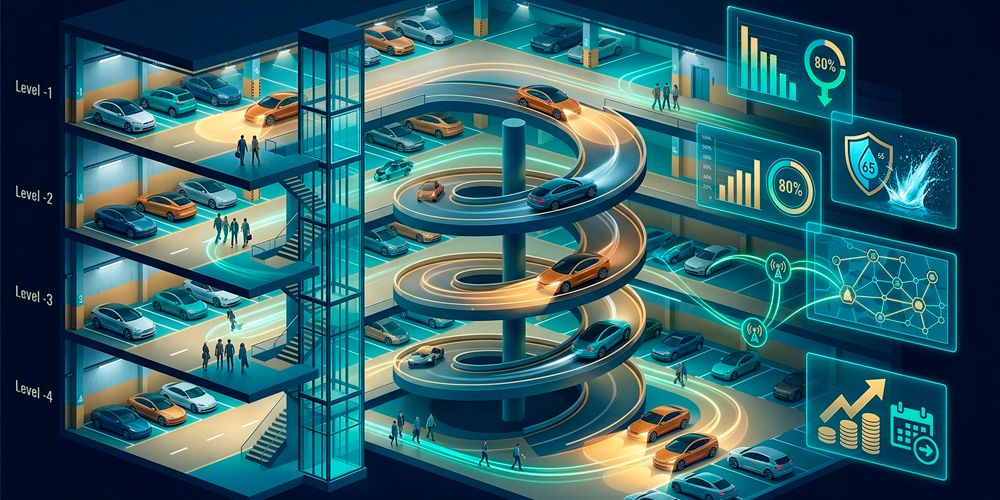
Car parks are among the installations with the greatest energy saving potential and the lowest technical complexity for the contractor who knows what they are doing. A structure running fluorescent tubes around the clock can spend more than £35,000 a year on lighting alone. With LED and microwave sensors, that cost can fall below £8,000. Payback sits consistently under twelve months at any installation size. This guide covers every technical, regulatory and commercial aspect so that you can cost, present and deliver car park projects with complete confidence.
1. What makes a car park technically different
A car park is neither an industrial unit nor an office. Its installation conditions are its own, and they decide which products are suitable and which are not.
Demanding environmental conditions
Design requirements specific to car parks
T8 and T5 fluorescent tubes strike slowly below 5 °C and effectively fail to strike below −5 °C.
On exposed roof decks, in semi-open ramp areas and at upland sites, that creates a genuine winter availability problem.
The British climate adds a second point. It is not polar darkness that decides things here, but short days and heavy cloud cover: through the winter months the artificial lighting is effectively the only light source in the structure for most of the working day, so its quality is noticed.
LED has no cold-start issue at all: instant light at any temperature within its operating range (typically −40 °C to +50 °C).
2. Applicable standards: illuminance required by zone
The reference standard for car park lighting is BS EN 12464-1:2021 (indoor work places), supplemented by BS EN 12464-2:2014 (outdoor work places). The Workplace (Health, Safety and Welfare) Regulations 1992 require suitable and sufficient lighting wherever work is carried out. For escape routes and emergency lighting, Approved Document B, BS 5266-1, BS EN 1838 and BS 7671 apply:
| Zone of the car park | Min. lux | Min. Ra | Max. UGR | Technical rationale |
|---|---|---|---|---|
| Main circulation zone (ramp, traffic lane) | 150 lux | Ra ≥ 40 | UGR < 25 | Critical zone with vehicles in motion. High visibility is a safety requirement. |
| Parking zone (bays) | 75 lux | Ra ≥ 40 | UGR < 25 | Minimum level that secures visibility for parking and for moving about on foot. |
| Pedestrian zone / routes to stair cores | 100 lux | Ra ≥ 60 | UGR < 22 | Higher Ra for facial recognition (perceived security). Recommended in CIE 171. |
| Stair core / vertical circulation | 150 lux | Ra ≥ 60 | UGR < 22 | Concentrated pedestrian movement and fall risk. Emergency luminaire required. |
| Access zone (vehicle entrance/exit) | 300 lux | Ra ≥ 60 | UGR < 25 | Transition from daylight to interior. The eye needs adaptation time: higher level at the threshold. |
| Control room / attendant's kiosk | 500 lux | Ra ≥ 80 | UGR < 19 | A staffed work station. 500 lux and UGR<19 are requirements of BS EN 12464-1. |
| EV charging bay | 200 lux | Ra ≥ 60 | UGR < 25 | A work zone for the user. Higher visibility to connect the charging cable correctly. |
| Emergency signage / escape routes | Emergency | — | — | Emergency escape lighting is mandatory: at least 1 lux on the escape route centre line (BS EN 1838). |
← Swipe the table sideways to see all the columns →
- Emergency escape lighting is required under the Building Regulations, Approved Document B, and maintained under the Regulatory Reform (Fire Safety) Order 2005, with the scope set by the building's fire risk assessment.
- BS EN 1838 requires at least 1 lux along the escape route centre line and 0.5 lux for open area (anti-panic) lighting, with a luminaire at every final exit, change of direction and stair.
- The minimum rated duration is one hour, and the system must operate automatically on failure of the normal supply. In UK practice BS 5266-1 leads to three-hour luminaires being specified in most car parks.
- The installation follows BS 7671 and the luminaires BS EN 60598-2-22. BS 5266-1 also sets the testing regime: a monthly function test and an annual full-duration test, both recorded in the log book.
- Do not confuse it with the general LED installation: emergency lighting is an independent system with its own power source. An LED luminaire "that also works on a battery" does not replace it.
- Where it is missing, the fire and rescue authority can serve an enforcement notice, and the responsible person carries the liability if something goes wrong.
3. Available technologies: the real comparison
This table compares every technology in use in car parks, including the older kit still installed in many structures, alongside today's LED solutions:
| Technology | Real load | Output (lm) | Efficacy (lm/W) | Service life | Key notes |
|---|---|---|---|---|---|
| Fluorescent T8 2×58 W | 116 W + ballast ≈ 132 W | 5,400 lm | 41 lm/W | 8,000 h | Low quality, slow strike, highly sensitive to cold. |
| Fluorescent T5 2×35 W | 70 W + ballast ≈ 80 W | 6,300 lm | 79 lm/W | 16,000 h | Better efficacy, but sensitive to temperatures below 0 °C on open decks. |
| High-pressure sodium 150 W | 170 W with ballast | 14,000 lm | 82 lm/W | 12,000 h | Good efficacy but very poor colour rendering (Ra = 20). Colours read badly at night. |
| Metal halide 150 W | 170 W with ballast | 12,000 lm | 71 lm/W | 10,000 h | Better Ra, but a 5-minute run-up. No instant restrike after switch-off. |
| LED high bay/panel 40 W | 40 W (driver included) | 5,000 lm | 125 lm/W | 50,000 h | Instant light, Ra ≥ 80, maintenance-free for 10 years. The current benchmark. |
| LED high bay 60 W | 60 W | 8,400 lm | 140 lm/W | 50,000 h | For heights of 3–5 m. High efficacy with optics designed for car parks. |
| LED high bay with sensor 40 W | 40 W (10% on standby) | 5,000 lm | 125 lm/W | 50,000 h | With integrated microwave sensor: 10% on standby, 100% on detected movement. |
← Swipe the table sideways to see all the columns →
Without a sensor, a 40 W LED luminaire running around the clock consumes: 40 W × 24 h × 365 d = 350 kWh a year per luminaire.
With a sensor at 10% standby and moderate traffic (presence for 30% of the time), real consumption is roughly 70 kWh a year per luminaire.
That is 80% additional saving over unregulated LED. Across 100 luminaires: 28,000 kWh saved every year on top.
The premium for the sensor built into the luminaire: £4 to £13 per unit. Payback on the sensor: weeks.
4. Worked example: a 200-space car park — before and after
Apply the figures to a typical real case: a 200-space basement car park under an office building, with fluorescent tubes running 24 hours a day. Calculated at £0.26/kWh on a commercial supply.
| Parameter | ❌ Before — fluorescent | ✅ After — LED with sensors |
|---|---|---|
| Number of luminaires | 120 fluorescent battens 2×58 W | 80 LED high bays 40 W with sensors |
| Total installed load | 15,840 W (15.8 kW) | 3,200 W on standby / 8,000 W at 100% |
| Estimated annual consumption | 138,340 kWh/yr (24 h/365 d) | 28,000 kWh/yr (sensor 10–100%) |
| Illuminance on bays | 60–80 lux (uneven) | 100–120 lux, uniform |
| Colour temperature | 4,000 K (drifts with age) | 4,000 K, stable across the service life |
| Colour rendering | Ra ≈ 55 (fluorescent) | Ra ≥ 80 (LED) |
| Luminaire service life | 8,000–16,000 hours | 50,000 hours (≈ 6 years running continuously) |
| Annual energy cost | £35,968/yr (at £0.26/kWh) | £7,280/yr (at £0.26/kWh) |
| Annual maintenance cost | ≈ £4,600/yr (lamps, labour, MEWP hire) | £0/yr for the first 6 years |
| Total annual operating cost (TCO) | £40,568/yr | £7,280/yr |
← Swipe the table sideways to see all the columns →
📉 The number that lands: from £40,568 to £7,280 a year
The reduction in total operating cost (energy plus maintenance) is 82.1%. The absolute saving is £33,288 a year — every year, across the next 6 years of the LED luminaires' service life.
The investment in LED luminaires with sensors (80 units at £145 each) was £11,600. The project pays for itself inside the first half-year.
Annual saving = £40,568/yr − £7,280/yr = £33,288/yr
Payback (months) = £11,600 ÷ £33,288/yr × 12 = 4.2 months
This is exactly the calculation to take into the meeting with the facilities manager: investment, annual saving and months to payback. Three numbers, none of them in watts.
5. Smart saving strategies: beyond the LED swap
LED is the first step. Combined with intelligent control, the saving can reach 80% against the original fluorescent installation:
| Strategy | How it works | Additional saving | Ideal application |
|---|---|---|---|
| Integrated microwave sensor (presence) | The sensor detects movement within a 5–10 m radius. With no traffic the luminaire drops to 10% (standby). On detecting a vehicle or a person it rises to 100% in under a second. | 50–70% | Public car parks open around the clock, hospital car parks, surface decks in residential areas. |
| Microwave sensor with communication (mesh) | The sensors talk to each other: when one detects movement it tells its neighbours to rise to 50–70% before the vehicle arrives. A "wave of light" effect. | 40–60% | Retail park, hospital and office building car parks. |
| Time control (astronomical time switch) | The system reduces output during quiet hours (overnight) and raises it at peak times. No sensors, purely by schedule. | 20–35% | Corporate car parks with known hours. The most economical option after sensors. |
| Central DALI control with energy reporting | A central management system that monitors each luminaire's consumption in real time, flags failures and generates efficiency reports. | Management | Large retail, airport and hospital car parks with energy reporting obligations. |
| Daylight dimming (external photocell) | For open or semi-open decks: the system trims output against available daylight — which through a British winter often means full output for most of the day. | 10–25% | Covered surface decks, semi-open structures and the top levels of multi-storey car parks. |
← Swipe the table sideways to see all the columns →
The commonest complaint from users of sensor-controlled car parks is arriving in a dark zone (on standby) and having to wait for the light to come up.
A mesh of linked sensors solves it: when sensor A detects a vehicle, it tells sensors B, C and D in the next lane to rise to 70% before the vehicle gets there.
The result: the user never meets darkness, and the energy saving holds because zones with no traffic stay on standby.
Additional cost over a standalone sensor: £9 to £22 per luminaire for the communication module.
6. Selecting the luminaire: what to look for in an LED high bay for car parks
Not every LED high bay suits a car park. These are the technical criteria to check on the data sheet:
- IP65 minimum, certified rather than claimedCheck that the IP rating is certified by an accredited laboratory and not simply asserted in the catalogue. In a car park the damp is constant.
- Colour temperature of 4,000 KThe standard for visibility and perceived security in a car park. Avoid 5,000–6,500 K (too harsh) and 3,000 K or warmer (reduced visibility).
- Colour rendering Ra ≥ 80Improves colour discrimination and the feeling of safety against the Ra ≥ 40 normative minimum. In pedestrian zones a high Ra supports facial recognition.
- Driver with power factor ≥ 0.9On installations with many luminaires (>50 units) a low power factor brings reactive power charges on the electricity bill.
- Surge protection (≥ 2 kV)Car parks have long cable runs exposed to voltage spikes. Protection integrated in the driver prevents early failures.
- Optics suited to mounting heights of 2.5–4 mThe standard optic in an industrial high bay is designed for 6–12 m. A car park luminaire needs a wide 120° optic to cover the bays from low level.
- Integrated microwave sensor, not PIRA PIR sensor detects temperature change, works poorly through vehicles and leaves dead zones. Microwave detects movement through obstacles and is more reliable here.
- Five-year warranty as a minimumIn a structure where maintenance is expensive (access by ladder or MEWP), a luminaire that fails after 3 years carries a significant hidden cost.
The right colour temperature: why 4,000 K and nothing else
In a car park, colour temperature is not an aesthetic question: it determines the driver's visual acuity, facial recognition in pedestrian zones and the user's sense of safety.
The colour temperature scale applied to car park lighting: 4,000 K is the reference value in every zone
IP ratings: what each zone of the structure demands
The IP rating has two digits: the first covers protection against solid objects and dust, the second against water. In a car park it is the second digit that decides.
| IP rating | Against solids | Against water | Suitable in a car park? | Zone of application |
|---|---|---|---|---|
| IP20 | Objects > 12.5 mm | None | ❌ No | Dry interiors only. Unsuitable in any zone of a car park. |
| IP44 | Objects > 1 mm | Splashing | ❌ No | Inadequate. This is the rating found in most poorly specified older installations. |
| IP54 | Dust protected | Splashing | ⚠️ Limited | Only in the control room, changing rooms and enclosed, dry service areas. |
| IP65 | Dust tight | Water jets | ✅ Minimum | The minimum on bays, ramps, pedestrian routes and traffic lanes in any structure, including basements. |
| IP66 | Dust tight | Powerful water jets | ✅ Recommended | Pressure wash bays, open ramps and roof decks exposed to rain and snow. |
| IP67 | Dust tight | Temporary immersion | ✅ Specific | Floor markers recessed into the slab, areas prone to standing water and around gullies. |
| IP68 | Dust tight | Continuous immersion | ✅ Exceptional | Only where water stands permanently. Over-specified everywhere else. |
← Swipe the table sideways to see all the columns →
- Load
- 40 W (heights of 2.5–4 m) or 60 W (heights of 3–6 m and wide lanes), driver included
- Luminous flux
- 5,000 lm (40 W) / 8,400 lm (60 W)
- Efficacy
- 125–140 lm/W for the complete product
- Colour temperature
- 4,000 K, stable across the service life
- Colour rendering
- Ra ≥ 80
- Ingress protection
- IP65 certified by an accredited laboratory (IP66 in wash bays and on open decks)
- Optics
- Wide 120° beam, designed for low mounting height
- Sensor
- Integrated microwave, 10% standby and 100% in <1 s, adjustable angle, detection to 8 m
- Driver
- Power factor ≥ 0.9 and surge protection ≥ 2 kV
- Service life and warranty
- 50,000 h · five-year warranty as a minimum
- IP65 as a minimum across the whole installation, basements included.
- 4,000 K in every zone, with no aesthetic exceptions.
- Ra ≥ 80 for facial recognition and a sense of safety.
- A microwave sensor with an adjustable angle, never PIR.
If a quotation does not meet these four conditions, it is not a car park luminaire: it is an industrial high bay sold as though it were one.
7. Delivery: the right sequence
The order of operations matters. These steps prevent the commonest problems on site and at commissioning:
- Survey the existing installationRecord light points, technology and real load including ballast, measure illuminance by zone and log actual running hours. Without a baseline there is no evidence of saving.
- Set the levels by zoneAssign each zone its standard requirement: 150 lux on circulation, 75 lux on bays, 100 lux on pedestrian routes, 300 lux at the entrance, 500 lux in the control room, with uniformity of at least 0.40.
- Select luminaire and opticIP65 LED high bay at 4,000 K and Ra ≥ 80, a 120° optic matched to the mounting height, driver with power factor ≥ 0.9 and surge protection of at least 2 kV.
- Remove the ballast on retrofitsWhen replacing fluorescent: bypass the magnetic ballast or replace the fitting entirely. Never install LED tubes with the ballast left in circuit.
- Commission the microwave sensorsSet angle, range, standby level and hold time zone by zone. In narrow lanes, restrict detection to 90–120° along the direction of travel.
- Verify the emergency lightingConfirm 1 lux along the centre line of escape routes and 0.5 lux for open area lighting, position an emergency luminaire roughly every 25 m along traffic lanes, and complete the full-duration test recorded in the log book to BS 5266-1.
- Measure and hand over the packFinal illuminance and consumption measurements, before-and-after savings report, data sheets with IP certification, LM-79 report, EPREL registration and the documentation needed for capital allowances or grant funding.
8. The six commonest mistakes in car park lighting
These mistakes turn up again and again in car park installations. All of them have serious consequences and all of them are avoidable:
| Mistake | How it happens | Consequence | The correct solution |
|---|---|---|---|
| IP rating too low in a wash bay or outdoors | IP44 or IP54 luminaires on an open roof deck or in the wash bay. | Electrical failure through water ingress. Risk to users. Warranty voided. | IP65 as a minimum in any zone with direct water exposure. IP66 in pressure wash bays. |
| Emergency lighting left out of the design | An LED project with no emergency luminaires, or without checking the existing coverage. | Non-compliance with Approved Document B and the fire risk assessment. Enforcement action by the fire and rescue authority. | At least 1 lux on the escape route centre line and an emergency luminaire roughly every 25 m along lanes. General LED does not replace it. |
| Wrong colour temperature for night-time visibility | Installing 2,700 K LED in a structure with heavy night-time use. | Warm light reduces visual acuity and colour discrimination at low illuminance. Higher perceived accident risk. | 4,000 K is the standard. It improves visibility, facial recognition and the sense of safety. |
| Microwave detection area badly set up | A sensor with 360° detection fitted in a narrow lane: it picks up movement on the adjacent bays. | The luminaire never returns to standby because there is always someone somewhere in the detection area. The energy saving is nil. | Choose sensors with an adjustable angle. In narrow lanes use 90°–120° aligned with the direction of travel. |
| Emergency lighting duration never tested | Emergency luminaires installed without confirming that the rated duration is maintained over time. | Batteries degrade. Without preventive maintenance they fail exactly when they are needed most. | The BS 5266-1 regime: monthly function test, annual full-duration test recorded in the log book, and battery replacement every 3–5 years per the manufacturer. |
| LED tubes in fluorescent battens without checking compatibility | Fluorescent tubes swapped for T8 LED tubes without removing the magnetic ballast. | The ballast reduces the LED tube's efficacy and can cause electromagnetic interference or shorten service life. | When converting fluorescent to LED in a car park: always bypass the ballast or replace the fitting outright. |
← Swipe the table sideways to see all the columns →
9. Payback by car park size: the argument that closes the project
The eight-month payback is not an exception: it is consistent across every installation size. The reason is arithmetic. The saving in total operating cost (energy plus maintenance) is always far greater than the investment when fluorescent running 24 hours is replaced by LED with sensors:
| Type / size | Investment | TCO saving/yr | Payback | Notes |
|---|---|---|---|---|
| Small (50 spaces / 40 luminaires) | £6,600 | £10,300/yr | 8 months | 40 W LED with sensors. TCO 73% lower than fluorescent. Very fast payback. |
| Medium (150 spaces / 100 luminaires) | £16,500 | £25,800/yr | 8 months | The same technology. The larger the structure, the better the proportional payback. |
| Large (400 spaces / 250 luminaires) | £41,300 | £64,500/yr | 8 months | With DALI control: consumption reporting and maintenance management. |
| Public car park, 24 hours (500 spaces / 300 luminaires) | £49,500 | £77,400/yr | 8 months | Round-the-clock running gives the best absolute payback: more hours, more saving. |
| Surface deck (100 spaces / 80 luminaires) | £13,200 | £20,600/yr | 8 months | IP66 throughout. External sensor with detection to 10 m. |
← Swipe the table sideways to see all the columns →
Do not present the project as "changing the light fittings". Present it as "cutting the car park's operating cost by 82%".
Whoever runs a car park does not think in watts or lumens: they think in pounds. Give them the number — what they pay now and what they will pay afterwards.
Add the maintenance that disappears: in a large structure, a MEWP visit to change a single fluorescent tube costs £120 to £180. With LED: zero visits in the first 6 years.
And mention the financial levers: full expensing and the Annual Investment Allowance apply to the capital cost, the Public Sector Decarbonisation Scheme funds work on public estates, and ESOS audits and tightening MEES thresholds keep pushing lighting up the priority list.
10. Integrating electric vehicles: the growing opportunity
The growth of electric vehicles adds a further dimension to car park projects. Approved Document S requires electric vehicle charge points in new buildings and in major renovations that include parking, and the wider EPBD 2024 framework is pushing the same way across Europe. That creates extra work for the contractor:
Conclusion: the car park is the LED project with the best payback on the market
Few installations offer a payback as clear, as predictable and as consistent as a car park. The variables are simple: running hours (always high), load replaced (always substantial) and maintenance eliminated (always material).
The contractor who masters car park lighting has access to an enormous market: the UK has hundreds of thousands of parking spaces in multi-storey and basement car parks beneath offices, retail parks, hospitals and residential blocks. The great majority are still lit with fluorescent or older technology. Approved Documents B and S, the EPBD framework and EV growth are driving refurbishment. The economics make it inevitable.
Factorled products for car parks
- LED high bay 40 W IP65 with microwave sensor5,000 lm, 4,000 K, Ra ≥ 80. For heights of 2.5–4 m. Detection 360°/8 m.
- LED high bay 60 W IP65 with microwave sensor8,400 lm. For heights of 3–6 m and wide traffic lanes.
- LED high bay 40 W IP65 without sensorFor use with central DALI or Zigbee control.
- LED high bay with mesh sensor"Wave of light" effect: communication between neighbouring sensors.
- LED emergency luminaire, 1 h / 3 hFor escape routes and the control room. Compliant with BS EN 1838 and BS EN 60598-2-22.
- IP65 LED batten 2×22 WFor the control room, changing rooms and service areas.
- Recessed LED floor marker IP67Marking ramps and pedestrian approaches.
- DALI controller for car parksCentral management with consumption reporting and fault detection.
Browse our car park range
Factorled offers a complete range for car parks: IP65 LED high bays with integrated microwave sensors in 40 W, 60 W and 80 W; emergency luminaires for escape routes; recessed floor markers; and control systems with sensor mesh.
Every product comes with a data sheet carrying IP certification, an LM-79 report, EPREL registration and the documentation needed for capital allowances or grant funding.
Written by the Factorled technical team · factorled.com