

Lamps and Spotlights for Lighting Schools and Universities: regulations and savings

David Torres
2026-10-05 08:40:14
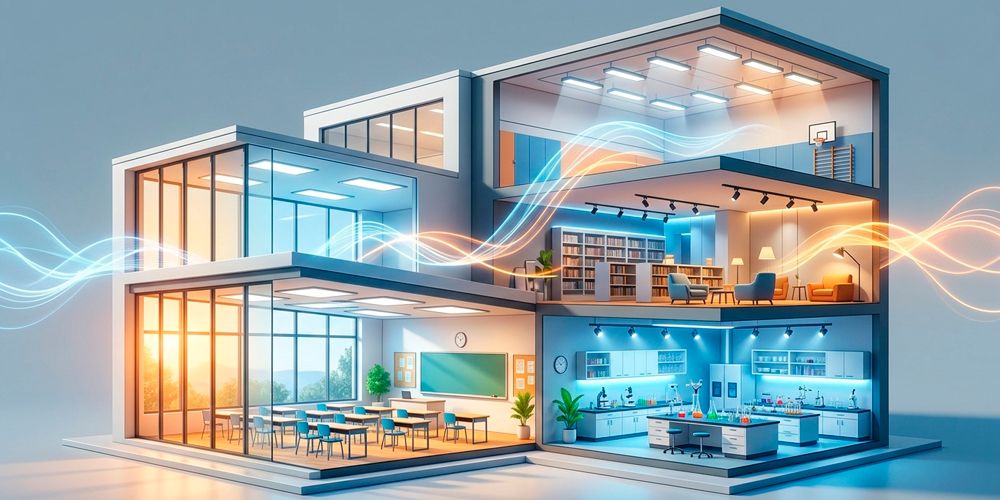
Schools are the buildings where lighting quality has the greatest long-term impact. A school classroom must have 500 lux on the desk, UGR below 19 and flicker-free LED luminaires (EN 12464-1). Pupils who spend their formative years under poor lighting do not only suffer eye strain and headaches: the evidence accumulated over the last two decades links poor lighting to worse academic performance, more restlessness in class and a worsening of the environmental symptoms of ADHD. This guide brings together the science of learning and lighting technology so that installers, architects and those responsible for educational centres can make well-founded decisions.
1. The science of learning and light: what the studies say
Two decades of research in neuroscience and pedagogy have established a direct, quantifiable relationship between classroom lighting conditions and pupils' academic performance, behaviour and visual health . These are the most relevant findings for the design of an educational centre:
| Parameter studied | Source of the study | Negative impact (non-compliant) | Benefit with correct lighting |
|---|---|---|---|
| Lux level and reading performance | University of Bochum (2014) | Below 300 lux, reading speed drops by 18% and the error rate rises by 26% compared with 500 lux. | 500 lux on the working plane is the threshold of maximum efficiency for reading and writing tasks. |
| UGR and eye strain | Lighting Research & Technology (2018) | With UGR > 22, pupils report eye strain 35% more often and lose concentration in the second half of the lesson. | With UGR < 19 the effect disappears and performance is maintained throughout the day. |
| HCL and attention in the classroom | Hochschule Luzern (2019); LICHT & SCHULE programme | With fixed light, stimulation cannot be adapted to the activity. | With Tunable White: 15% faster reading under cool light (6,000K) and greater relaxation under warm light (2,700K). |
| Flicker and headaches | Lighting for Learning (Velux Foundation, 2021) | With low-cost drivers and high flicker, 28% of pupils report frequent headaches. | In classrooms with flicker-free LED the incidence falls to 8%. In educational centres: Flicker Percent < 5% without exception. |
| Daylight and academic progress | Heschong Mahone Group (1999, Daylighting in Schools) | Classrooms with little daylight record clearly lower annual progress. | Pupils with more daylight progressed 20% faster in maths and 26% faster in reading. daylight harvesting is an educational investment, not just an energy one. |
| ADHD and lighting | Karolinska Institutet (2016) and later reviews | Conventional fluorescents are associated with more hyperactivity in children with ADHD. | With 4,000K, Ra≥80 and UGR<19, less hyperactivity and more concentration are observed. It does not replace treatment, but it reduces the symptoms aggravated by the environment. |
← Swipe the table horizontally to see all columns →
A head teacher who invests in correct lighting is not buying luminaires. They are investing in better academic results, less absenteeism due to headaches and a healthier working environment for the teaching staff.
The Heschong Mahone Group data are especially convincing: +20% in maths and +26% in reading in classrooms with good daylight. For families or the school board, these figures carry more weight than any energy argument.
And the cost: a 50 m² classroom with 8 UGR<19 LED panels and an occupancy sensor means an investment of 800–1.200 €, which the energy savings recover in around two years.
Why LED is the technology for the classroom
2. Technical parameters: what the standard requires in each space
The standard EN 12464-1 (2021 edition) sets the minimum values for educational centres. In classrooms with screens and interactive whiteboards the same requirements apply as in an office: UGR<19 mandatory.
| Space | Lux | Colour temp. | CRI | UGR | Special criterion |
|---|---|---|---|---|---|
| Primary / secondary classroom | 300–500 | 4,000K | Ra≥80 | <19 | Reading and writing. UGR<19 essential. Occupancy sensor recommended. |
| Early years classroom (3–6 years) | 300 | 3,500–4,000K | Ra≥80 | <19 | Slightly lower level. No hard edges of light. Uniformity critical. |
| Science laboratory | 500 | 4,000–5,000K | Ra≥90 | <19 | Ra≥90 recommended to observe experiments and samples correctly. |
| IT / computer room | 500 | 4,000K | Ra≥80 | <19 | No reflections on screens. Luminaires parallel to the line of sight, perpendicular to the plane of the screens. |
| Library / study room | 500 | 4,000K | Ra≥80 | <19 | Prolonged concentration. High uniformity. Tunable White highly recommended. |
| Art room | 750 | 4,000–5,000K | Ra≥90 | <19 | Colour fidelity. More lux for detailed work. |
| Music room | 300 | 3,000–4,000K | Ra≥80 | <22 | Lower visual demand. A warmer atmosphere favours artistic expression. |
| Language room / lecture room | 500 | 4,000K | Ra≥80 | <19 | With a projector: dim to 30–50% so as not to compete with the image. |
| Gymnasium | 300–500 | 4,000–5,000K | Ra≥80 | <22 | IP44 and IK08. No upward glare. High uniformity. |
| Changing rooms / toilets | 200 | 4,000K | Ra≥80 | <25 | Occupancy sensor. Mirror lighting with Ra≥80. |
| Corridor / circulation | 100–200 | 4,000K | Ra≥60 | <28 | Occupancy sensor: maximum savings. Emergency lighting mandatory. |
| Staff room / administration | 500 | 4,000K | Ra≥80 | <19 | Same standard as an office. |
| School dining hall | 200–300 | 3,000–3,500K | Ra≥80 | <22 | Warm atmosphere for rest and meals. |
| Covered playground / multi-purpose hall | 300 | 4,000K | Ra≥65 | <25 | IP44 and IK08. High uniformity for varied activities. |
← Swipe the table horizontally to see all columns →
500 lux on the desk, verified UGR<19, Flicker Percent<5% and an occupancy sensor. If a proposal does not meet these four points, it is not a proposal for an educational centre, however good the price.
And the UGR is checked with a simulation of the real dimensions of the classroom, not just the manufacturer's data sheet.
IP and IK protection ratings by space
Damp spaces or those with a risk of impact need luminaires with suitable protection. This is the practical reference for each zone of the centre:
| Space | IP rating | IK rating | Main risk | Recommended type of luminaire |
|---|---|---|---|---|
| Classroom, library, staff room | IP20 | — | None specific. Dry, protected environment. | 60×60 UGR<19 LED panel recessed in a suspended ceiling. |
| Laboratory — general area | IP20 | — | Precision work with samples and reagents. | Ra≥90 LED panel with Flicker Percent<3%. |
| Laboratory — sink and water points | IP44 | — | Splashes of water and chemicals. | Panel or luminaire with sealed IP44 diffuser. |
| Gymnasium / sports hall | IP44 | IK08 | Ball impacts (5 J), dust and moisture. | Surface-mounted or recessed waterproof luminaire with protective grille. |
| Covered playground / porch | IP44 | IK08 | Dust, ambient moisture, knocks, vandalism. | Waterproof LED luminaire. IP65 if exposed to direct rain. |
| School dining hall | IP44 | — | Steam, splashes and intensive cleaning. | Panel or downlight with closed IP44 diffuser. |
| Changing rooms and toilets | IP44 | — | Moisture and steam from showers. | IP44 downlight or ceiling light; in shower zones, according to the Spanish wiring regulation ITC-BT-27. |
← Swipe the table horizontally to see all columns →
3. Zone-by-zone design: the 5 key spaces of an educational centre
- Lux on the desk
- 500 lux on the working plane (0.75 m). 300 lux minimum at the periphery. Uniformity ≥ 0.6.
- Mandatory UGR
- UGR < 19. Essential since the arrival of interactive whiteboards. Verify by simulation for the real dimensions.
- No flicker
- Flicker Percent < 5% and Flicker Index < 0.05. Children are more sensitive to flicker than adults. No exceptions in any classroom.
- Light on the board
- 300 lux minimum on the board surface, without reflections. Luminaires must not point at the board or be reflected in the interactive whiteboard.
- Temperature
- 4,000K for standard work. With Tunable White: 5,000–6,000K for exams and 3,000K for creative activities and rest.
- Occupancy sensor
- Essential. The classroom is empty between lessons, at break and outside teaching hours. A microwave sensor avoids consumption when empty.
- Minimum CRI
- Ra ≥ 90 to correctly see chemical reactions, biological samples and colour experiments.
- No shadows
- Very uniform lighting on the benches. Shadows on the samples make the pupils' work harder.
- IP in the wet zone
- IP44 minimum at sinks and water points. In the rest of the laboratory, IP20 is sufficient.
- Temperature
- 4,000–5,000K. Neutral-cool light maximises visual precision in detailed work and analysis.
- No flicker
- Camera microscopes are sensitive to flicker. Same requirement as a clinical laboratory: Flicker Percent < 3%.
- Emergency
- In chemistry laboratories, emergency signage towards the eyewash shower and the evacuation exit, with the route immediately visible.
- Lighting level
- 300 lux for school sports activity. 500 lux for competitions or assessed physical education tests.
- IP and resistance
- IP44 minimum and IK08 (resistance to 5 J impacts). A luminaire without mechanical protection lasts months in a school gymnasium.
- No glare
- Luminaires must not be in the pupils' line of sight during exercises. UGR < 22; in competition halls, UGR < 19.
- Uniformity
- Ratio ≥ 0.5. Dark areas are an injury risk in speed and jumping activities.
- Instant start
- With fluorescent or discharge lamps, the teacher waits 30–60 seconds with the pupils in the corridor. LED gives 100% instantly.
- Temperature
- 4,000–5,000K. Cool light maintains alertness and physical activation during the lesson.
- Highest demand
- It is the space of most prolonged concentration in the centre. Office standard: 500 lux, UGR<19, Ra≥80.
- Tunable White ideal
- Pupils spend hours reading; the circadian sequence helps sustain concentration.
- Shelving
- Accent light on the spines to locate books: 3,000K LED strip on the shelves.
- Differentiated zones
- Individual reading (500 lux, high uniformity), group work (500 lux, livelier atmosphere) and computer area (500 lux, verified UGR<19).
- No flicker
- Prolonged hours of reading make flicker especially harmful. Same requirements as an office workstation.
- Control
- Daylight sensor throughout the library. With large windows, daylight harvesting pays for itself in 6–8 months.
- Objective
- Rest and recharge. 3,000–3,500K and 200–300 lux encourage relaxation in the middle of the day.
- No more than 300 lux
- At 500 lux the dining hall looks like a hospital cafeteria. Moderate light creates a more homely atmosphere and reduces restlessness.
- No glare
- Pupils are seated with a horizontal line of sight: UGR < 22 to avoid lateral glare.
- Resistance
- IP44 recommended. Cleaning is intensive and splashes and steam are frequent.
- Occupancy sensor
- Very concentrated use (2–3 sittings at midday). Outside those hours, the light usually stays on unnecessarily.
- Temperature
- 3,000–3,500K. Avoid cool light that turns the dining hall into an industrial canteen.
4. Human Centric Lighting in the classroom: the light sequence that optimises learning
After more than 15 years of research projects in Germany, Switzerland, the Netherlands and Sweden, dynamic lighting (Tunable White) has established itself as a tool that improves performance when used correctly. These are the three reference temperatures of the sequence:
Colour temperature scale in the classroom: from warm light for rest to cool light for exams
| Scene / activity | Typical time | Colour temp. | Intensity | Objective and intended effect |
|---|---|---|---|---|
| Arrival / start of the day | 07:30–09:00 | 4,000–5,000K | 80–100% | Activation. Cool, bright light helps the transition from sleep to alertness. |
| Lecture / presentation | 09:00–11:00 | 4,000K | 80% | Sustained attention. Neutral light maintains concentration without overstimulating. |
| Group work / workshop | 11:00–12:30 | 4,000K | 70–80% | More dynamic activity. Slightly reduced level for a collaborative atmosphere. |
| Exam or assessment test | When applicable | 5,000–6,000K | 100% | Maximum cognitive stimulation and alertness. |
| Covered playground / break | Break | 3,000K | 50% | Real switching off before the next lesson. |
| Creative activity / art | When applicable | 3,500–4,000K | 70% | Creative concentration. Light that is too cool can inhibit artistic expression. |
| Last hour / end of the day | Last 2 h | 3,000–3,500K | 60% | Progressive reduction and transition towards home. |
| Interactive whiteboard / projection | When applicable | 4,000K | 30–40% | So the screen can be seen without competing light. |
← Swipe the table horizontally to see all columns →
Cool light (5,000–6,000K) during exams and assessment tests is the best-documented benefit of Tunable White in education.
The mechanism is physiological: light with a higher blue component stimulates the photosensitive cells of the retina (ipRGC), which act on the brain's alertness centres and temporarily increase wakefulness and processing speed.
In studies with dynamic-light classrooms, pupils completed reading tests 15% faster under exam light (6,000K) than under standard light (4,000K), with no increase in errors.
Cost difference between a Tunable White panel and a fixed one: €20–35 per unit. In a classroom of 8 panels, 160–280 € extra.
5. The 7 most common mistakes in schools
These mistakes are present in the vast majority of centres built before 2015, and all of them directly affect pupils' wellbeing and performance:
| Mistake | Situation | Consequence for pupils | Correct solution |
|---|---|---|---|
| Unmaintained fluorescents | Tubes more than 3 years old, visible flicker and reduced light level. | Flicker at frequencies that children perceive even when adults do not. Headaches and restlessness, especially in children with ADHD. | Complete replacement with flicker-free LED (Flicker Percent < 5%), financed by the savings in about 2 years. |
| UGR not verified in the classroom | Panel installed without checking whether the distribution meets UGR<19 in the real dimensions. | In small classrooms (<5×5 m) the real UGR can exceed 21 even if the panel is certified. Non-compliance and eye strain. | Photometric simulation with DIALux for the exact dimensions. The manufacturer's certificate is not enough. |
| 6,500K in early years classrooms | Cool white LED in classrooms for 3–6 year olds. | Can increase restlessness in groups that are already very active. | 3,500–4,000K in early years: a slightly warmer atmosphere, appropriate for the age. |
| No occupancy sensor | Light on between lessons, at break and outside teaching hours. | In a school with 20 classrooms, out-of-hours consumption can be 30–40% of the total: thousands of euros a year. | Occupancy sensor in every classroom, essential in centres with after-school and weekend activities. |
| Light badly aimed at the board | Downlights pointing at the board or reflected in the interactive whiteboard. | From certain positions the content cannot be seen; on interactive whiteboards the reflection can be disabling. | Low-glare optics and verification of the light in the pupil's line of sight. |
| Insufficient IP in the gymnasium | IP20 downlights in the gymnasium ceiling. | Balls break luminaires without IK08; dust and moisture cause failures. | IP44 and IK08 as a minimum. Surface-mounted or recessed waterproof with grille. |
| Emergency lighting not verified | Emergency luminaires installed without an annual autonomy test. | Batteries degrade and, in a real evacuation, the luminaires may not work. | Documented annual test and preventive battery replacement every 3–5 years. |
← Swipe the table horizontally to see all columns →
- Emergency lighting: in a school, hundreds of children who do not know the routes as an adult does are evacuated. The annual autonomy test and its documented record are not optional, and emergency maintenance is more critical than in an office.
- Flicker in children: a low-cost LED driver can flicker more than the fluorescent it replaces. Always demand the Flicker Percent figure in the data sheet.
- Gymnasiums without IK08: a luminaire broken by a ball can drop fragments of the diffuser onto the pupils. Grille or mechanical protection always.
- Laboratories: emergency signage must lead unambiguously to the eyewash shower and the exit.
6. Grants for the energy refurbishment of educational centres
Educational centres can access several lines of aid to renew their lighting. Knowing them allows the installer to present complete proposals. The calls change every year, so it is always worth checking which ones are open:
A school with 20 classrooms that replaces fluorescents with LED and sensors can save between €8,000 and €12,000 a year on its electricity bill.
That saving is equivalent, for example, to the technological equipment of several classrooms, the renewal of teaching materials or a good part of the building's annual maintenance.
Presented this way, the investment in lighting does not compete with the education budget: it expands it.
7. ROI by type of educational centre
Educational centres have very predictable use (known timetable, school holidays and great savings potential with sensors), which makes the ROI especially reliable:
| Type of centre | Investment | Savings/year | ROI | Notes |
|---|---|---|---|---|
| State school, 20 classrooms (800 m² of classrooms) | 18.000 € | 9.500 € | 23 months | LED + sensors in classrooms, corridors and toilets. With a 30–40% grant, the payback is shortened considerably. |
| State-funded private school, 30 classrooms (1,200 m²) | 27.000 € | 14.000 € | 23 months | The savings free up budget for educational materials. |
| Secondary school, 40 classrooms (2,000 m²) | 45.000 € | 23.000 € | 24 months | With laboratories (Ra≥90), gymnasium and sports facilities. |
| University / campus (5,000 m² building) | 110.000 € | 56.000 € | 24 months | DALI + sensors + daylight. With PRTR aid: net investment ≈ €66,000 and ROI ≈ 14 months. |
| Nursery school, 8 classrooms (400 m²) | 8.000 € | 4.200 € | 23 months | 3,500–4,000K, flicker-free, IP44 due to the high level of activity. |
| Vocational training centre / academy (600 m²) | 12.000 € | 6.300 € | 23 months | Vocational workshops and laboratories with Ra≥90. Differentiated solution per classroom. |
← Swipe the table horizontally to see all columns →
A school stands empty for about 85 working days a year (Christmas, Easter and summer). With uncontrolled fluorescents, it is common for some areas to be left on by mistake for days or weeks.
With LED and an occupancy sensor, the light switches itself off when it detects absence. The savings during the holidays can account for 15–20% of the annual savings.
In addition, the gymnasium, the dining hall and the corridors are often left on after evening and weekend events. The sensor switches those off too.
Complete Factorled classroom kit: a standard 50 m² classroom, turnkey
Everything a classroom needs to comply with EN 12464-1 and start saving from day one: 8 flicker-free 60×60 UGR<19 LED panels, 1 occupancy sensor and 1 daylight sensor, with the technical documentation for grants included.
Also available in a Tunable White version (2,700–6,500K) for classrooms with exam, lesson and break scenes, and with a DALI-2 driver for integration into the building's control system.
8. How the installer enters the education market
The education market has particularities that the installer must know in order to enter it effectively.
State schools: tendering
State schools and secondary schools buy through public tenders or simplified procedures, and lighting projects are usually part of broader energy-efficiency and refurbishment tenders. To bid for them, the installer must:
- Be registered in the Spanish Official Register of Bidders and Classified Companies of the Public Sector (ROLECE) or its regional equivalent.
- Know the applicable CPV codes : 31500000 (lighting equipment), 45311000 (electrical installations) and 50700000 (maintenance of installations).
- Present complete technical documentation: Ra, R9, Flicker Index, verified UGR, efficiency in lm/W and CE certification. Everything Factorled supplies.
State-funded private and private schools: the direct proposal in 7 steps
Private and state-funded private schools decide more directly. The installer who secures a meeting with the head teacher or the maintenance manager can follow this sequence, from audit to handover:
- Quick energy auditEstimated current consumption, installed technology, actual hours of use, savings potential and investment required.
- Photometric simulation of each spaceDemonstrate visually with DIALux that the new design meets 500 lux and UGR<19 in the real dimensions of each classroom.
- Luminaire selection by spaceFlicker-free UGR<19 panels in classrooms, Ra≥90 in laboratories and art rooms, IP44 and IK08 in gymnasiums and covered playgrounds.
- Control system designOccupancy sensors in classrooms, corridors, toilets and the dining hall; daylight sensors next to large windows; Tunable White scenes where they add value.
- Analysis of applicable grantsIdentify the programmes the centre may qualify for and quantify their impact on the ROI.
- Technical and pedagogical proposalExplain the impact of lighting on academic performance. A head teacher who knows the Heschong studies or the dynamic classroom programmes has additional reasons to go ahead with the project.
- Installation, measurement and handoverCarry out the work preferably during the holidays, measure lux and uniformity on site, programme sensors and scenes, test the emergency lighting and hand over the technical dossier.
Frequently asked questions about school lighting
How many lux does a school classroom need?
500 lux on the desk plane (0.75 m), with a minimum of 300 lux at the periphery, uniformity ≥ 0.6 and 300 lux on the board. In early years 300 lux is enough; in art rooms, 750 lux.
What UGR must classroom lighting meet?
UGR below 19 in classrooms, libraries, laboratories, IT rooms and staff rooms. It must be verified with a photometric simulation for the real dimensions: in small classrooms the UGR can exceed 21 even if the panel is certified.
Why is flicker especially important in schools?
Children perceive flicker frequencies that adults do not notice. Flicker is associated with headaches, fatigue and restlessness. In educational centres: Flicker Percent < 5% and Flicker Index < 0.05; in laboratories with microscopes, < 3%.
Which colour temperature is best for a classroom?
4,000K for daily work; 3,500–4,000K in early years; 3,000–3,500K in dining halls; 4,000–5,000K in laboratories and gymnasiums. With Tunable White, 5,000–6,000K for exams and 3,000K for breaks.
What is the Tunable White exam mode?
A cool-light scene (5,000–6,000K) at 100% that increases alertness during tests. In studies with dynamic classrooms, reading was 15% faster than under 4,000K, with no more errors. It costs €160–280 more per classroom of 8 panels.
What protection does school gymnasium lighting need?
IP44 and IK08 as a minimum (resistance to 5 J impacts), 300 lux for lessons and 500 lux for competition, UGR < 22 and uniformity ≥ 0.5.
How long does the switch to LED take to pay for itself in a school?
Around 23–24 months without aid. A school with 20 classrooms invests about €18,000 and saves about €9,500 a year. With a grant, the payback can fall to about 14 months.
Conclusion: the most overlooked and most profitable educational investment
Educational centres have spent decades investing in technology, methodology and teacher training. Very few have invested in the most basic tool of learning: the quality of the light under which their pupils spend 7 hours a day, 200 days a year, for 10–18 years of their lives.
The good news is that correcting it is cheap, quick and has a measurable ROI. A classroom with flicker-free LED, UGR<19 and 500 lux does more than comply with the regulations: it favours better academic results, reduces discomfort from eye strain and frees up budget for what really matters, the pupils.
Factorled products for educational centres
- 60×60 UGR<19 Flicker<5% LED panelStandard for classrooms. Available with DALI-2 driver.
- 60×60 Tunable White UGR<19 LED panelFor HCL in classrooms, library and study room. 2,700–6,500K.
- IP44 IK08 waterproof LED luminaireFor gymnasiums and covered playgrounds. High mechanical resistance.
- Ra≥90 LED panel for laboratoriesWith Flicker Percent < 3% for use with microscopes.
- Zigbee and DALI occupancy sensorsFor classrooms, corridors, toilets and library.
- Zigbee and DALI daylight sensorsFor daylight harvesting in classrooms with large windows.
- 1 h emergency luminaireFor corridors, stairs and escape routes. With automatic self-test.
- Complete classroom kit8 UGR<19 panels + 1 occupancy sensor + 1 daylight sensor. Turnkey for a 50 m² classroom.
Factorled for educational centres: luminaires, documentation and technical support
We supply flicker-free UGR<19 LED panels with all the documentation that education tenders require: Ra, Flicker Index, efficiency in lm/W, verified UGR, Declaration of Conformity and EPREL registration.
Tunable White panels for HCL projects, occupancy and daylight sensors, and complete kits per classroom. For tenders, we prepare the complete technical dossier required in the specifications.
Article written by the Factorled technical team · factorled.com