


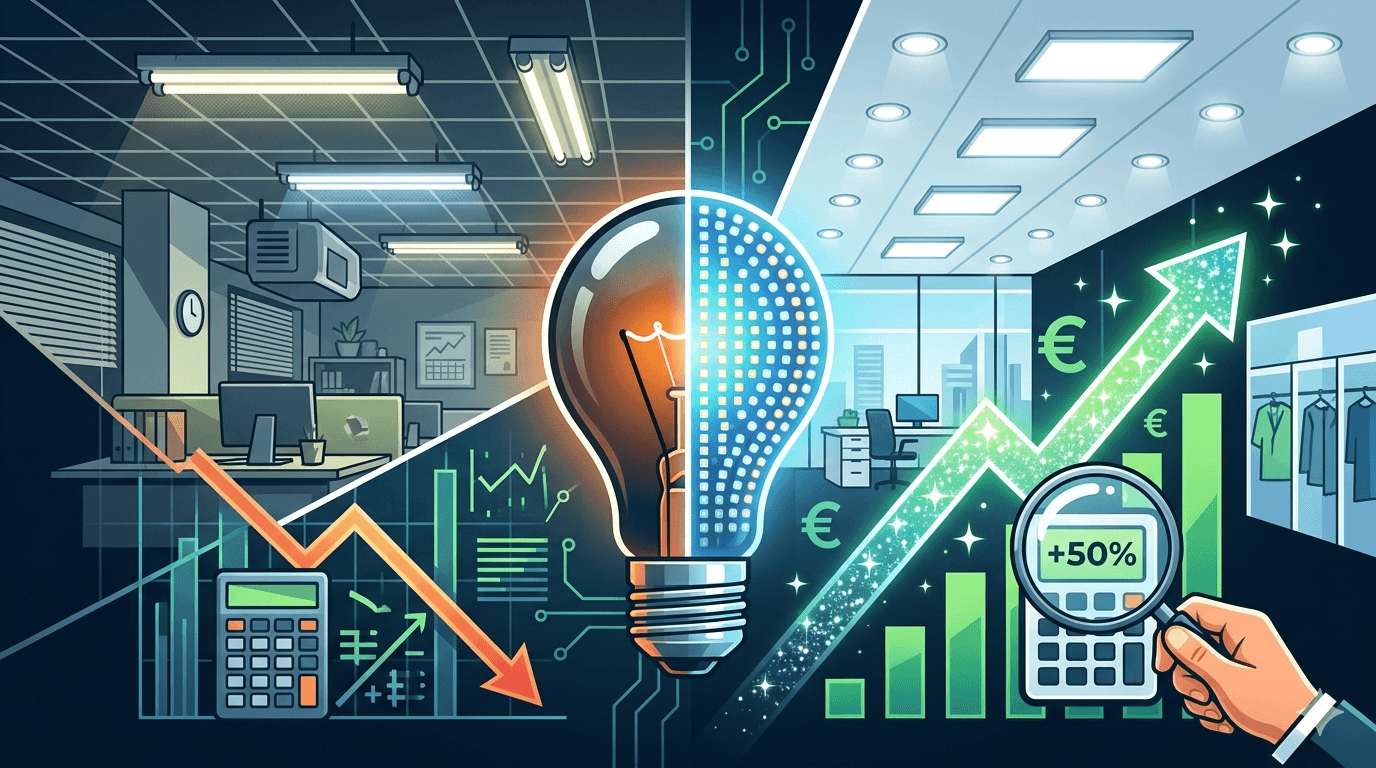
1. The electricity bill nobody bothers to analyse
Most businesses know their total electricity bill, but very few know precisely how large a share lighting accounts for. The figures are unambiguous:
- Offices and commercial premises: lighting accounts for between 30 and 50% of total electricity consumption.
- Hospitality and catering: between 25 and 40%, depending on kitchen equipment and refrigeration.
- Industrial units and warehouses: between 20 and 35%, with peaks in shift-work sites running lighting around the clock.
In concrete terms: an 80 m² retail unit with conventional lighting can pay between £1,500 and £2,500 per year on lighting alone. With LED, that cost falls to £400–£700.
According to data from the UK Department for Energy Security and Net Zero (DESNZ) and the Carbon Trust, the commercial sector (retail, offices, hospitality) could reduce its electricity consumption for lighting by up to 60% with a full transition to high-efficiency LED technology, in line with the UK's legally binding target of net zero greenhouse gas emissions by 2050 under the Climate Change Act.
2. Real consumption: fluorescent vs LED by luminaire type
Before calculating the total saving for an entire installation, it is useful to examine the figures fitting by fitting. This table shows the most common real-world values:
| Luminaire type | Previous technology | Previous consumption | LED consumption | Saving per unit | Saving % |
|---|---|---|---|---|---|
| Recessed downlight | 2 × 26 W PLC | 52 W | 18 W | 34 W | 65% |
| Office panel 60×60 | 4 × 18 W T8 | 72 W | 36 W | 36 W | 50% |
| Fluorescent tube T8 (1.2 m) | 58 W + starter | 68 W | 22 W | 46 W | 68% |
| Industrial high-bay fitting | 400 W MH | 430 W | 150 W | 280 W | 65% |
| Bathroom wall fitting G9 | 2 × 40 W G9 | 80 W | 10 W | 70 W | 88% ⭐ |
| Recessed halogen spotlight GU10 | 50 W GU10 | 50 W | 7 W | 43 W | 86% |
| Exterior street fitting SON | 250 W SON | 275 W | 100 W | 175 W | 64% |
With 50 light points and 12 hours of operation per day, the difference between technologies can amount to 30,000–40,000 kWh per year — equivalent to the annual consumption of several UK households.
3. The formula: calculate your installation's savings yourself
You don't need an engineer to know whether LED conversion is cost-effective in your installation. Apply this formula:
× hours/day × days/year × £/kWh
Step-by-step example: fashion retail unit 80 m²
| Parameter | Calculated value | Calculation detail |
|---|---|---|
| Number of light points | 50 units | 40 GU10 spotlights 50 W + 10 PLC downlights 52 W |
| Total previous consumption | 3,520 W | Including ballasts and starters |
| Selected LED equivalent | 18 W LED downlight | Equivalent lumen output (1,800 lm), direct replacement |
| Total LED consumption | 900 W | 50 units × 18 W |
| Power reduction | 2,620 W less | 74% reduction in installed wattage |
| Daily operating hours | 12 hours | Shop open 09:00–21:00 |
| Trading days per year | 300 days | Including bank holidays and closures |
| kWh saved per year | 9,432 kWh/year | 2.62 kW × 12 h × 300 days |
| Average unit rate (business tariff) | £0.26/kWh | Average UK business electricity rate 2025 incl. standing charges |
| Annual financial saving | £2,452.32/year | 9,432 kWh × £0.26 |
| Investment in LED luminaires | ≈ £2,400 | 50 LED downlights 18 W at approx. £48 per unit |
| Payback period (ROI) | 12 months | £2,400 ÷ £2,452/year × 12 months |
From month 13 onwards, the shop owner has £2,452 of additional net profit every year. Cumulative saving over 10 years: over £14,000 at UK business electricity rates — one of the best payback periods in the set.
4. Estimated savings by sector
This table shows typical savings potential for the most common sectors Factorled works with. Figures are in pounds sterling based on average UK business electricity rates 2025:
| Business type / installation | No. of luminaires | Daily use | Days/year | Est. annual saving | ROI approx. |
|---|---|---|---|---|---|
| Restaurant (150 m²) | 80–120 | 12 h/day | 300 | £1,600–£2,800 | 12–18 mo. |
| Open-plan office (300 m²) | 60–80 | 10 h/day | 250 | £1,100–£1,900 | 14–20 mo. |
| Industrial unit (1,000 m²) | 40–60 | 16 h/day | 300 | £10,500–£19,000 | 18–24 mo. |
| Supermarket (500 m²) | 150–200 | 14 h/day | 350 | £6,500–£11,700 | 16–22 mo. |
| Hotel (50 rooms) | 200–300 | 8 h/day | 365 | £3,900–£7,800 | 20–28 mo. |
| Retail unit (80 m²) | 30–50 | 12 h/day | 300 | £1,300–£2,300 | 14–20 mo. |
| Public car park (100 spaces) | 60–100 | 24 h/day | 365 | £5,200–£9,800 | 18–26 mo. |
| Office building (20 floors) | 400–600 | 10 h/day | 250 | £20,000–£40,000 | 20–30 mo. |
An industrial unit running 16 hours a day has a ROI nearly 3 times better than a retail unit at 8 hours — even though the investment is ten times higher. The more hours of operation, the faster the investment is recouped.
5. The saving that doesn't appear on your electricity bill
The total cost of ownership (TCO) extends far beyond electricity consumption alone. When comparing LED against legacy technologies, you must also factor in:
Maintenance and lamp replacement
T8 fluorescent tubes require replacement every 1.8–3.4 years. Metal halide lamps every 1.4–2.3 years. Quality LED requires no intervention until year 11. In an installation with 100 fluorescent fittings, maintenance costs (lamp plus labour) can amount to an extra £400–£800 per year — absent from consumption comparisons but very real.
Air conditioning: the invisible effect
Fluorescent and halogen fittings convert between 60 and 80% of the energy they consume into heat. LED reduces the thermal load of the space and generates an estimated additional saving of 8–15% on air conditioning costs in premises with intensive lighting use.
6. UK support schemes and tax incentives for energy efficiency
LED conversion can benefit from several financial support mechanisms that improve the ROI still further:
Enhanced Capital Allowances (ECA)
Businesses investing in energy-efficient equipment listed on the Energy Technology List (ETL) can claim 100% first-year capital allowances, allowing the full cost of qualifying LED installations to be deducted from taxable profits in the year of purchase.
ESOS — Energy Savings Opportunity Scheme
Large UK organisations are required to carry out energy audits under ESOS every four years. LED upgrades are among the most commonly identified savings measures, with documented ROI qualifying for reporting under the scheme's compliance framework.
SALIX Finance — Public Sector
Public sector organisations including schools, NHS trusts and local authorities can access interest-free loans through SALIX Finance specifically for energy efficiency improvements, including LED lighting upgrades, with repayments funded from energy savings.
ECO4 & Green Finance
The ECO4 scheme and green business loans from UK banks offer favourable financing terms for SMEs investing in energy efficiency. Many high-street banks now offer dedicated green loans at below-market rates for qualifying LED installation projects.
To access Enhanced Capital Allowances or SALIX Finance, you need technical documentation confirming the technology upgrade and energy savings achieved. Factorled supplies all necessary technical paperwork: product datasheets with luminous efficacy in lm/W, CE and UKCA declarations of conformity, and certificates compliant with BS 7671 (18th Edition Wiring Regulations) and the Building Regulations Part L requirements.
7. The 4 most common objections — and how to answer them
As an installer or distributor, you'll regularly hear these objections from your clients. Here are the data-backed responses:
| Client's objection | Root cause | Effective commercial response |
|---|---|---|
| "It's too expensive" | LED costs more than fluorescent | With a 12–20 month ROI, LED pays for itself. From month 13 onwards, every pound saved goes straight to the bottom line. |
| "My fluorescents work fine" | No perceived urgency to change | Fluorescent fittings consume 3–5× more electricity. Every month without upgrading, you're overpaying on your energy bill. The cost of inaction is real. |
| "Not sure it's worth it" | Lack of concrete data | Let's work it out together: tell us how many fittings you have, how many hours you run them and what you pay per kWh. We'll give you the precise ROI for your installation. |
| "I'd rather wait" | Hesitation over the upfront investment | UK business electricity prices have risen over 40% in 3 years. Every month you wait shortens the payback period further. The sooner you act, the more you save. |
8. How to present an LED conversion project to your client
The key to closing an LED upgrade project is presenting the data in a way that gives the client full confidence to commit:
Survey the existing installation
A complete inventory of all current fittings with real consumption figures — not just nominal wattage: include the ballast or starter consumption in the total.
Propose LED equivalents
For each existing fitting, identify the LED equivalent that matches or improves the illuminance level (lux) at lower wattage, ensuring compliance with BS EN 12464-1 lux requirements.
Calculate a personalised ROI
Using the client's actual operating hours and the unit rate they pay per kWh. A personalised figure is far more compelling than generic industry averages.
Present the cost of inaction
Show how much money the client is losing every month by not acting. The opportunity cost argument is particularly persuasive in the current energy price environment.
Documentation for support schemes
If the client can access Enhanced Capital Allowances or SALIX Finance, the ROI can fall from 12 to 6–8 months. That removes virtually every remaining objection.
We hold up-to-date LED equivalency tables for all technologies (fluorescent T8/T5/PLC, metal halide, SON, halogen GU10/MR16/G9). Get in touch and we'll send you the complete equivalency document for your quotation.
Factorled Products for Your LED Conversion
The complete range to replace every conventional lighting technology
Frequently Asked Questions About LED Savings
The saving is between 50% and 88% depending on the technology being replaced. A recessed PLC 2×26 W downlight replaced with an 18 W LED downlight saves 65%. A G9 wall fitting at 80 W replaced with LED at 10 W achieves 88%.
The typical payback period is 12 to 24 months. In the 80 m² retail example, ROI is achieved in just 12 months (at UK business electricity rates). With Enhanced Capital Allowances or SALIX Finance, this can fall to 6–8 months.
Use the formula: Savings (£/year) = (W old − W LED) ÷ 1,000 × hours/day × days/year × £/kWh, multiplied by the number of luminaires. From the article example: (3,520 W − 900 W) ÷ 1,000 × 12 h × 300 days × £0.26/kWh = £2,452/year.
Key schemes include Enhanced Capital Allowances (ECA) for 100% first-year tax relief, SALIX Finance interest-free loans for the public sector, the Energy Savings Opportunity Scheme (ESOS) framework for large organisations, ECO4 for commercial properties, and green business loans from high-street banks at preferential rates.
Yes. Fluorescent and halogen fittings convert 60–80% of their energy into heat. LED reduces the thermal load of the space and generates an estimated additional saving of 8–15% on cooling costs in premises with intensive lighting use — a particularly valuable benefit given UK summer temperatures and the prevalence of air conditioning in commercial premises.
Conclusion: every month without LED is money you won't get back
Switching to LED is not a technological trend. It is a financial decision with one of the best returns on investment available to any business: low risk, predictable and measurable.
The figures are clear: 50–88% saving on energy consumption, ROI in 12–24 months, six times longer lifespan and virtually zero maintenance for 10 years. And with the support schemes available in the UK, the payback period can be halved.
The only variable working against a swift decision is time itself. Every month of delay is a month of unnecessary energy overspend that can never be recovered.
Request Your Personalised Savings Analysis — Free of Charge
At Factorled we carry out personalised energy savings analyses for installers, distributors and end users at no cost whatsoever. We simply need: the number and type of your existing fittings, daily operating hours and your electricity unit rate. Within 48 hours we'll send you a full annual savings calculation, ROI breakdown and product equivalency proposal.