

Retail Lighting: Light Is the Most Powerful Tool for Driving Sales

David Torres
2026-08-24 08:18:58
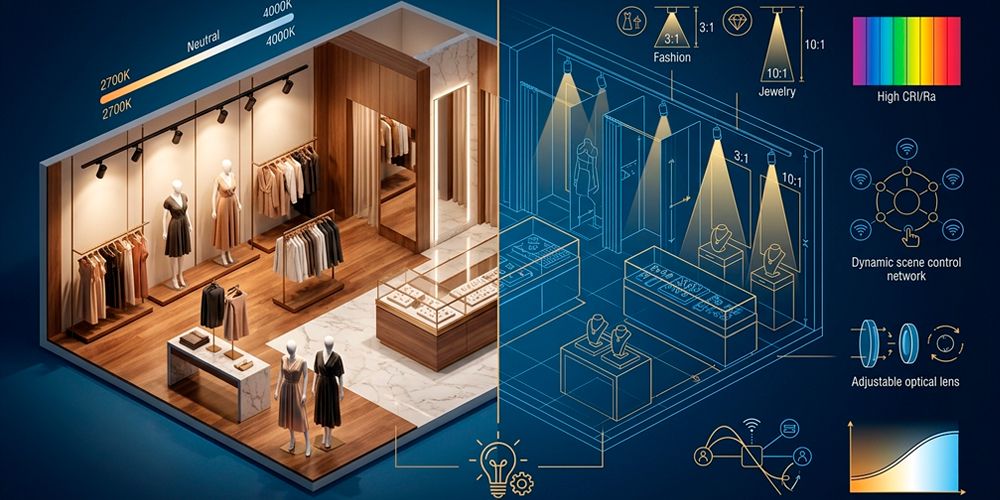
Retail science has spent decades studying what makes a customer walk into a shop, how long they stay, what they touch, what they buy and how much they spend. The conclusion is consistent: lighting is the environmental factor with the greatest influence on buying behaviour, ahead of music, temperature and scent. A well-lit shop does not merely look better: it sells more, justifies higher prices and builds better loyalty. This article brings together everything an installer, an interior designer or a shop owner needs in order to turn light into their best salesperson.
1. The science of retail lighting: what the studies show
The University of Twente in the Netherlands published a review of more than 40 studies on lighting in retail environments in 2019. The findings are unambiguous: high-quality accent lighting raises the perceived quality of the product by 20 to 35% and increases the customer's willingness to pay the asking price without negotiating.
What light does in the shopper's brain
A study by the British retailer Marks & Spencer (2018) showed that improving fitting room lighting — moving from an overhead downlight to side lighting at CRI ≥ 95 — increased the conversion rate within the fitting rooms by 19%.
In a shop with 200 fitting room visits a day and an average transaction value of £70, that 19% improvement represents £2,660 in additional monthly revenue.
The investment in lighting four fitting rooms: under £500. Payback: less than seven days.
2. Technical parameters by shop type
Every retail format has its own lighting requirements. This table is the technical reference for specifying correctly:
| Shop type | Lux | CCT | Min. CRI | Accent / ambient | Design significance |
|---|---|---|---|---|---|
| Premium fashion / luxury | 300–500 | 2,700–3,000 K | CRI ≥ 95 | 3:1–5:1 | Very high |
| Casual fashion / fast fashion | 500–1,000 | 3,000–4,000 K | CRI ≥ 80 | 2:1 | High |
| Jewellery and watches | 500–1,000 | 2,700–3,000 K | CRI ≥ 95 | 5:1–10:1 | Critical |
| Food / supermarket | 750–1,500 | 3,500–4,000 K | CRI ≥ 90 | 1.5:1 | Medium to high |
| Bakery / patisserie | 300–500 | 2,700–3,000 K | CRI ≥ 90 | 3:1 | High |
| Electronics / tech store | 500–750 | 4,000–5,000 K | CRI ≥ 80 | 2:1 | High |
| Homeware / interiors | 300–500 | 3,000 K | CRI ≥ 90 | 3:1 | Very high |
| Pharmacy / health and beauty | 500–750 | 4,000 K | CRI ≥ 80 | 2:1 | Medium |
| Bookshop / stationery | 300–500 | 3,000–4,000 K | CRI ≥ 80 | 1.5:1 | Medium |
| Footwear | 500–750 | 3,000–4,000 K | CRI ≥ 90 | 3:1 | High |
| Cosmetics and perfumery | 500–750 | 2,700–3,000 K | CRI ≥ 95 | 3:1–5:1 | Critical |
| Sports / outdoor | 500–750 | 4,000–5,000 K | CRI ≥ 80 | 2:1 | Medium to high |
← Scroll the table horizontally to see all columns →
The colour temperature scale applied to retail
Visual colour temperature scale applied to the different retail formats
Lux levels and colour temperature are well understood. The accent-to-ambient ratio is what separates a shop with correct light from a shop that sells.
The ratio is the relationship between the illuminance on the featured product (accent) and the illuminance of the general ambient background.
In a fashion shop with 500 lux of ambient light and a ratio of 3:1, the track spotlight must deliver 1,500 lux onto the hanging rail or the featured garment.
This contrast is what the customer perceives as “good light”, even without being able to name it.
3. The accent-to-ambient ratio: the most powerful tool in retail
The accent-to-ambient ratio is the parameter with the greatest influence on buying behaviour, and the least understood by installers without retail training. This scale explains each level and its real effect:
Accent-to-ambient contrast scale and its effect on buying behaviour
| Ratio | Name | Effect on customer behaviour | Typical application | Impact on sales |
|---|---|---|---|---|
| 1:1 | No contrast (uniform light) | The customer does not know where to look. Everything appears equally important. Nothing stands out. | Basic supermarket, warehouse retail | Low |
| 2:1 | Soft contrast | Slight visual hierarchy. The featured product draws marginally more attention than the rest. | Fast fashion, pharmacy, bookshop | Moderate |
| 3:1 | Retail standard contrast | The accented product stands out clearly. The customer finds it faster and perceives it as being worth more. | Fashion, footwear, homeware | High |
| 5:1 | High contrast — spotlight effect | The hero product captures 80% of visual attention. Very effective for featured products. | Premium fashion, cosmetics, window display | Very high |
| 10:1 | Dramatic contrast — theatre | The product appears lit by a stage light. Jewellery and high-end watches need this level in order to sparkle. | Jewellery, watches, luxury | Maximum |
← Scroll the table horizontally to see all columns →
Accent illuminance (lux) = Ambient illuminance (lux) × Target ratio
Spotlight flux (lm) = Accent lux × Lit area (m²) ÷ Utilisation factor (0.6–0.8)
Fashion shop with 500 lux of ambient light and a target ratio of 3:1, accenting a hanging rail of 1.5 m²:
Accent = 500 × 3 = 1,500 lux → Flux = 1,500 × 1.5 ÷ 0.7 ≈ 3,215 lm. With a track spotlight at 110 lm/W: ≈ 30 W per accent point.
4. Design by shop type: specific solutions
- Priority number one
- CRI ≥ 90 as a minimum, CRI ≥ 95 ideally. Without a high CRI, garment colours look flat and returns increase.
- Colour temperature
- 3,000 K for warm and classic ranges. 3,500–4,000 K for contemporary and sportswear. Never mixed within the same room.
- Accent ratio
- 3:1 for casual fashion. 5:1 for premium fashion. The hero product of the week: 10:1 over the ambient level.
- Fitting rooms
- Side light at CRI ≥ 95, 3,000 K, 300 lux at mirror height. The fitting room is the conversion point: invest here.
- Window display
- Adjustable narrow-beam track spotlight (15°–24°). Accent 10:1. Re-aimed with every range change, with no building work.
- LED track
- Track is essential in fashion: it lets spotlights be re-aimed when the shop layout changes, without touching the wiring.
- CRI, no compromise
- CRI ≥ 95 without exception. Below CRI 90, diamonds do not sparkle, gold loses its saturation and coloured stones look dull.
- Colour temperature
- 2,700 K for yellow gold and warm pieces. 3,000 K for platinum, silver and diamonds. Complete consistency throughout the shop.
- Accent ratio
- 10:1 in display cases. A diamond under 1,000 lux of accent against a 100 lux background appears to glow from within.
- Type of spotlight
- Miniature spotlight with very low glare (anti-glare). The customer should not see the luminaire, only its effect on the piece.
- LED stability
- Quality LED, rather than budget modules, holds its colour temperature over the whole service life. Colour drift with ageing is unacceptable in jewellery.
- Ambient level
- Very low, 50–80 lux. The extreme contrast with the product creates the sense of exclusivity and of a justified high price.
- Butchery / charcuterie
- CRI ≥ 95, 3,000–3,500 K. Warm light with a high CRI makes red meat read in its natural colour. Under cool light it looks pale or grey.
- Fish counter
- CRI ≥ 95, 4,000 K. Cool-neutral light intensifies the blues and silvers of fresh fish. Under warm light it looks less fresh.
- Fruit and vegetables
- CRI ≥ 90, 3,500–4,000 K. The greens and yellows of produce need a neutral-to-cool colour temperature in order to look vivid.
- Bakery / patisserie
- 2,700–3,000 K, CRI ≥ 90. Warm light makes golden bread and pastries look freshly baked and more appetising.
- General shelving
- 4,000 K, CRI ≥ 80. Efficiency and product visibility take priority. Level of 750–1,000 lux.
- Till area
- 4,000 K, 500 lux. Staff need to see the products and the payment system clearly. Without glare.
- Maximum CRI
- CRI ≥ 95 throughout the shop, CRI ≥ 97 at the testing mirrors. A customer who looks good under the shop's light buys.
- Colour temperature
- 3,000 K as standard. Avoid cool light, which renders skin pale and bluish. The customer should see themselves at their best.
- Mirror lighting
- Frontal or side light, never overhead. Light from above casts shadows under the eyes and nose at the mirror that flatter nobody.
- Window display
- Track spotlight at CRI ≥ 95 over the hero products. Packaging colours must read exactly as they do in the campaign photography.
- Testing area
- Testing counter with side lighting at CRI ≥ 97. Central mirror lit from both sides. This is the highest-converting point in the shop.
- Heat output
- Excess heat from conventional luminaires degrades cosmetics on display. Low-heat LED protects the investment in stock.
An installer without retail training raises the lux level when the client says the shop “looks flat”. It is almost never a problem of light quantity, but of colour quality and contrast. Before adding power, check two things: that the CRI is 90 or above, and that an accent-to-ambient ratio of at least 3:1 exists. More lux with no accent and no CRI does not sell more: it only consumes more.
5. The nine zones of a shop and how to light each one
A shop is not a homogeneous space. Each zone has a function and a specific lighting treatment:
| Zone of the shop | Recommended lighting solution | Design criterion and effect on sales |
|---|---|---|
| Shop window | Track spotlight 15°–24° plus 2,700 K LED strip in the pelmet | Highest-impact zone. Draws the customer in before they enter. Accent 10:1 on the hero product. |
| Entrance / threshold | Dimmable downlight at 3,000 K plus a welcome effect | Transition from the street into the shop. Brighter than the exterior to create the pull. |
| Shelving and hanging rails | Adjustable track spotlight 24°–36°, CRI ≥ 90 | Light the product, not the space. Track allows adjustment without building work when the layout changes. |
| Centre table / island | Multiple track spotlights plus ambient downlights | The centre table carries the product of the week. A high accent (5:1) forces attention. |
| Fitting rooms | Side light at CRI ≥ 95, 3,000 K, 300 lux at the mirror | This is where the customer decides. Flattering light is light that turns a visit into a sale. |
| Till / counter | Downlight plus 3,000 K LED strip under the counter | Staff need to see clearly. Keep the colour temperature consistent with the rest of the shop. |
| Internal display cases | 2,700 K CRI ≥ 95 LED strip in profile plus miniature spotlight | Product in a display case is the premium tier. CRI ≥ 95 and a 10:1 accent are essential. |
| Rear of the shop | Ambient downlights plus a sense of depth | The rear wall must pull the customer inwards. A dark rear empties the shop. |
| Brand and graphics zone | Backlit wall panels or a framing projector | Brand walls and photography need CRI ≥ 90 lighting so that they do not lose colour. |
← Scroll the table horizontally to see all columns →
- Illuminated signage is controlled through advertisement consent, a separate regime from planning permission. Establish with the local planning authority what the fascia and window scheme requires before ordering equipment.
- Works to a listed building require listed building consent, and additional controls apply in a conservation area. Fixing spotlights or signage to a listed shopfront without consent is a criminal offence, and «I only installed it» is not a defence.
- Light spilling from a shopfront or window display into neighbouring residential windows can be actionable as a statutory nuisance under the Environmental Protection Act 1990, as amended by the Clean Neighbourhoods and Environment Act 2005. There is no fixed lux threshold: the environmental health team assesses the effect on the neighbour.
- The usual technical reference is the Institution of Lighting Professionals' Guidance Note 01, The Reduction of Obtrusive Light, which sets limits by environmental zone E0 to E4 and applies tighter values after the curfew hour, commonly 23:00.
- Practical consequence: design in an astronomical time switch or a programmable controller on the window and signage circuit from the outset. An installation whose switch-off depends on staff does not stay compliant for long.
6. The seven lighting mistakes that cost sales every day
These mistakes are present in thousands of shops across Europe. All of them are correctable with the right product:
| The mistake | Typical situation | Impact on sales and on the customer | The correct solution |
|---|---|---|---|
| Uniform light with no accent | The whole space at the same illuminance level. | With no visual hierarchy the customer does not know what to look at. Lower conversion and a lower average transaction value. | An accent-to-ambient ratio of at least 3:1. The hero product always under a higher intensity. |
| Low CRI on coloured garments | CRI = 70 spotlights in a fashion shop. | Garment colours look flat in the shop and vivid at home. The customer returns the item. | CRI ≥ 90 as a minimum in fashion. CRI ≥ 95 in jewellery, cosmetics and fresh food. |
| Cool light on fresh food | 5,000 K lighting over fish, meat and produce counters. | Meat looks pale, fish loses its sheen, produce loses its colour. Sales are directly affected. | 3,000–4,000 K for butchery and fish. CRI ≥ 95 so that natural colours read properly. |
| Fitting room with a single overhead point | One downlight in the fitting room ceiling. | Shadows under the eyes and nose create an unflattering effect. The customer does not buy. | Side or frontal light at CRI ≥ 95, 3,000 K. Never overhead alone. The fitting room sells as much as the shop floor. |
| Window display with no night contrast | The window has the same lighting by day and by night. | At night the lit interior competes with reflections in the glass. With no night accent the window is invisible from the pavement. | A control system with a night scene: reduce the ambient level and raise the accent on the product to its maximum, within the applicable curfew. |
| Inconsistent colour temperatures between zones | Entrance at 4,000 K, shop floor at 3,000 K, fitting rooms at 2,700 K. | The customer perceives the inconsistency without being able to identify it. The space reads as improvised. | A single colour temperature throughout the shop, or two at most where there is a clear functional split between work and sales. |
| No dimming provision | All the lighting at 100% throughout the day. | Without dimming you lose the ability to create scenes, feature new arrivals or match the atmosphere to footfall. | Track with dimmable spotlights from the outset. A dimming system is essential in quality retail. |
← Scroll the table horizontally to see all columns →
- Mixing different production batches in the same room: the difference in tint between batches is visible on a light wall or along a continuous run of shelving, even where the data sheet quotes the same colour temperature.
- Installing spotlights with no glare control aimed into the field of view: a visible source ruins the effect and causes visual fatigue for staff who spend eight hours on the shop floor. BS EN 12464-1 gives UGR ≤ 22 for the sales area and UGR ≤ 19 at till and wrapping positions.
- Handing over the installation without an aiming session: a badly aimed track spotlight lights the floor instead of the product. Final aiming on site is part of the job, not an extra.
Beyond its commercial role, shop lighting in the UK sits within health and safety law. The Workplace (Health, Safety and Welfare) Regulations 1992 require suitable and sufficient lighting, and the HSE guidance HSG38, Lighting at Work, sets out how that is assessed. The technical standard applied in practice is BS EN 12464-1, on the lighting of indoor work places.
As an orientation for retail: sales area 300 lux with UGR ≤ 22, till and wrapping counter 500 lux with UGR ≤ 19, with adequate uniformity and no direct glare. These values are the compliance floor, not the optimum selling level: the parameters in section 2 sit deliberately above them.
For new build and refurbishment there is also the energy side. Approved Document L sets minimum luminaire efficacy and lighting control requirements for non-domestic work, with a separate treatment for display lighting. Confirm the applicable edition and the display lighting allowance with the building control body before fixing the specification.
7. The payback on retail lighting: figures by sector
The decisive argument for any shop owner: what does it cost and what comes back?
| Shop type | Investment | Savings + sales/year | Approx. payback | Principal effects |
|---|---|---|---|---|
| Fast fashion shop, 120 m² | £5,000 | £1,500/year | 40 months | +12% average transaction value plus 60% energy saving against fluorescent |
| Premium fashion boutique, 80 m² | £7,500 | £2,700/year | 34 months | +22% transaction value, CRI ≥ 90 supporting premium prices, plus savings |
| Jeweller, 40 m² | £6,300 | £3,200/year | 24 months | +35% conversion, higher perceived price, plus energy saving |
| Supermarket, 400 m² | £15,000 | £6,700/year | 27 months | +8% sales on fresh food plus 65% energy saving |
| Bakery / patisserie, 60 m² | £3,800 | £1,850/year | 24 months | +18% transaction value through appetite appeal plus 60% saving |
| Homeware shop, 200 m² | £10,000 | £3,800/year | 32 months | +20% dwell time, more impulse purchasing, plus savings |
| Cosmetics / perfumery, 70 m² | £6,700 | £2,900/year | 27 months | +25% conversion from the window, brand loyalty, plus savings |
← Scroll the table horizontally to see all columns →
Do not open with the energy saving: it is real but secondary in retail. The engine of the payback is the increase in sales.
Ask the client three questions: how many people come in each day? What is your average transaction value? What is your conversion rate?
With those figures, work out the impact of a 10% gain in conversion or a 15% gain in transaction value. In most cases it exceeds the lighting investment within the first three months.
The energy saving is the bonus: an additional argument, not the main one.
8. The technology: why track-mounted spotlights are the retail standard
Most quality retail schemes use LED track with spotlights as the primary accent lighting solution. The reason is simple: retail changes constantly. Ranges change each season, layouts are reworked every few weeks, window displays are refreshed monthly.
How a retail lighting scheme is specified and commissioned
- Visit the shop during trading hoursObserve the real customer route, where they stop, which zones stay dead, and how daylight from the window falls at different times of day.
- Establish the retail format and its parametersUsing the table in section 2: lux, colour temperature, minimum CRI and target ratio. These four values govern everything else in the scheme.
- Zone the shopWindow, entrance, shelving, centre table, fitting rooms, till, internal display cases, rear and brand zone. Each zone with its level and its function, per section 5.
- Establish the consents that applyAdvertisement consent for the fascia, listed building consent or conservation area controls where relevant, and the obtrusive light limits for the environmental zone. This check comes before the quotation.
- Set out the track runTrack must cover shelving, centre table and window, with spare length for future extensions. Better a metre more today than building work tomorrow.
- Select spotlights and beam anglesNarrow (15°–24°) for the window and display cases, medium (24°–36°) for shelving and hanging rails, wide (60°) for ambient. All at the same CRI and colour temperature.
- Define the controls and the scenesThree scenes as a minimum: day, evening and night or window, programmed on a time clock and respecting the applicable curfew, so that they run without staff intervention.
- Aim the spotlights with the shop merchandisedWith the product already on display and after dark, to see the real effect. This is the stage that most distinguishes a professional scheme from a correct but unremarkable installation.
💡 Osram UGR<17: the answer to glare in sales and work zones
In retail schemes with mixed sales and advisory zones — pharmacies, opticians, health and beauty counters, advice desks and till areas — glare is the recurring problem: staff spend eight hours under the luminaire and the customer needs to see the product without distracting reflections.
The Osram LED panel with UGR<17 answers both needs at once. Its low-glare optic holds the UGR well below the limit of 19 that BS EN 12464-1 gives for till and wrapping positions, with a uniformity that allows it to serve as the ambient base onto which the track accent is layered.
Recommended combination: Osram UGR<17 panel as the ambient layer, plus CRI ≥ 90/95 track spotlights as the accent. This is the formula that achieves a 3:1 or 5:1 ratio without creating glare from any position in the room.
A shop owner rarely remembers the contractor who swapped the lamps for LED. They remember the contractor who changed their sales.
A retail scheme done well is the one the client describes like this: “since we changed the lighting, the shop sells itself”.
That is exactly what quality lighting delivers with CRI ≥ 90 track spotlights, a 5:1 ratio and the right colour temperature. It is not magic: it is physics applied to consumer behaviour.
Conclusion: light is the best salesperson in the shop
Retail has learned to optimise every square metre of selling space to maximise sales. Lighting is the only element that works 24 hours a day, takes no commission and influences every customer from the moment they pass the window to the moment they decide in the fitting room.
The gap between a shop with mediocre lighting and one with professional lighting is measured in conversion rate, average transaction value, returns rate and brand perception. And its cost is straightforward to justify with the data from any consumer behaviour study. In the UK there is the consents process on top — advertisement consent, listed building and conservation area controls, obtrusive light limits and workplace illuminance — and that is precisely where an installer who knows the trade sets themselves apart.
Factorled products for retail
- LED track spotlights, CRI ≥ 90Beam angles 15°, 24°, 36° and 60°. 2,700 K, 3,000 K and 4,000 K. With dimmable driver.
- LED track spotlights, CRI ≥ 95For jewellery, cosmetics and high-end food. Maximum colour fidelity.
- Single-circuit and three-circuit trackIn white, black and aluminium. Lengths from 1 to 3 m. Connectable in runs.
- Dimmable LED downlightsFor the ambient background layer. 2,700 K and 3,000 K, CRI ≥ 90.
- Osram LED panels, UGR<17Low-glare ambient light for sales and work zones. CRI ≥ 90, DALI.
- CRI ≥ 90 LED strip for display cases2,700 K in aluminium profile for internal display case lighting.
- Dimmers and track controllersFor window, day and night scenes with no manual intervention.
- Interchangeable optical modulesTo change the beam angle without changing the luminaire.
Design your retail lighting scheme with Factorled
Factorled works with installers and interior designers specialising in retail to define the right lighting proposal for each shop format: selection of spotlights and track, colour temperature and CRI by zone, control system, and calculation of the accent-to-ambient ratio.
A complete retail range: CRI ≥ 90 and CRI ≥ 95 track spotlights, in every colour temperature and beam angle, with DALI and Zigbee dimmable drivers.
Article written by the Factorled technical team · factorled.com