

100W UFO LED High Bay
4 products
New
Industrial LED High Bay 200W-150W-100W UFO ENDURANCE OSRAM CHIP DURIS E 2835
79,90 €
VAT included
Ref: ENDUR-HB200W
New
Industrial LED High Bay 150W-100W-80W UFO ENDURANCE OSRAM CHIP DURIS E 2835
69,80 €
VAT included
Ref: ENDUR-HB150W
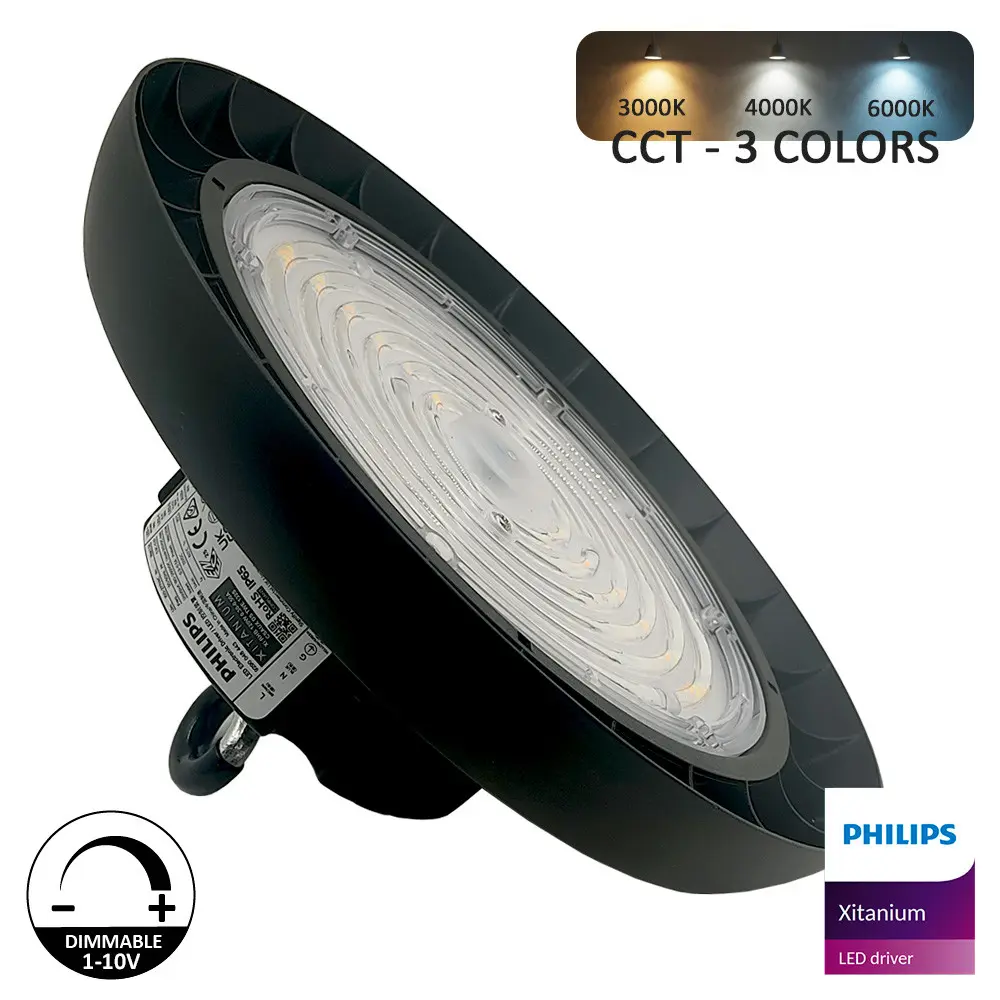
Industrial LED High Bay 120W-100W-80W | UFO GERMANY | 3CCT | Philips Xitanium Driver | Dimmable 1-10V
79,90 €
VAT included
Ref: HBGER100W-CCT-91435
Industrial LED High Bay 80W-100W-150W-200W - UFO - OPORTO - CHIP LUMILEDS
83,43 €
VAT included
Ref: HB-MULTI
100W UFO LED high bay: order the smallest in the range with the datasheet and accessories already settled
This is the round unit at the lowest power setting of the range, and this page explains what comes in the box. What its datasheet declares, which lens is fitted as standard, what can be attached from the outside, what it hangs from and which fields you need to fill in so the order arrives right first time.
Your lighting requirements (how many lux the task needs, the mounting height of each point, how many units the layout calls for) are worked out beforehand, and that is what the wattage page covers. Once that count is settled, all that remains is not to get the product code wrong, which is where the morning gets lost: the right fitting with the wrong lens.
We manufacture the range, so the datasheet can be read in full and the figures are measured in-house, not copied from someone else's document. If you have two quotes on the table that look like the same fitting, ask us for the datasheet and compare the five lines that genuinely set one apart from the other. And if this is for a project or for resale, register as a trade customer before you quote: tiered discounts apply from your very first order.
The three figures you decide on with the 100W UFO LED high bay datasheet: luminous flux, efficacy and weight
The first thing to separate on the datasheet is the LED chip flux and the luminaire flux. The second is what comes out through the lens and reaches the floor; the first is a laboratory figure for the component and is always higher. When the manufacturer declares the luminaire flux alongside the actual power drawn, the efficacy works itself out and can be compared without argument.
In this series the figure ranges from 160 to 200 lumens per watt, which is where the high efficiency of this family is measured today. It is worth reading with its origin in mind: it is taken with a brand-new fitting and at a stable ambient temperature, so the maximum efficiency on the label will not be the one you get in August under a metal roof. What counts is the figure the luminaire sustains once it is running hot.
The long service life stated in the document is expressed in the same way: in operating hours, up to the point where the flux drops to a given percentage, and never in years of warranty. Confusing one measure with the other when comparing two datasheets is the most common mistake.
The datasheet closes with weight and dimensions, which are the figures that determine how it is suspended. At this power level the body is light, and that is the on-site advantage that never appears in any performance table: it fixes to the existing section without calculating reinforcements and fits into a technical suspended ceiling or onto a roof truss without touching the structure. The high brightness per unit has its practical limit in mounting height: above seven metres the project calls for a different product, and under the high ceilings of modern logistics or in high-bay halls this fitting falls short because of geometry, not quality.
Philips and a driver with a declared curve: the electronics that mean you will not be going up to replace a 100W UFO industrial LED high bay
The driver is the component that determines how long the luminaire lasts. The LED chip holds up; what degrades first are the power supply's capacitors when they run hot and at the limit of their range. That is why we fit electronics from an identified manufacturer with a declared curve, Xitanium or Sosen depending on the series, instead of an anonymous power supply that forces you to replace the whole fitting the day it fails.
The same goes for the LED chip. The datasheet declares the package, SMD, and who makes it: OSRAM, Bridgelux or Lumileds LEDs depending on the production series. That matters because lumen depreciation over time depends on the chip and the temperature it runs at, and it is what underpins the durability of the luminaire in a building that operates twelve hours a day.
The third line in this part is surge protection. On a circuit shared with heavy-start machinery, spikes from the installation itself are a common cause of early electronics failure, so it pays to ask about it before ordering, not afterwards. A well-protected input control gear is what gives high reliability to a large batch, where the outcome is set not by the best unit but by the worst.
Behind that decision comes the warranty, which reaches up to 6 years depending on the product and never drops below three. Before comparing two quotes, ask in writing which LED chip and which electronics each one uses: it is the only way to know whether you are comparing two luminaires or two labels.
90º and 60º optics: the beam angle fitted at the factory on this UFO unit and the reflector ordered separately
The fitting arrives with its beam already fitted, and that figure is declared on the datasheet as the beam angle or, failing that, in the photometric curve. It is the line almost nobody reads and the one that decides the whole light distribution.
Three beam angles are available. The 120º option floods the area and is the one most units at this power level come with. The 90º opens just enough for wide aisles and machine areas. And the 60º concentrates the beam into a narrow strip, which is what a racking aisle needs. All three come from the same product code, so the beam angle is a field on the order, not a separate product to be quoted.
When the geometry does not suit what is already installed, the reflector clips over the lens from the outside and narrows the cone without opening the body. It can be ordered after measuring, with the installation in place, and ships in the same package as the units if it goes on the same line of the delivery note.
A note on results: uniform, powerful lighting on the working plane is not achieved by adding watts; it comes from choosing the right lens, and powerful, efficient lighting is always the kind that puts the flux where the work is actually done. If the client asks for a lighting level report, the contrast between maximum and minimum is the figure their health and safety officer will look at, and that contrast is corrected with the lens. State where each unit is going when you place the order, because the beam angle cannot be corrected with the luminaire up there without going back up on the access platform.
Adjustable wattage with a selector: the 100W UFO LED high bay is configured before it is hung, without duplicating codes on the shelf
There are two different adjustments in this family and it is best not to mix them up, because they solve completely unrelated problems.
The first is done once, during installation. A UFO LED high bay with selectable wattage leaves the factory with several power levels in the same body, 150W and 200W among them depending on the combination, and is set with the wattage switch before the fitting is hung. For a building with two zones of different heights, that means a single product code on the order and on the shelf: you buy one body and configure each unit according to where it goes. Less tied-up stock, fewer mistakes when preparing the material and far simpler replacement two years down the line.
The second adjustment is continuous and is not an accessory: it is a different version chosen at the time of purchase. That is covered in the section on the body, further down.
An electrical note: changing the power setting does not change the circuit protection, which remains sized for the maximum at that point. What is worth doing is noting on the distribution board which setting each unit was left on, because it is the only thing that explains a consumption reading two years later.
5000K and a premium range: the colour temperature of the industrial LED high bay is set on the order, not on the ceiling
The colour temperature is chosen at ground level, before the fitting is hung; after that it cannot be changed without taking it down. The switch is accessible on the body and offers three positions within the same product code.
5000K comes close to midday natural light and is what an inspection station or a goods dispatch area needs, where you want to see the true colour of what is being handled. Dropping to neutral 4000K softens the atmosphere in areas where people stay for long periods and is less tiring over a long shift. There is no single answer, only the task.
Having the switch as standard is what separates a well-designed series from a mass-produced one, and its practical effect is felt in the warehouse: the same code covers three colour temperatures and the spares cupboard no longer needs three slots. Nor is there any orphaned stock when a project is cancelled halfway through. Tell us the position you want for each room when you send the quantities and the material ships already separated.
IP65, aluminium and heat dissipation: the body you hang and the dimmable version chosen when ordering
On the datasheet, the IP65 protection rating sums up two tests: no dust inside the body and resistance to water jets. A building that is hosed down, that has airborne particles or that takes in moisture every time the loading door opens needs exactly that; in a dry interior it looks like a luxury until someone takes a reading two years later and discovers how much light has been lost to the grime stuck to the lens. That IP65 rating also covers the covered loading bay, the canopy and the covered car park.
The aluminium housing serves a thermal function before an aesthetic one, and the finned aluminium is what draws heat away from the LED junction. Heat dissipation keeps that junction cool, and a cool junction is what preserves flux and colour temperature over the years. At this power level the margin is generous, so the risk lies not in the fitting but in where you hang it: if the body sits tight against the roof or is boxed into a space with no airflow, the luminaire loses light output long before anything burns out. Tell us how it will be installed and we will confirm the minimum clearance before the order ships.
That leaves the version. The dimmable one accepts a 1-10V dimmable analogue signal, with no data bus to run and no addresses to assign unit by unit; the fixed version cannot be dimmed later. And on the top cover there is a Zhaga Merrytek socket where the radar sensor plugs in from the outside, without dismantling anything or going near the electronics. Because it is an accessory, the batch arrives ready and the detectors go only to the aisles that need them.
Large areas: what goes on the order so a large batch does not have to be opened on site
A project order is nothing like buying a single fitting. On site, twenty, forty or a hundred units arrive at once, with a fixed installation date and the electrical circuit already run, and the first thing you need to know is how many packages it will arrive in and whether the loading bay can take them all at once.
The delivery note has room for five fields, and with them the order goes out right: product code, beam angle, colour temperature position, fixed or dimmable version and accessories per unit. Add the breakdown by room when the building has several: it is one more line and saves opening boxes on site to work out what goes where. Because we manufacture them ourselves, the fittings all come from the same mould, with identical lens and identical kelvin, so if the delivery is split into two shipments the ceiling will not end up with two different shades of light.
That is the argument that supports a high-performance batch across a large floor area, and also the one you make to the owner when they ask about energy efficiency: the sums are done with the watts actually installed and the real operating hours, and the energy saving shows up on the following year's bill, not in a brochure. An industrial luminaire type with range continuity is also what lets you extend a row two years from now without redoing all of it.
In industrial and commercial environments there are three tools used daily once your account is open. The product listing can be downloaded as a PDF with your logo and details. Packages ship with no sender details printed, so a batch can go straight to your customer's site. And dropshipping connects the range to your shop with daily stock updates. To register, all you need is the registration form and your company or sole trader documents, sent to uk@factorled.com; deferred payment is available, but each request is reviewed individually.
Questions we get from site about this unit and its installation
What comes in the box and what do I need to supply?
The fitting with its lens in place, the suspension ring, the manual and whatever you have added on that line of the order. What does not come in the box is how it is suspended from above: cable, chain or threaded rod are down to the installer depending on the structure. With a sandwich panel roof, the fixing point is anchored to the load-bearing purlin, never to the sheeting.
Can I order the 100 W UFO LED high bay with the sensor already fitted?
The sensor is always supplied as an accessory and plugs into the socket on the top face in a minute, so it arrives in the same shipment but separately. That is what lets you order a complete batch and fit sensors only in aisles with occasional traffic. The reflector works the same way. What does have to be decided on the order is the dimmable version, because that cannot be added later.
Can I mix different wattages on the same floor?
Yes, and in buildings with zones of varying height it is the sensible thing to do. What must not coexist within the same line of sight is the colour temperature: two colour temperatures side by side in industrial buildings are noticeable from the door and give the impression of a botched repair. If you are going to mix, fix the kelvin before the wattage.
A unit in an installed row has failed: what do I order and how?
The same product code, with identical beam angle and identical colour temperature position. The process is an RMA that you open yourself from your account area; there is no need to phone and the material stays where it is until it is approved. Because we manufacture it ourselves, the replacement arrives identical as long as the series remains in the catalogue, and that is the detail that matters in industrial lighting: a single replacement unit with a different colour temperature means taking down the entire row so the ceiling does not end up with two shades of light.
What if I have surplus material or the order arrives damaged?
Surplus can be returned with no questions asked, within our published terms, and the condition lies entirely in the state of the package: original box as it was shipped, with no stickers or tape stuck on it, and with packaging, documentation and accessories inside. You pay the return carriage and the route is the RMA. For transit damage, any visible knock must be noted on the delivery note before signing; and when the damage only appears on unpacking, let us know as soon as you find it. With a large batch, the habit that saves grief is to open one unit from each pallet while the carrier is still at the loading bay.
If your count is already settled and all you need is the material, send the five fields for the 100W you need to uk@factorled.com and we will send the order back to you ready, with the number of packages it will take up. The material is dispatched without queueing and the estimated date appears on confirmation; for the Canary Islands, Ceuta and Melilla, the DUA customs document and a prior call are involved. Shipping costs are calculated by the basket by weight, volume and destination before payment, and the tracking number arrives by email when the package ships. To sort it out by phone, call 91 805 67 67, or the mobile 654 777 000 if you catch us out of the office.
Más en UFO LED High Bay