

150W UFO LED High Bay
7 products
New
Industrial LED High Bay 200W-150W-100W UFO ENDURANCE OSRAM CHIP DURIS E 2835
79,90 €
VAT included
Ref: ENDUR-HB200W
New
Industrial LED High Bay 150W-100W-80W UFO ENDURANCE OSRAM CHIP DURIS E 2835
69,80 €
VAT included
Ref: ENDUR-HB150W
Industrial LED High Bay 150W UFO FRANCE 3CCT 200Lm/W | Smart Motion Sensor | Sosen Dimmable 1-10V | OP 60º - 90º
106,48 €
VAT included
Ref: SENS150W-91292
Industrial LED High Bay 150W | UFO FRANCE 3CCT | SMD2835 Lumileds 200Lm/W | Zhaga Plug And Play | Sosen Dimmable 1-10V | 60º-90º
95,90 €
VAT included
Ref: HB150W-CCT-91292
Industrial LED High Bay 150W UFO - NEW TITAN CCT - CHIP LUMILEDS SMD 2835
46,49 €
VAT included
Ref: HB150W-CCT-91335
Industrial LED High Bay 80W-100W-150W-200W - UFO - OPORTO - CHIP LUMILEDS
83,43 €
VAT included
Ref: HB-MULTI
High Bay LED 150W -170Lm/W- UFO NEW ITALY PHILIPS XITANIUM - 1-10V DIM
89,90 €
VAT included
Ref: NEW-HBPHL150W
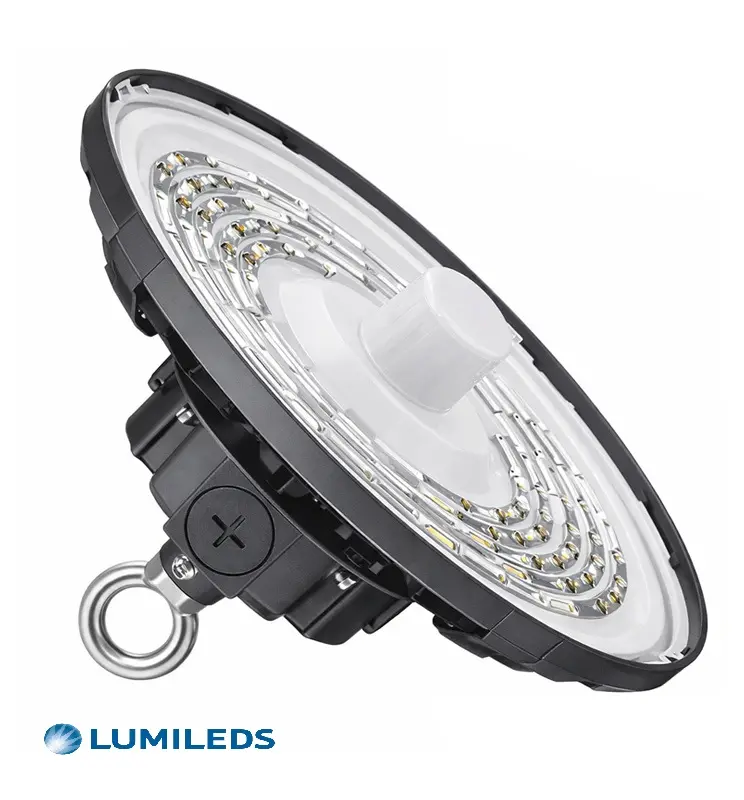
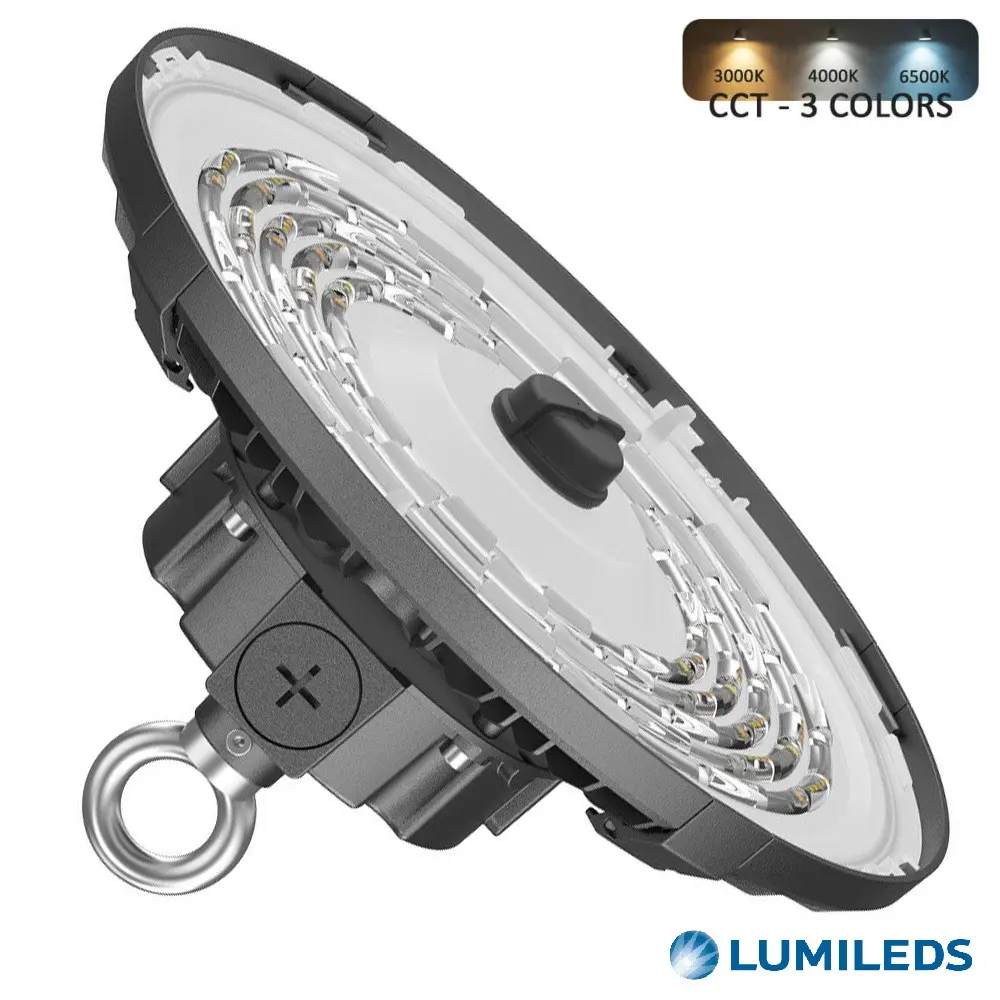
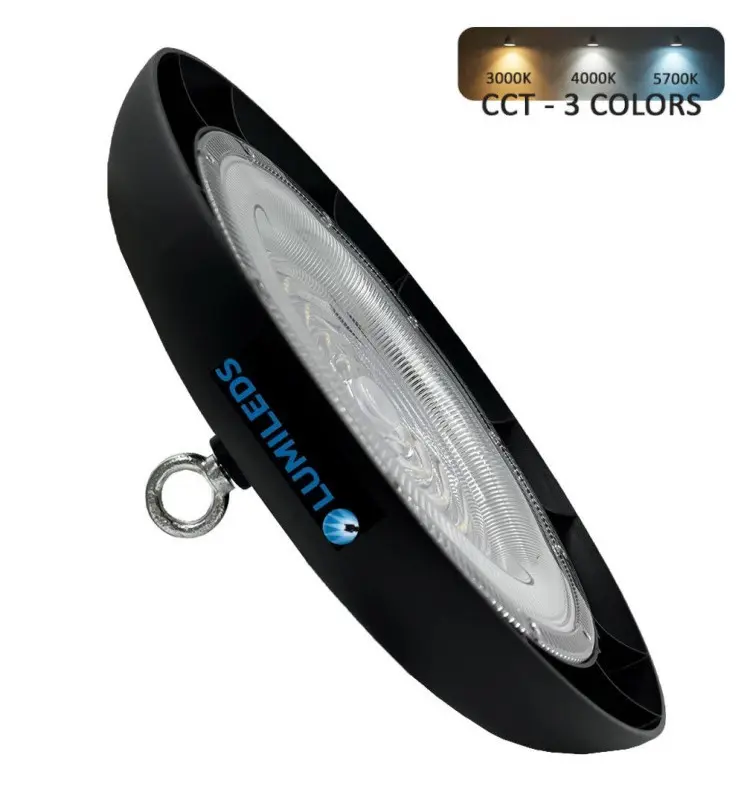
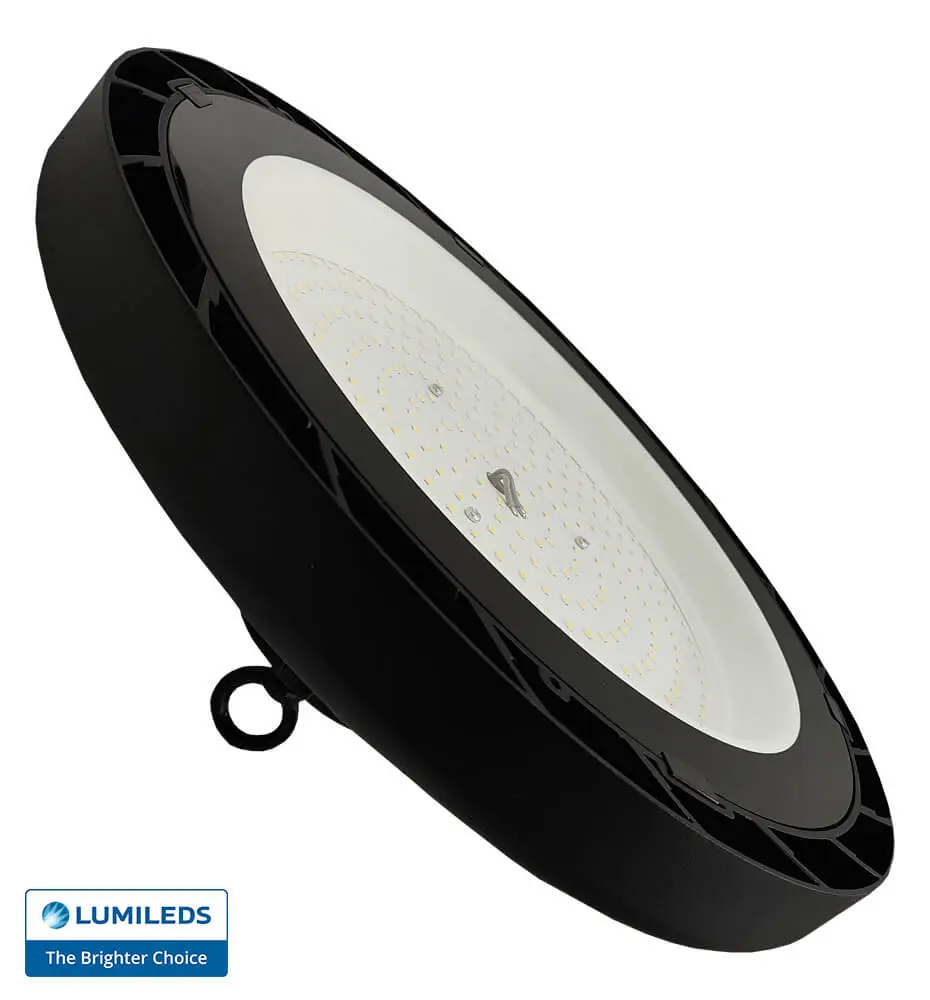
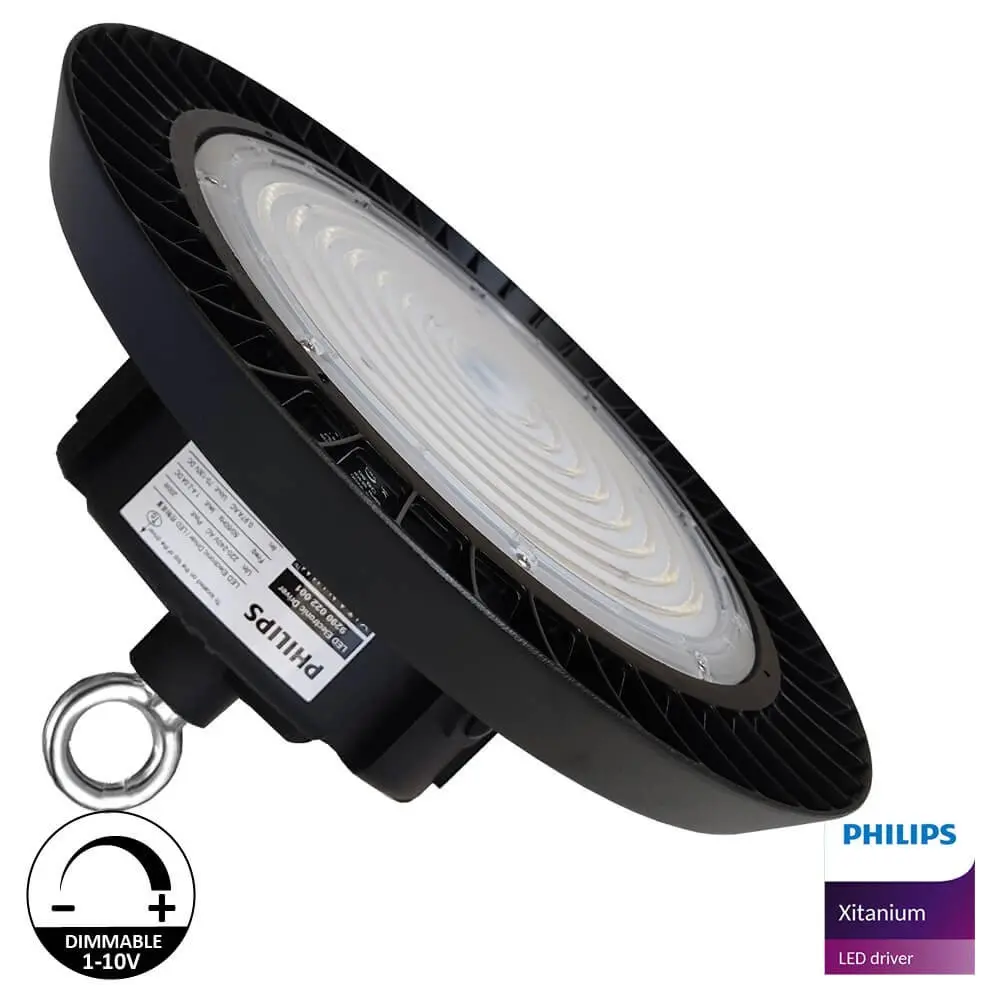
150W UFO LED high bay: the model that covers the mid-range setting with no surprises in the box
Once the calculation is done and the wattage decided, what remains is choosing the exact model. This page is about the 150W UFO LED high bay: what it comes with as standard, what can be fitted to it, what it hangs from and what to write on the order so that you receive exactly what you need rather than something similar.
Lighting requirements – how many lux, at what height, how many fittings – are worked out beforehand, on the plan, and belong on the wattage page. This page deals with the rest: the five lines on the datasheet that separate two units that look identical in the box, and the fields on the order that prevent the most expensive mistake in this family, the right unit with the wrong beam angle.
We manufacture the range in Pinto, so the figures come from our own test bench and the datasheet can be read in full with no small print. That matters on the day you need to extend a row or replace a unit: a high bay is bought once and replaced for years. And if the stock is going to a project or for resale, open a trade account before quoting, because volume pricing applies from the very first order.
No small print: the datasheet of a 150W UFO industrial LED high bay that stands up to comparison
Start with the luminous flux, and check where it was measured. The figure that counts is that of the complete luminaire, at the output of the optic, not that of the bare emitter: the difference between the two is between ten and twenty per cent. If the datasheet does not say where it was measured, it was measured wherever suited best. Our datasheet states that value in lumens together with the actual power drawn, which rarely matches the number in the product name.
With those two figures, efficacy works itself out. In this series it sits between 160 and 200 lm/W depending on the model, and that is where high efficiency is decided today in this type of product. It is worth reading it knowing what it measures: the luminous efficacy stated on any datasheet refers to a new unit at a controlled ambient temperature, so the honest number is the one the light source maintains once the whole unit is running hot. The same applies to the long service life stated on the datasheet of an industrial luminaire in continuous operation, expressed in hours to a percentage of remaining flux rather than in years.
The third line is light distribution. The unit leaves the factory with a fixed beam and the beam angle is stated, or failing that the photometric curve. 90º is the beam angle almost all units at this wattage ship with; below it, the 60º reflector can be fitted to narrow the cone. It is the figure most often missing from a product description and the one that changes the result the most.
The fourth is CRI, which is chosen by task, not taste: 80 for logistics and handling, 90 where there is visual colour inspection below. And the fifth is the type of dimming the electronics support. When any of the five is missing, the comparison is no longer technical. The datasheet ends with dimensions and weight, which is what matters for suspension: the compact design at this wattage means it can be lifted and fixed in one go, without putting up scaffolding for each point. Ask us for the full datasheet of the series you are considering and compare it with the one on your desk.
What decides a volume purchase: Philips driver and input protection in every industrial high bay
The emitter is almost never what fails. It is the electronics powering it, so this is the part of the datasheet that decides a volume purchase. Every unit at this wattage comes with a driver from an identified manufacturer with a declared curve, Xitanium or Sosen depending on the production series, never an anonymous power supply. The practical difference shows on the day of a fault: with a component from a proven brand, an equivalent spare is available years later and only the part is replaced; without it, the whole fitting has to be changed, access platform included.
The emitter is declared in the same way, with its package and manufacturer: OSRAM, Bridgelux or Lumileds in SMD format, depending on the series. That transparency is what makes it possible to compare two datasheets properly, because the package determines the flux per watt and also how the chip behaves as the housing heats up.
Also ask about input protection. On an industrial estate, with direct-on-line machinery switching on and off the mains, spikes are the real enemy of an installation: a unit with surge protection withstands transients that knock out those without it. It is the line that separates two offers that look the same in the box, and the one that underpins the reliability of the installation after five years.
Behind that decision comes the cover: up to 6 years depending on the model, with 3 as a minimum, and the replacement comes from the same production line as the unit already hanging. A high-quality power supply component is also what makes the unit long-lasting in a building that is lit twelve hours a day, and what its real durability depends on. Before signing a quote, insist on written confirmation of which electronics are fitted and whether input protection is included.
Switchable CCT with 5000K: the colour temperature of the UFO LED high bay is set before it goes up
The housing has a selector accessible on the side. Three settings and a single product code on the shelf, instead of three different codes for the same unit.
The settings are the usual ones in industry: neutral 4000K, the intermediate one and cool 6000K. The colour temperature is set on the ground, with the unit still in its box, and changing it afterwards means taking it down. That is why the order is prepared with the zones already defined: if you know which areas are for picking and which for finish inspection, the units ship with the setting already selected and the installer does not open boxes blindly.
The choice per zone is not aesthetic. Where labels are read at a distance, neutral white gives enough contrast without making the space feel harsh; in finish inspection or precision machining, the cool end sharpens the perception of detail; and where workstations are occupied all day, visual comfort takes priority, with a mid-range tone and no bright spot visible from the working position. What should be avoided is mixing two different tones within the same visible space.
Dust, hoses and canopies: the IP65 rating that keeps this 150W UFO LED high bay going on your site
A single figure on the datasheet decides whether this model will cope on your site. The sealing is rated IP65: no dust ingress inside the housing and resistance to water jets from any direction. In terms of hardware, it means the gaskets and cable glands are sized for that, which is exactly where sealing is lost when a manufacturer cuts corners.
That sealing does not only protect against water. The unit is dustproof and waterproof in equal measure, and fine dust is what eats into performance in joinery workshops, cement plants or recycling facilities: a layer of sawdust on the optic costs twenty per cent of the flux within a matter of months. Well-designed sealing is what keeps the unit delivering the same output five years from now. The IP65 protection rating also allows outdoor use under cover: canopies, covered loading bays or car parks. Fully exposed to the elements, with nothing overhead, the right choice is a different product family.
The finish completes on the outside what the sealing achieves on the inside, and it counts when there is a forklift or a cleaning pole nearby. That robust design comes down to tempered glass, stainless steel fixings and a housing that does not dent at the first knock, and the optical ring arrives protected from the factory.
In industrial environments with steam, temperature swings or salt mist, what matters is not the number on the label but the gasket material. If your site is washed down with hoses or builds up fine dust, tell us when requesting a quote: that detail changes the recommended model. Warehouses handling food fall squarely into this case, because cleaning is daily and under pressure.
The replacement you will need in two years is decided on this order: housing, mounting and accessories shared across the series
In this family, the 150W and 200W industrial units share the housing, plate and suspension system with the lower setting. What changes between the 100W and this one is the number of emitters on the board, the declared flux and the weight, which increases just enough for the mounting to stay the same. So does the package: fewer units fit per box, and that shows when the order ships palletised.
Nothing else changes. The same family of electronics, the same colour temperature settings, the same socket on the top face and the same accessories. A UFO industrial high bay from this series takes the same reflector whichever wattage you choose, so an installer working with two wattages does not have to double up on ancillary stock.
Below it sits the 120W level, following the same logic, and above it the series continues up to the top of the range without changing the brackets or accessories. For an installer who keeps their own stock, that continuity within the family is what makes it possible to reorder without comparing datasheets all over again each time.
In industrial settings where the installation grows in phases, it is worth fixing the model with the first purchase and setting aside a couple of spare units. That is what saves you from taking down an entire row two years later just to match the colour temperature.
Reflector, motion sensor and remote control: what your industrial UFO LED high bay accepts without opening the housing
Everything that fits this unit is ordered on the same order line and ships in the same package. There are four items and they are fitted without opening the housing.
The first is the reflector, which clips over the optic from the outside and narrows the beam. It can even be ordered later, once it has been confirmed on site that the cone is too wide.
The second is the radar sensor with a Zhaga Merrytek base. It plugs into the standardised socket on the top face, without dismantling the housing or going near the electronics, and communicates through its own 0-10V interface. It detects movement rather than body heat, so it responds the same way to an operator in winter clothing as to a pallet moving on a pallet truck.
The third is the remote control, and with it the Zigbee controller when zones need grouping or scenes need saving. The fourth is not an accessory but an option on the order: the dimmable version is a separate model and is chosen at the time of purchase, because a unit without the right electronics cannot be dimmed later. That option on the order is the one that prevents the most returns.
Because everything is an accessory, the batch arrives ready and sensors are fitted only where they are needed. Tell us which units take what and the stock ships already separated by zone.
UFO LED high bay wattage by wattage: what to write on the order
An order for this family is closed with five details, and with them it goes right first time: series, beam angle, colour temperature setting, fixed or dimmable version, and accessories per unit. If any of the five is missing, someone will have to decide it for you at the packing bench.
Add to those five the breakdown by zone if the building has more than one. It costs no more than an extra line and prevents everything arriving mixed together on one pallet, which is what forces boxes to be opened on site to find out what goes where. When the batch is large, it is also worth knowing how many packages it ships in and whether the loading bay can take them all at once.
That detail is what underpins a consistent, high-performance batch in industrial lighting: every unit comes from the same housing, with the same distribution and the same colour temperature, so a delivery split across two shipments does not leave you with half the floor lit differently from the other half. The trade account offers wholesale pricing with quantity tiers, provides the price list in PDF with your logo, ships with no visible sender and lets you sell via dropshipping with the range synchronised daily. To sign up, simply send the registration form and documentation of your business activity to uk@factorled.com.
Orders are dispatched without delay and the estimated delivery date for your address is shown at checkout. For the Canary Islands, Ceuta and Melilla, allow extra time: a DUA customs document and advance notice are required. Shipping costs are calculated in the basket according to the package's weight, size and destination, and are shown before payment. When the package is out for delivery, you receive the tracking number by email.
With the package on the loading bay: the five answers installers ask for
What comes in the box besides the unit?
The unit with its optic already fitted, the suspension ring, the documentation and any accessories you ordered on that order line. The reflector and the sensor arrive separately but in the same shipment, so it is worth counting them on receipt. What is not included is the suspension system to the structure: steel cable, chain or rod is supplied by the installer depending on what it hangs from.
What exactly does it hang from, and how much does each point weigh?
From the standard ring, with chain or steel cable to the beam, truss or purlin. The weight at this wattage is modest and a standard fixing to the section is enough, with no bespoke brackets. There are two things nobody should skip: checking that the point can take dynamic loads, because an industrial building with an overhead crane vibrates, and leaving free air space above the housing. It connects directly to the mains and, in the dimmable version, two extra wires run back to the distribution board.
Can I order the sensor later, or does it have to go on the first order?
The sensor can, because it goes into the socket on top and plugs in within a minute without touching the electrical installation. So can the reflector. What cannot be added later is dimming capability, which lives inside the electronics. If there is any chance of introducing controls in the future, order the ready version now.
One unit in a row that is already installed has failed: what do I order?
The same model with the same beam angle and the same colour temperature setting, and that is where manufacturing the range pays off: the replacement comes from the same line that made the one you installed. It is handled via RMA from your account area, with no phone call needed, and the unit stays in place until the request is approved. If the order arrived damaged, note it on the delivery note before signing for the carrier; if the damage only shows when unpacking, let us know as soon as you see it.
What if I choose the wrong beam angle or have stock left over?
Returns without giving a reason are available, under the conditions set out in our policy, and the unit must come back in its complete original box, free of stickers and tape, with packaging, manuals and accessories. Return shipping is at your expense, and failing to meet any of these points reduces the amount refunded. The process is the same as for warranty claims. The sensible thing is not to get that far: if you are unsure between two beam angles, write to us at uk@factorled.com with the spacing between points you have calculated and we will sort it out before you place any order.
The energy savings of an installation with this series come from two places: the output of each watt and the hours the unit spends at full power, and energy efficiency can only be proven with the following year's bill in hand. If your calculation is already done, send us the five order details and we will send the order back to you ready; if what you need is to extend a row in industrial buildings that is already installed, tell us what is up there and the equivalent unit will slot into the gap without the changeover showing. To talk it through, there are two lines: 91 805 67 67 landline and 654 777 000 mobile.
Más en UFO LED High Bay