

UFO LED High Bay
13 products
New
Industrial LED High Bay 200W-150W-100W UFO ENDURANCE OSRAM CHIP DURIS E 2835
79,90 €
VAT included
Ref: ENDUR-HB200W
New
Industrial LED High Bay 150W-100W-80W UFO ENDURANCE OSRAM CHIP DURIS E 2835
69,80 €
VAT included
Ref: ENDUR-HB150W
Industrial LED High Bay 150W UFO FRANCE 3CCT 200Lm/W | Smart Motion Sensor | Sosen Dimmable 1-10V | OP 60º - 90º
106,48 €
VAT included
Ref: SENS150W-91292
Industrial LED High Bay 200W UFO FRANCE 3CCT 200Lm/W | Smart Motion Sensor | Sosen Dimmable 1-10V | OP 60º - 90º
129,47 €
VAT included
Ref: SENS200W-91293
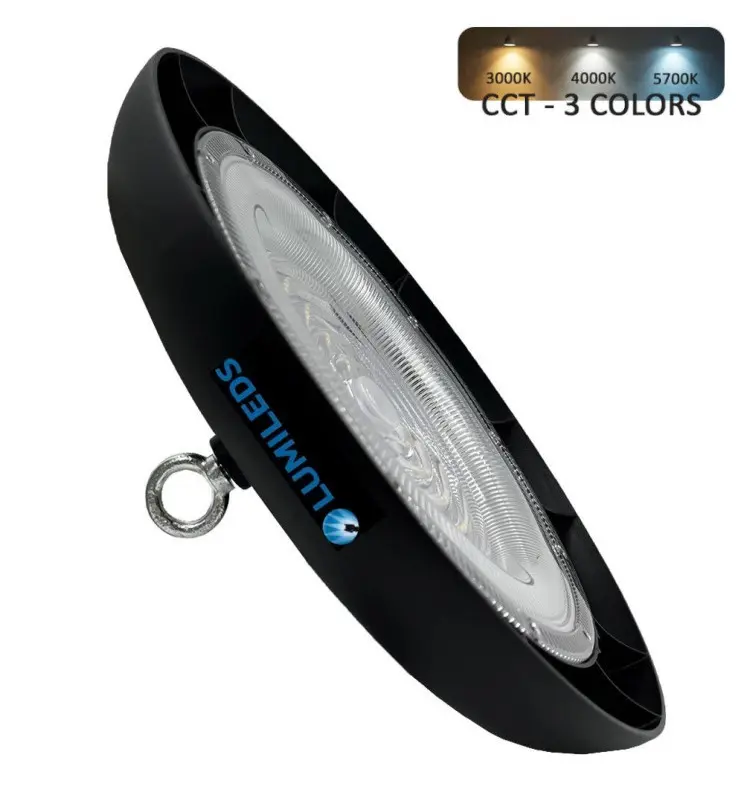
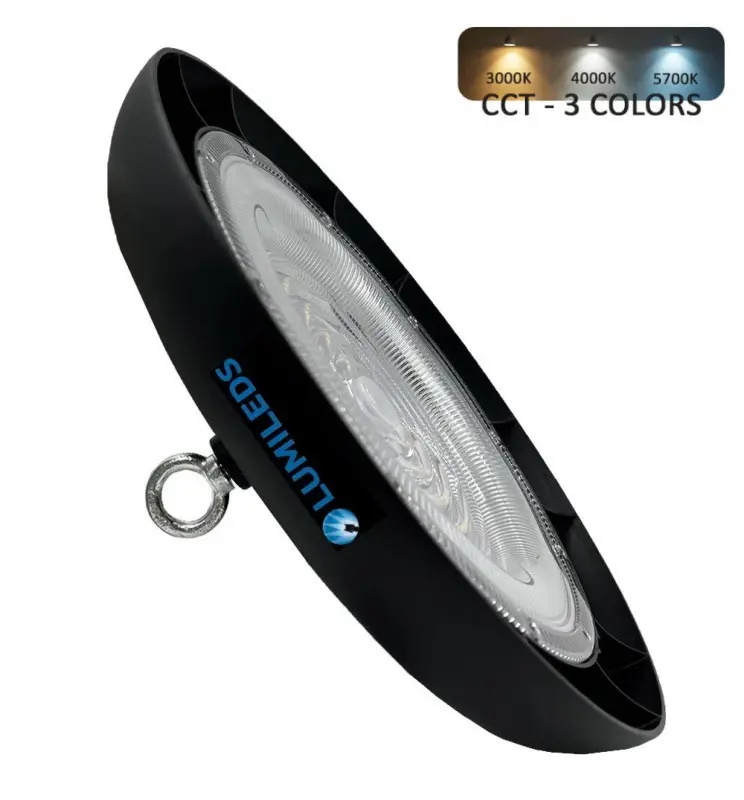
Industrial LED High Bay 150W | UFO FRANCE 3CCT | SMD2835 Lumileds 200Lm/W | Zhaga Plug And Play | Sosen Dimmable 1-10V | 60º-90º
95,90 €
VAT included
Ref: HB150W-CCT-91292
Industrial LED High Bay 200W | UFO FRANCE 3CCT | SMD2835 Lumileds 200Lm/W | Zhaga Plug And Play | Sosen Dimmable 1-10V | 60º-90º
119,90 €
VAT included
Ref: HB200W-CCT-91293
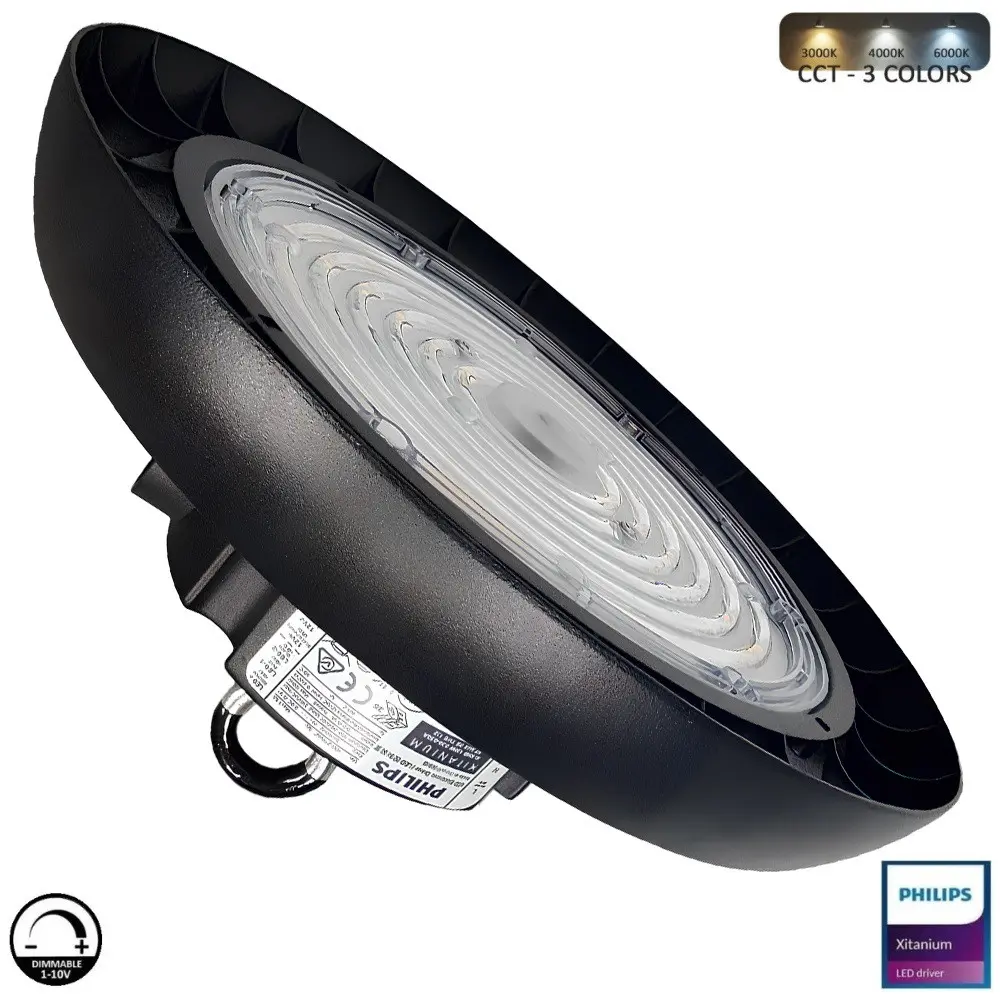
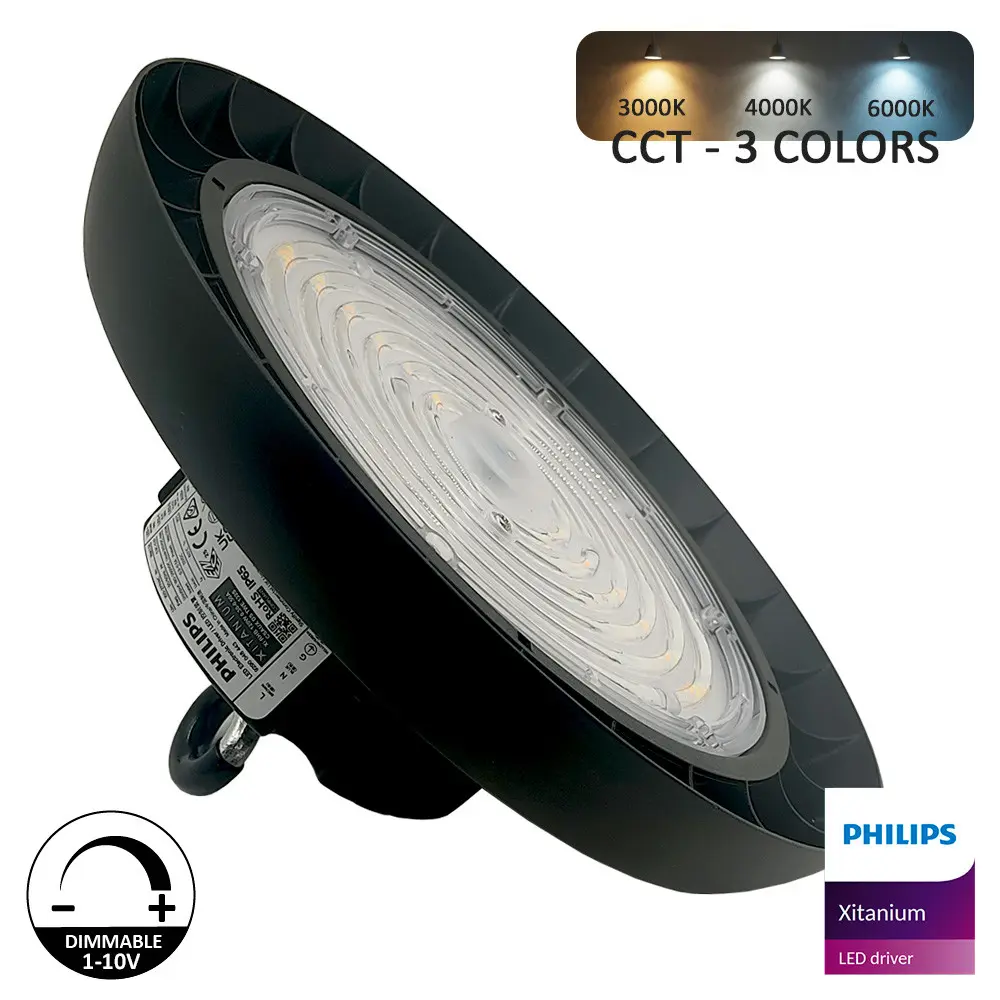
Industrial LED High Bay 200W-160W-120W | UFO GERMANY | 3CCT | Philips Xitanium Driver | Dimmable 1-10V
95,90 €
VAT included
Ref: HBGER200W-CCT-91436
Industrial LED High Bay 120W-100W-80W | UFO GERMANY | 3CCT | Philips Xitanium Driver | Dimmable 1-10V
79,90 €
VAT included
Ref: HBGER100W-CCT-91435
Industrial LED High Bay 200W UFO - NEW TITAN CCT - CHIP LUMILEDS SMD 2835
59,42 €
VAT included
Ref: HB200W-CCT-91336
Industrial LED High Bay 150W UFO - NEW TITAN CCT - CHIP LUMILEDS SMD 2835
46,49 €
VAT included
Ref: HB150W-CCT-91335
Industrial LED High Bay 80W-100W-150W-200W - UFO - OPORTO - CHIP LUMILEDS
83,43 €
VAT included
Ref: HB-MULTI
High Bay LED 150W -170Lm/W- UFO NEW ITALY PHILIPS XITANIUM - 1-10V DIM
89,90 €
VAT included
Ref: NEW-HBPHL150W
200W High Bay LED UFO DIAMOND Philips Xitanium - Dimmable 1-10V - 170lm/w - IP65
97,02 €
VAT included
Ref: HBPHL200W
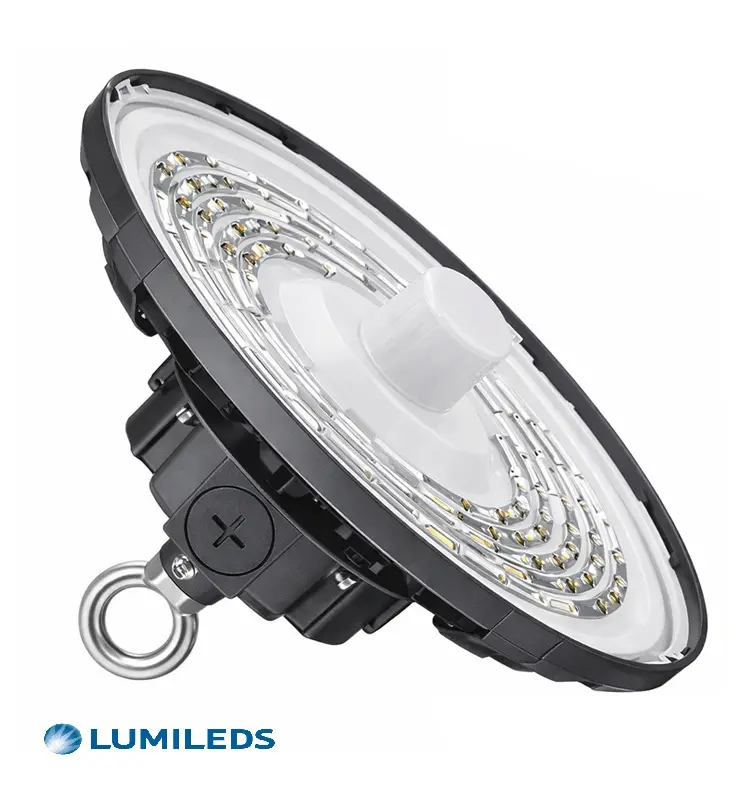
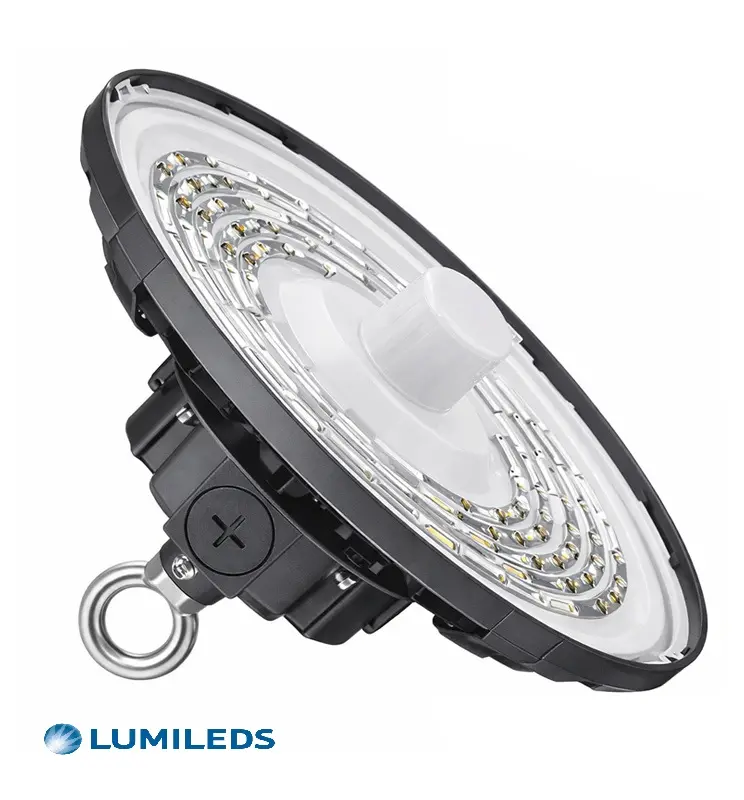
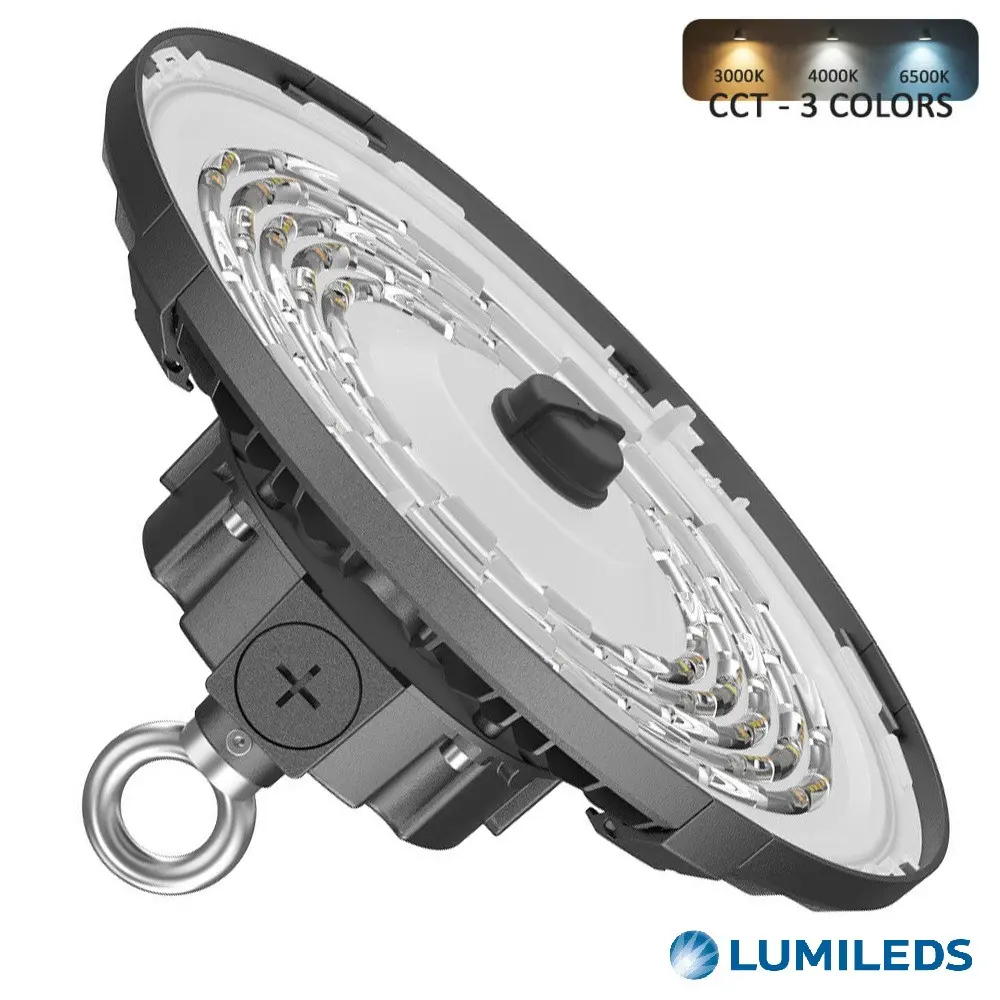
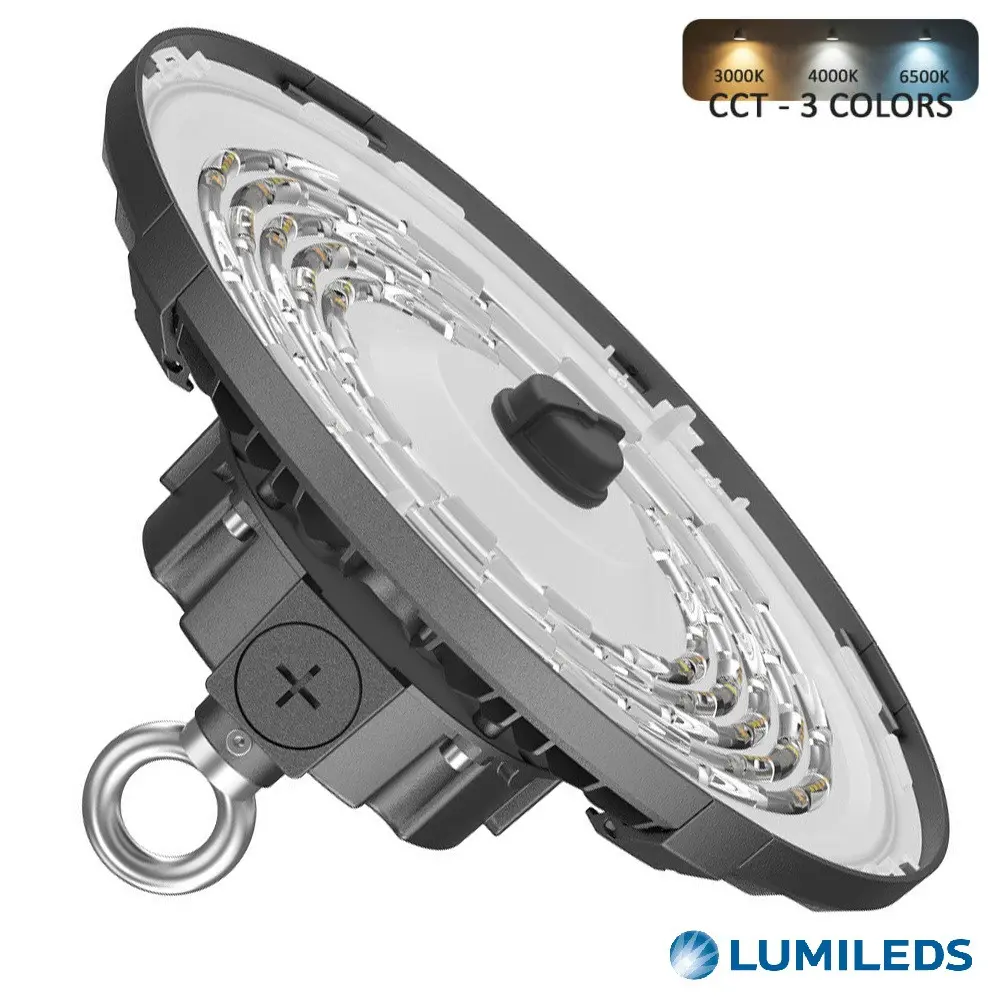
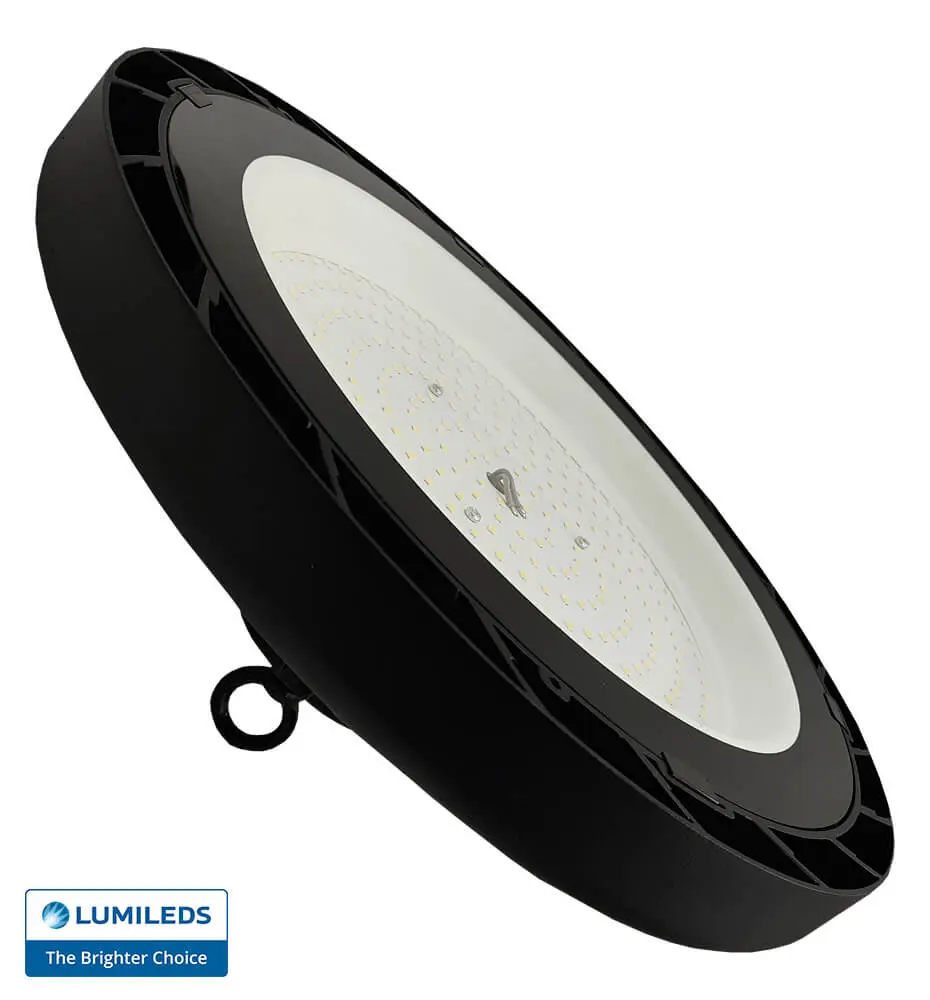
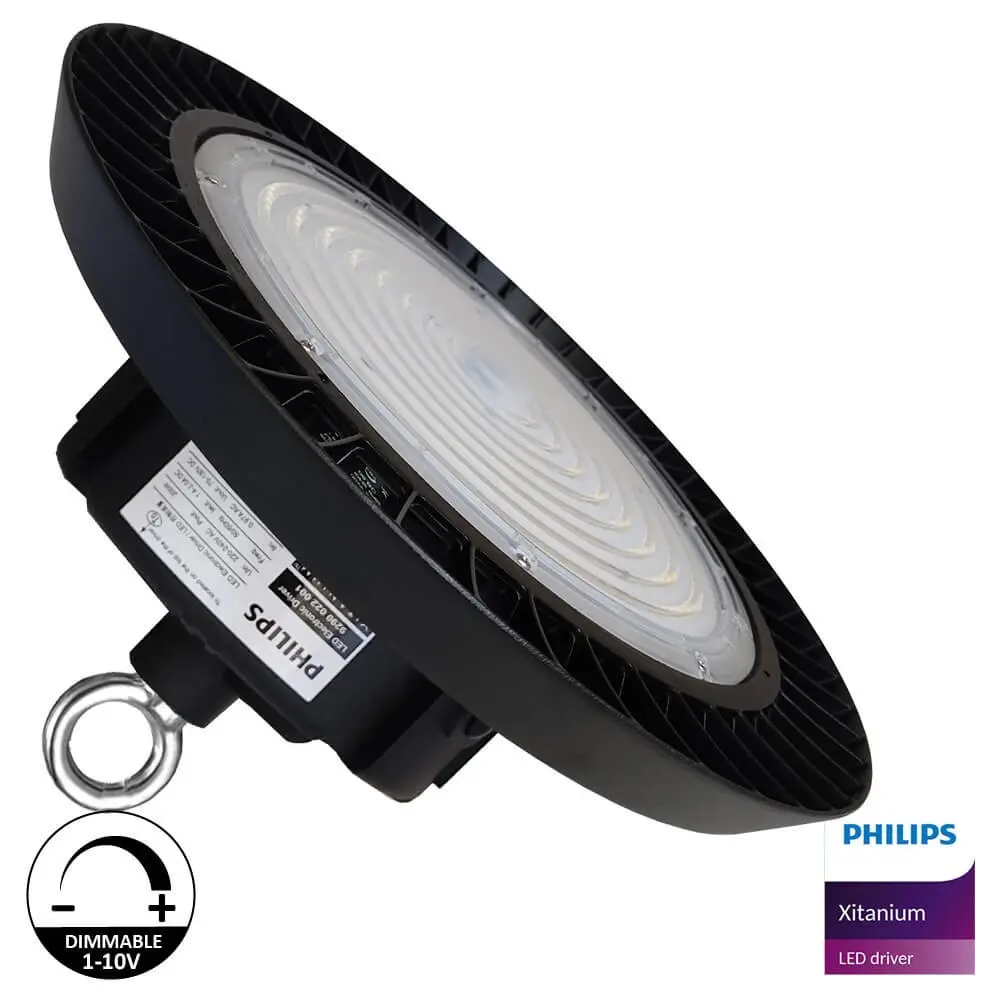
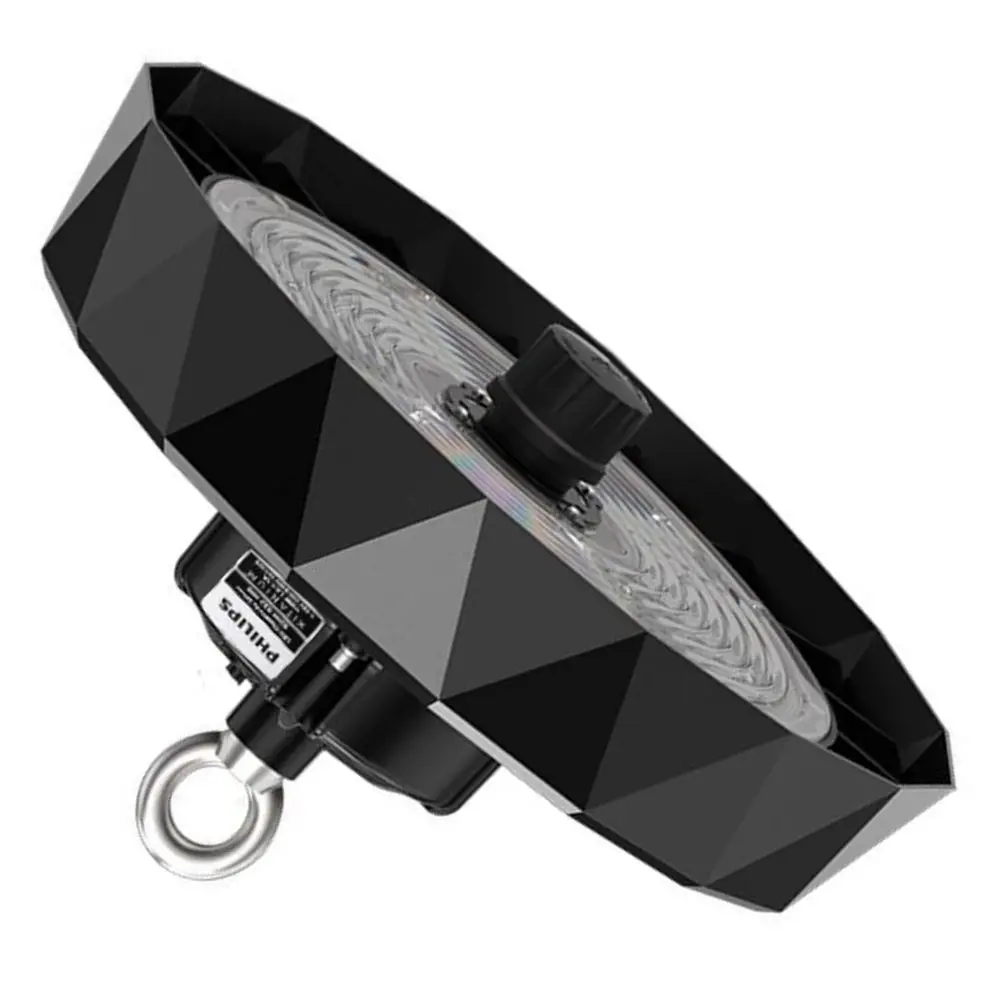
UFO LED high bay: the circular format that performs best under high ceilings
When the ceiling is high, the format matters more than the wattage. The UFO LED high bay has become the default industrial luminaire for high-mounting installations: it adds little weight to the structure, concentrates maintenance at a single point and lets you change the light distribution without rewiring the circuit. A UFO LED high bay spreads its heat-sinking mass around the light source, dissipates heat through the entire perimeter of the housing and hangs from a single fixing point.
Behind the name lie three or four decisions that are made once and shape the installation for years. The beam angle. The type of driver fitted inside. The colour temperature. And the way the housing gets rid of heat, which outweighs all the others. Manufacturing our own high bays lets us control those points and, above all, keep the same product available when, three years from now, you need to replace a unit and nothing else matches.
Buying LED lighting online does not mean buying blind. The datasheet gives the luminaire's lm/W, the beam angle, the ingress protection rating and the control mode, and with those four figures you can size an entire floor before anyone goes up to install anything. Ask for the datasheet of the model you are considering and compare it with whatever else you have on the table. And if you have already settled on the format and just need to fine-tune it, send a dimensioned plan with the mounting height and aisle widths to uk@factorled.com: we will reply with the right beam angle for each section, the power setting to lock in and the accessories worth adding to the same order line.
A housing that saves you going back up to replace it: aluminium, radial fins and a UFO industrial LED high bay that runs cool
The enemy of a high-power LED is not dust or moisture. It is its own junction temperature. Every extra degree on the board costs you lost luminous flux and shorter service life, and this is where the circular housing has a geometric advantage: the distance between the hot spot and the outside air is the same in every direction, so no part of the heat sink works twice as hard as the part next to it.
The fins are radial and vertical for a simple physical reason. Hot air rises, and if the channels between the fins face upwards, natural convection does the job on its own, with no fan or moving parts to maintain. Die-cast aluminium acts as both structure and cooling: the same housing that holds the board carries its heat away. That is what the datasheet sums up as excellent heat dissipation, and it is why the high bay keeps delivering its output after tens of thousands of hours.
A maintenance detail almost nobody plans for: a two-millimetre layer of dust on the fins cancels out a good part of that heat dissipation. In particle-laden environments such as joinery, concrete, textiles or dry food processing, heat sink cleaning should be scheduled just like extractor cleaning, and you will notice it in the light level long before you see it on the energy bill.
This leads to something that is rarely explained at the trade counter: lumen depreciation over the years is not a manufacturing defect, it is physics. A luminaire running ten degrees hotter than intended ages faster, and not just the LED but the driver's capacitors too. That is why the thermal headroom of the housing counts for more than the wattage printed on the box.
Sealing is a separate matter and addresses a different problem. With IP65, the unit is dust-tight and withstands the low-pressure water jets a plant receives every time it is hosed down. A high-quality housing shows itself in its weight and the number of fins rather than in the catalogue photo: more heat-exchange surface means a lower board temperature for the same consumption.
The compact design also has a practical benefit on site. The whole disc fits between narrow lattice trusses, casts no shadow on itself and can be mounted close to the steel section without losing performance. Combined with the sealing and the electronics kept away from the heat source, that is what delivers the long service life and durability expected of a range installed at ten metres that nobody wants to touch again. That thermal headroom does not show in a catalogue photo: if you are about to commit to a large order, order a single unit and hang it at the hottest point of the building.
Eyebolt, hook or steel wire rope: the fixings for each industrial LED high bay are settled on the order, not on the access platform
The entire load hangs from one point, so that point determines how safe the installation is. The usual arrangement is a threaded eyebolt on top of the housing with a hook working in pure tension on it. No screws loaded in shear, and no plastic cable ties used as a temporary fixing that then stay there for ten years.
On a steel structure, steel wire rope solves what a hook alone cannot: adjusting the height. A roof truss is not at the same height along its whole length, and if you hang each unit directly from the section, the row of luminaires ends up staggered and the distribution on the floor is no longer even. With an adjustable sling or wire rope you level the heights and bring every unit to the same line.
Keeping the unit horizontal is not a matter of looks. If the high bay hangs at an angle, the fins stop channelling air vertically and the light distribution shifts towards one side of the aisle. Check it with a spirit level as you hang each unit, not once the whole row is up.
Leave clear space above. Fitting the housing tightly between two closely spaced beams, or into a void in a suspended ceiling, kills convection no matter how well the heat sink has been sized. The more enclosed the space above, the hotter the board gets, and that is the installation mistake that costs the most luminous flux in projects that looked well calculated on paper.
And keep the connection point accessible. At ten metres, every intervention costs you an access platform and downtime, so the terminal block or quick connector must be reachable without taking the unit down. The same goes for the top socket if you plan to add a sensor later: better to leave it free from day one than to go up twice. And while you are at it, finalise the fixings, reflectors and sensors you intend to fit on the same order: coordinating a single delivery with an access platform already booked costs far less than discovering mid-morning that a sling is missing and having to come back another day.
The beam angle is ordered with the luminaire: 60º, 90º or 120º optics depending on the height of your industrial building
The three beam angles in the catalogue are 60º, 90º and 120º, and getting this wrong is the most expensive mistake with this range. The angle does not change how much light the luminaire delivers, it changes where it goes: a narrower optic concentrates the same flux on a smaller area and raises the level on the working plane, while a wider one spreads it out and lowers it.
Between four and six metres, the wide beam wins. At that distance, a narrow optic draws sharp circles on the floor and leaves dark patches between units, so you end up adding more fittings to fill the gaps. With 120º the overlap comes naturally and uniformity is achieved without inflating the quantity.
From six to nine metres, 90º covers most cases and is the standard beam angle on almost every project. It is the sweet spot: enough light on the floor, sensible overlap with a spacing similar to the mounting height, and little glare for a forklift driver looking straight ahead.
Above nine or ten metres, and whenever there is high racking with narrow aisles, the 60º optic does the work. There, lighting the floor is not enough: you need to get light onto the vertical face of the racking, where operators read labels and product codes. A narrow beam travels down the aisle without being wasted on the top of the racks, and the 60º reflector accessory lets you narrow the optic of a UFO high bay that is already installed without replacing the whole luminaire.
A point that saves you redoing calculations: powerful lighting on the working plane does not come from adding watts, it comes from choosing the right beam angle. Doubling the power with the wrong optic increases consumption and perceived glare, not the useful light level. And glare at height is no minor detail when there are overhead cranes or platforms working beneath the luminaires. Before finalising quantities, send us the mounting height and aisle widths: we will tell you which beam angle suits each area and whether it is worth adding the reflector to the same order line, which is where most is lost by deciding by eye.
One selector, three settings and a single box on the shelf: adjustable power is set before the luminaire is hung
A UFO LED high bay with switchable power is the same fitting with three or four output configurations. The switch is accessible on the housing and acts on the driver, which limits the current delivered to the board: consumption and luminous flux change without touching the optic or the beam angle. The catalogue includes power levels such as 200W-150W-100W and 150W-120W-100W-80W.
It serves two very specific purposes. The first is keeping a single product on the shelf instead of three: the same box covers the picking aisle and the loading bay, so maintaining a portfolio of installations no longer ties you to three shelf slots and three different product codes.
The second is more interesting and almost nobody makes use of it: adjusting after measuring. You install it on the highest setting, measure the actual light level on the working plane with a lux meter and, if there is too much light, drop one setting. A project calculated from drawings always has deviations, such as an actual height that differs from the plan, the colour of the floor and walls, or racking that was not foreseen, and this correction takes fifteen minutes instead of swapping luminaires. When one area calls for high power and the next does not, you avoid buying two different products.
Switching is done with the luminaire de-energised, before it is hung, and recorded in the installation log. It is the step most often forgotten: if nobody notes which setting each line was left on, two years later nobody knows why one area gives less light than another.
Many models also offer colour temperature switching, listed in the catalogue as 3CCT: 4000K, 5000K or 6000K in the same unit. Neutral white suits mixed areas where office workstations sit close to production, while cool white is reserved for precision work and visual inspection. Being able to choose on site avoids the classic problem of two different colour temperatures on the same ceiling because the second order came from a different series. The series keeps coming off our own production line, so an extension two years from now is handled with the same product rather than a similar equivalent. If you are ordering in volume, the trade price list applies quantity discounts from the moment you register.
The driver determines real-world lifespan, and the dimmable version has to be ordered from the outset or not at all
The component that determines a high bay's real-world lifespan is not the LED, it is the electronics powering it. A chip operating within its curve lasts tens of thousands of hours; the driver controlling it is what fails first when it is short on cooling or built with marginal components. That is why we fit Philips Xitanium or Sosen drivers: electronics with published datasheets, declared tolerances and spare parts you can still source years later.
On an industrial supply there is a second threat that does not exist in homes: surges. Switching spikes from motors, compressors and overhead cranes enter through the lighting circuit just as they do through any other, so check the datasheet for the protection the driver declares, because not all of them offer the same. A protected driver combined with a generously sized heat sink is what delivers the maximum reliability demanded of a luminaire hanging at twelve metres.
The 1-10V dimmable version works with an analogue control line, the most widespread in industry, compatible with anything from a wall-mounted potentiometer to a full building management system. Decide on it before ordering, because the driver output cannot be changed later: if the luminaire was not supplied ready for dimming, flux adjustment is no longer possible without replacing hardware.
The radar motion sensor with a Zhaga connector is the clean way to automate at height: it plugs into the standardised socket on top of the high bay, with the luminaire sealed, and the Merrytek model communicates with the driver via 0-10V. Because Zhaga is a standard, the same sensor is compatible with any luminaire fitted with that socket, so you can automate one area today and another next year without changing approach.
For large installations, the Zigbee controller divides the ceiling into zones and stores scenes, while the remote control handles one-off adjustments without anyone going up. In aisles with occasional traffic, keeping a low background level and jumping to full output only when presence is detected cuts consumption during idle periods without leaving the area in darkness. What cannot be changed later is the driver, so decide before ordering whether that line will be dimmed. If you are unsure, ask via the website chat with your wiring diagram to hand and we will tell you which version to order.
Fewer fittings for the same light level: the lm/W, IP65 and 6000K figures to compare on a UFO LED high bay before finalising quantities
Two quotes for circular high bays almost always look the same, and what separates them comes down to four figures. The first is the lumens per watt of the complete luminaire, never those of the bare chip: the range declared for this family starts at 160 lm/W and goes up to 200, and within that band you find out whether you are looking at a genuinely high-efficiency high bay or one that only appears so in the headline. For the same consumption, delivering 190 lm/W is not the same as sitting at the bottom of that range: we are talking about several more units for the same light level, and that is paid for in materials and installation hours.
The second is the chip. It is declared as SMD, for example an OSRAM SMD 3030, and the range includes OSRAM, Bridgelux and Lumileds. These are high-performance manufacturers with well-known behaviour, which is what allows you to compare two datasheets without relying on adjectives. Because there are plenty of adjectives: almost every datasheet talks about high brightness, and that means nothing until you convert it into lux on the working plane.
The third is sealing. IP65 protection means dust-tight and resistant to low-pressure water jets, which is exactly what a unit hanging over an aisle that gets hosed down receives. Where there is no water or airborne particles, this figure stops being decisive and the comparison comes down to the other three.
The fourth is colour temperature together with CRI. For general work a standard CRI is enough, but in quality control, painting or colour sorting it needs to be higher, or operators end up carrying the part to the door to see it in daylight. In demanding environments, with high humidity, cement dust or temperature swings, it is also worth checking the permitted ambient temperature range, which appears on the datasheet and almost nobody reads.
There is one figure that is not printed anywhere and is worth asking about: whether that series will still be in production next year. An extension carried out with a different product leaves two different colour temperatures on the same ceiling, and there is no elegant way to fix that. Our warranty starts at 3 years and extends up to 6 years depending on the product. Once you have chosen the power level, whether a 150W UFO high bay or whatever your calculation gives, go to the page for that wattage and download its datasheet: that is where the declared values are listed unit by unit. Compare them with whatever else you have on the table and place the order with the figures in front of you, not the headline on the box.
Warehouses, large retail spaces and car parks: three lighting configurations of the same unit, and which to order
In industrial lighting the ceiling matters more than the floor area, and each space calls for a different configuration of the same unit. A warehouse with high racking is not solved by looking at the floor: what you need to cover is the vertical face of the racking, where the labels are. A narrow beam, units aligned with the aisle axis and none hanging above the racking, which is where the most luminous flux is wasted.
In retail spaces the configuration changes, not the luminaire: uniformity and the colour of the merchandise take priority, so the colour temperature is fixed on site and the beam is widened so that no circles appear on the goods.
In covered car parks the height is low and the area vast. Here the wide beam, high ingress protection and a sensor in the socket on low-traffic levels win out, which is where the savings appear by themselves. In workshops or production areas the logic is reversed, because the light is concentrated on the workstation: a 200W unit with a narrow beam over the workbench achieves more than several wide-beam units around it.
The lighting requirements of two industrial buildings of the same size have nothing in common if one stores pallets and the other assembles components. Mounting height, aisle width and the task below: with those three figures on the table, configuring each unit is no longer an argument about watts. Send them to us and we will come back with the beam angle, output setting and accessories, ready for you to place the order.
Frequently asked questions about PRO LED series industrial high bays
What difference does the circular format make compared with what I already have installed?
Three things that end up showing in the maintenance log, not in the wattage on the box. First, all the metal mass surrounds the light source, so the housing runs cooler for the same consumption and the luminous flux holds up better over the years. Second, maintenance is concentrated on a single fixing point and a single connection, which makes every trip up the access platform cheaper. And third, the top socket is standardised, so the area can be automated later without opening the luminaire. If you are replacing in phases, order the first area with the configuration finalised and the rest will go in identically when the time comes.
Can I change the optic or add a sensor once the high bays are installed?
Yes, and it is the least known advantage of this format. The reflector attaches over the original optic to narrow the beam without replacing the luminaire, and the radar sensor fits into the top Zhaga socket without dismantling anything or running a control line back to the distribution board. When operations cannot stop for a lighting refurbishment, that difference is decisive. The controller and remote control can be added in the same way, at any time.
How long does delivery take and what does shipping cost?
We ship fast, and how long the package takes to reach your premises depends on the destination: the estimated delivery time appears on screen when you complete the order, so you can book the access platform with that date in front of you. The Canary Islands, Ceuta and Melilla require a DUA customs declaration and prior contact before dispatch. As for free shipping, the basket itself gives you the answer: the shipping cost is calculated by weight, volume and zone before you confirm payment, which is the only way to get it right when a shipment can range from a single unit to a full pallet. As soon as the shipment leaves, we email you the tracking number.
What does the warranty cover and what should I do if a unit arrives damaged?
Cover ranges from a base of 3 years up to a maximum of 6 depending on the product. If the box arrives with visible damage, note your reservation in writing on the delivery note before signing it while the carrier is still there; and if the damage only becomes apparent on unpacking, let us know the same day. For returns at your own discretion, the terms set out on our returns page apply, plus one strict condition: the original box must arrive intact, with no stickers or tape stuck on it, and with its inner packaging, manuals and accessories inside. Return shipping is paid by the customer and, if the condition of the package does not meet these requirements, the refund amount is adjusted. Requests are opened via RMA in the customer area, with no need to call, and the goods must not be sent until the request has been approved.
Are there different terms for installers and resellers?
Yes. A trade account gives you special prices and volume discounts, plus three things that make a difference when reselling: a personalised catalogue with your company logo and details, blind shipping with no visible sender on the package, and dropshipping, with our range loaded into your online shop and updated daily. There is also a credit line allowing deferred payment, always subject to review and approval. To register, send the registration form and your company or sole trader documentation to uk@factorled.com .
With the ceiling measurements sorted, all that remains is to finalise the power and beam angle and place the order for your UFO LED high bays. You can use the website chat or, if you prefer to talk, call our landline 91 805 67 67 or mobile 654 777 000. Orders can be paid by Visa, Mastercard, PayPal, Stripe or bank transfer, and the invoice can be downloaded from your customer area.
Más en LED High Bay