

100W LED High Bay
5 products
New
Industrial LED High Bay 200W-150W-100W UFO ENDURANCE OSRAM CHIP DURIS E 2835
79,90 €
VAT included
Ref: ENDUR-HB200W
New
Industrial LED High Bay 150W-100W-80W UFO ENDURANCE OSRAM CHIP DURIS E 2835
69,80 €
VAT included
Ref: ENDUR-HB150W
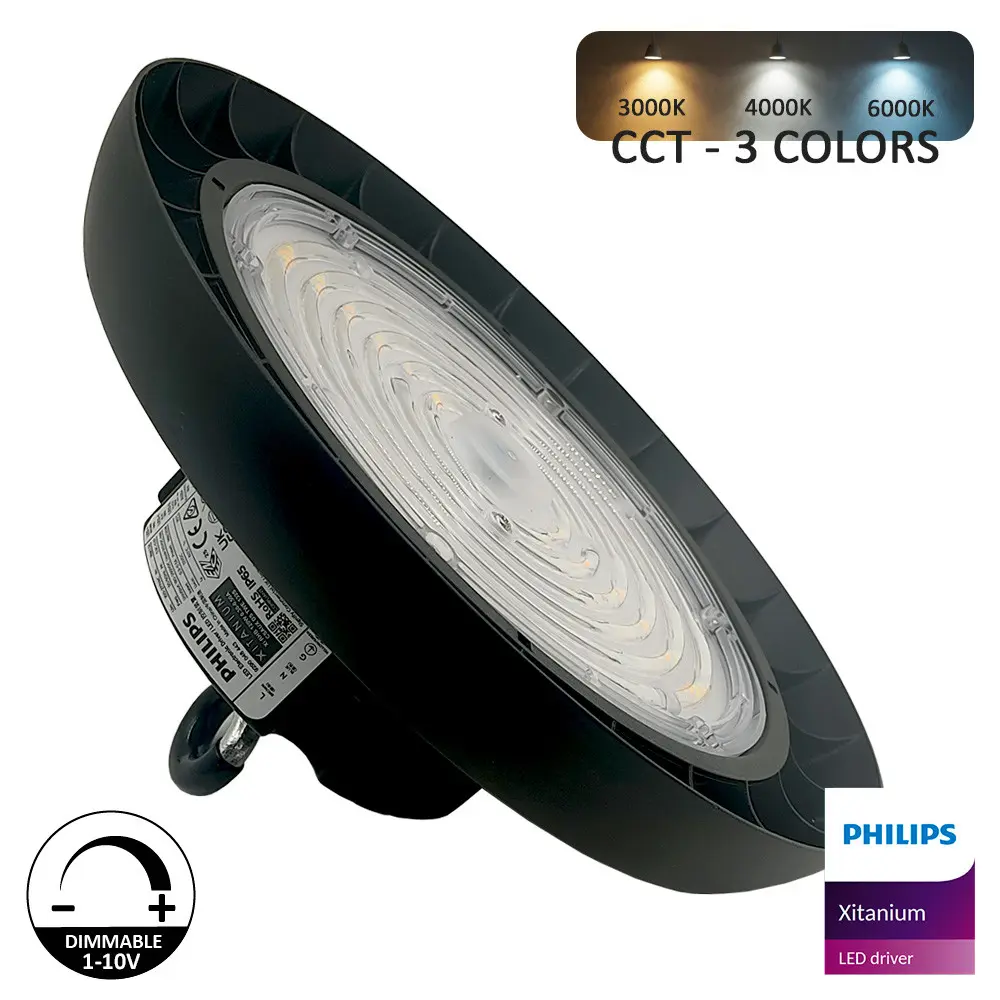
Industrial LED High Bay 120W-100W-80W | UFO GERMANY | 3CCT | Philips Xitanium Driver | Dimmable 1-10V
79,90 €
VAT included
Ref: HBGER100W-CCT-91435
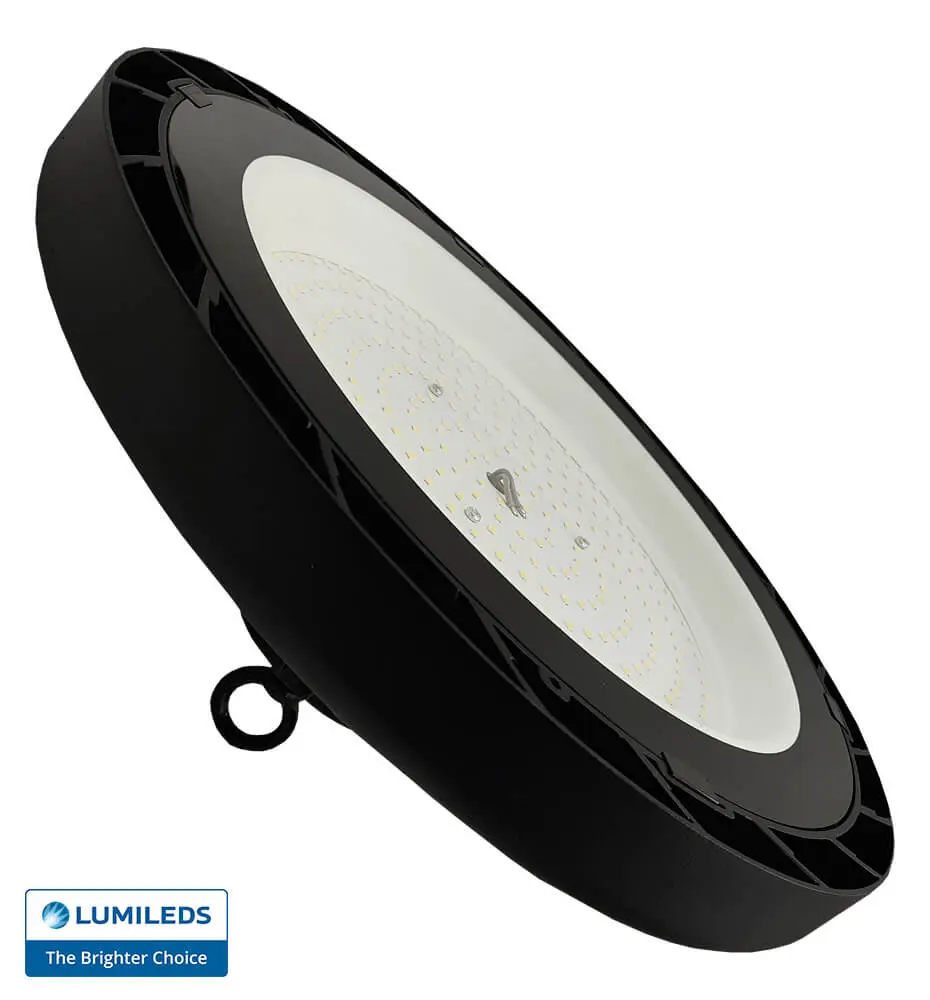
Industrial LED High Bay 80W-100W-150W-200W - UFO - OPORTO - CHIP LUMILEDS
83,43 €
VAT included
Ref: HB-MULTI
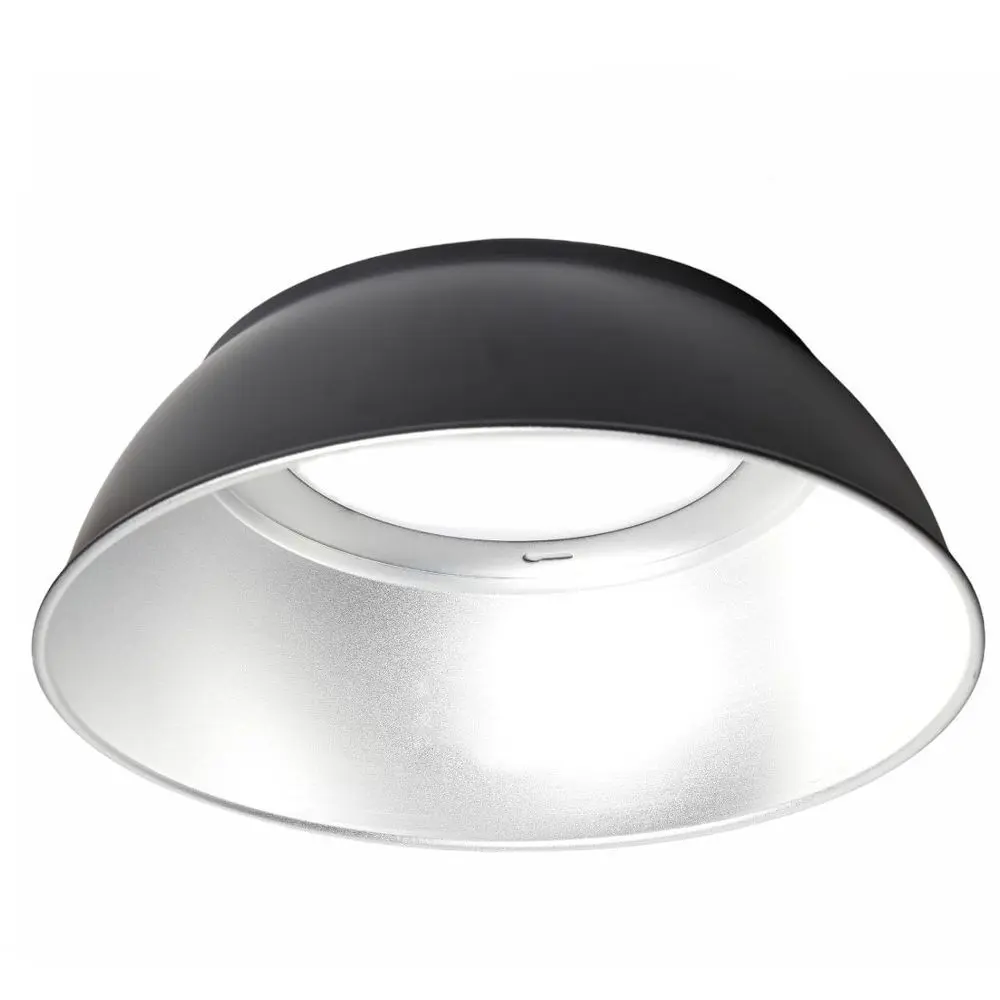
Reflector - 60º - High Bay LED 100W-150W UFO ENDURANCE Osram Chip
12,41 €
VAT included
Ref: CV-HB100W-150W-ENDUR
100W LED high bay: the output that handles a 4 to 6 metre ceiling without glare
A five-metre ceiling and a twelve-metre one do not ask for the same thing, and the difference is settled on the drawing before you look at a single product code. This wattage works in the first: when you need to light a vehicle workshop, a loading bay or an aisle between mid-height racking, extra watts stop being a virtue and start getting in the way, because the light source sits almost at eye level and the operator catches the glare every time they look up.
It is sized precisely for that range. It delivers more than enough flux to cover four to six metres with even distribution, and it does so with a surface luminance far less harsh than that of the larger formats. On the drawing the difference looks small. On the workshop floor it is not: fewer hard shadows between machines and fewer tired eyes at the end of the afternoon shift.
Installation changes scale too. At this height almost everything can be done from a ladder or a light access platform, so labour costs drop sharply and each fitting can be inspected or replaced without stopping production. For a business that cannot close a through-route for half a day, that matters as much as annual energy use.
None of this is decided by eye. We model your space in DIALux and send you back the simulated distribution with the number of fittings and their layout. Send the floor plan to info@factorled.com with the height to the soffit and the work carried out below, and the order is finalised on the basis of that proposal.
4 to 6 metre ceilings: the height at which the 100W industrial high bay is the one to order
Sizing comes down to two figures: the lux on the working plane and the uniformity between fittings. The watts follow as a consequence. With the efficacies of this range, from 160 to 200 lumens per watt, this output delivers between sixteen and twenty thousand lm per fitting. At four metres with a wide beam, that covers a large area without leaving dark bands between units.
With 150W or 200W on the same ceiling, the opposite happens. It is not that they light badly: they are designed to work from eight or ten metres, and at four they leave a very bright pool directly beneath the fitting that falls off quickly towards the sides. The eye spends the shift jumping between two different levels, and the cost shows up as visual fatigue long before it shows up on the electricity bill.
The usual workaround is to space the fittings further apart so as not to overshoot the lux. That fixes the excess but ruins uniformity precisely in the circulation areas, which is where the forklift runs and where a shadow does the most harm.
A larger, more powerful luminaire lights from further away, which is not the same as lighting better. From seven or eight metres upwards, the jump in wattage justifies itself. Below six, what you need is distribution, not force.
That is where the high performance of this power level on the drawing comes from. It delivers what the workstation requires and stops there, with a high efficiency that shows on the first quarter's bill and in the number of fittings you need to hang. A five-metre ceiling done with the right unit needs fewer fittings, fewer metres of trunking and fewer hours of work at height than the same ceiling done by pushing up the wattage and spreading the rows. Give us the mounting height before you settle quantities and we will confirm whether the power level you have in mind is the right one.
Workshops, loading bays and circulation areas: the indoor lighting that the 100W LED high bay handles
The vehicle workshop is the most demanding of the three. You have to read a number engraved on a part, tell the colour of a wire inside a terminal block apart and work under a lift that casts a shadow over itself. There, colour rendering matters as much as flux: with a low CRI, blues and greys blur together and the job is done by guesswork even when the lux meter says there is light to spare.
The loading bay has a different problem: contrast. The open door lets daylight in for half the day, and at night it leaves a black hole exactly where the forklift manoeuvres. The solution is to reinforce the dock line, not to raise the general level of the whole space: two well-placed rows over the dock levellers achieve more than twenty fittings spread by eye.
Circulation areas are the most neglected and the ones where most near-misses happen. Aisles between racking, corridors to changing rooms, the stretch linking two buildings. They do not need the same level as a workstation, but they do need continuity: an aisle with patchy light forces the eye to readjust every few metres and is more tiring than an aisle with half the lux evenly distributed.
And there are spaces that share this height without being a conventional industrial unit. Food production rooms, butchery rooms, garages with an inspection pit, a local sports hall with six metres to the soffit. Very different cases with one thing in common: people working underneath all day and a ceiling that leaves no room to hide the light source. Lighting for these spaces is decided with three figures in front of you, height to the soffit, floor area and the task carried out below, and from those three come the grid and the optic. Order the units for every room on a single delivery note: they go up in one run and you do not have to hire lifting equipment again.
Warehouses, industrial buildings and livestock farms: send us the floor plan and we will help you design the lumen distribution for a 100W industrial LED high bay
In a space with mid-height racking, the aisle takes priority over the average level of the room. The light that gets the job done is the light that climbs the vertical face of the rack to the top level, because that is where the label is that has to be read without bringing the pallet down. With ceilings of four to six metres, the row of fittings runs along the centre line of the aisle, never over the racking.
What gets decided on the drawing is how many rows fit and with which beam angle. With a wide aisle, the standard beam is enough; with tall racking and a narrow aisle, the beam has to be narrowed so that the light does not end up hitting the front face of the racking. That choice changes the number of fittings, so it is settled at the same time as the quantity, not afterwards.
A unit at this power level covers the span between portal frames without doubling up rows, and that is the argument to put to the building owner: fewer fittings, fewer joints, and the grid repeats exactly in the second bay. With two or three identical bays, that saving multiplies with every module.
Farm buildings are another area where this power level fits well. Milking parlours, finishing sheds and handling areas: low ceilings, high humidity, organic dust and pressure washing several times a week. Here the drawing uses fewer fittings and wider spacing than a picking area would require, because the required level is lower, but the sealing of the fitting moves up a class. In warehouses with constant airborne dust, periodic cleaning of the housing also stops being an optional extra in the maintenance contract: a heat sink clogged with dirt runs hotter, and heat eats into the flux before anything else does. Give us the aisle width and the rack height and we will send you back the number of units per aisle.
Fit every light point into the drawing before you order: aluminium housing, diameter and 120º beam angle
A light point is not a cross on a drawing: it takes up space, it has weight and it projects a cone. All three determine where it can be hung.
Start with the volume. The body has cooling fins, and that aluminium has a practical consequence on site: the weight per unit is modest, so the grid does not force you to look for reinforced points in the structure, and the fitting can be hung from a hook, a chain or threaded rod wherever the drawing requires. The width of the housing matters for the same reason. One that is too large at four metres enters the field of view of anyone walking underneath and acts as a screen over the overhead crane or the compressed air line; a compact body slips between ducts and cable trays without forcing you to redraw the grid.
Then there is the cone. The standard wide beam is the one that suits a four to six metre ceiling because it spreads and overlaps, so fittings are spaced at roughly the mounting height. Narrowing to 90º or 60º concentrates the flux and forces you to tighten the row, with more units to cover the same area. Beam angle and quantity are the same decision made twice, which is why they go together on the order sheet.
This wattage is available in both of our body styles: the round one, with a circular housing, and the linear one, which spreads the light along a line instead of opening it out in a ring. Either delivers the flux you have calculated, so the grid you have drawn works for both; which one suits you depends on the shape of the space, and that is settled on the format page, where you will also find the full datasheet for each version.
What a 100W industrial LED high bay declares and what goes into the calculation: driver and 50,000 hours
Only a few lines of the datasheet make it into the project, and it is worth knowing which ones.
The first is the power factor. The higher it is, the less reactive current the line carries, and that determines how many fittings fit on each circuit before a new one has to be opened; with forty fittings hanging off the same supply, it stops being a detail. The second is the driver, because it is the component responsible for most failures in any installation at height and the one that sets the cost of maintaining the lighting: a unit with a Philips driver Xitanium or Sosen has spares you can still source years later, whereas unbranded electronics turn a trivial fault into replacing the whole fitting.
The third is the replacement horizon. A declared lifespan in the region of fifty thousand operating hours, at twelve hours a day, comes to more than eleven years, and that figure is what lets you decide how many units to set aside as spares and when to review the whole installed base. The reliability of the installation is planned with that number, not with a hunch.
The rest belongs on the product datasheet and is checked once the product has been chosen: the LED chips with their declared brand, the SMD package, an OSRAM LED, Bridgelux or Lumileds emitter depending on the production line, and the certification of the assembly. These are verifiable high-quality data that let you compare two quotes for the same wattage, and on the datasheet they are named in full rather than summed up in an adjective. The range comes off our own production lines, so what you buy today can be supplied again tomorrow with the same colour temperature and the same distribution.
Assign colour temperature by zone: switchable CCT from 4000K to cool white 6000K in the same LED lamp
Colour temperature is measured in kelvin and describes the tone of the white, not the quantity of light. Hang two fittings with identical flux but different tones and the lux meter will read the same while the eye sees two rooms that look nothing alike. It is the most common confusion when someone asks for more light and what they actually want is a different tone.
The light colour is determined by the task carried out below, so it is assigned zone by zone on the same drawing on which you counted the fittings. Neutral white is the standard for a long working day because it does not tire the eye and renders material colours well. The cool end leans towards blue, increases the sense of sharpness and suits quality control, visual inspection and butchery rooms. In a changing room or a rest area, on the other hand, it feels harsh.
Because the three-position selector already comes on much of the catalogue, the tone is set when each fitting is hung, without ordering a different product. For a site with mixed zones, production, workshop office, circulation aisle, that means a single order line with the tone decided zone by zone. Two different tones side by side in the same room stand out from the doorway: they look like a patch-up, not a design. Note which setting you want in each zone when you send us the quantities, and the goods will leave already allocated by room.
Mark which lines are dimmable and which are manually switched, with IP65 and waterproof for outdoor applications
There are two ways to control the lighting, and both are marked on the drawing before the order, never afterwards. Analogue dimming works with two control wires in addition to the power supply, and that is how both a control by the workshop door and a signal from the main distribution board come in; the dimmable version works on 1-10V. Direct switching by circuit remains the sensible option for lines that run the whole shift. A fitting without dimmable electronics cannot be dimmed later, so the allocation of lines is settled now: which ones have control, which stay fixed and which zones step down when there is no activity.
Sealing is allocated in the same way, by zone. Sealing protects against dust and water jets, and there are parts of the building where it is mandatory and others where it makes no difference: a loading canopy, a forecourt canopy, a vehicle wash bay or a room that is hosed down all need a sealed body; a workshop office does not. Mark on the drawing which environments require that rating and which do not, because that determines the product code for each row.
Under an open canopy the same criterion applies, with one maintenance precaution: avoid aiming a pressure washer directly at the diffuser seal, which is where water gets in when it does get in. Tell us how each area of the building is used and we will finalise your order with the lines already defined. One delivery note and one trip up the ladder.
Three things worth checking first: the product details, the UFO high bay type and installation in commercial premises
How many fittings do I need in a workshop with a five-metre ceiling?
It depends on three figures and nothing else: floor area, height to the soffit and the lux required on the working plane. From those three comes the grid, the beam angle is decided and the number of fittings follows. Send us the floor plan with the dimensions and the intended use and we will send you back a proposal with quantity, layout and spacing between rows. If there are aisles between racking, tell us the rack height as well: it changes the optic and sometimes the number of fittings.
What suits a shop or service premises at this height?
The same power level, with the distribution adjusted to a different task. In a shop, a service workshop or a customer-facing area, the required level is lower than in production, so the grid opens up and the tone moves to neutral. What changes compared with an industrial unit is the glare criterion: with customers moving around, the light source should not be visible from the checkout line or from the counter.
What energy efficiency can I promise compared with old discharge lighting?
This range sits between 160 and 200 lm/W, and that value only means something when multiplied by the hours the fitting is on over the year. That multiplication is what decides the payback; the rated consumption on the label, on its own, tells you nothing. On top of that comes something that does not appear on any spreadsheet: the fitting switches on instantly and tolerates constant on-off switching, which discharge lamps do not forgive. High efficiency is made with those two columns, watts installed and hours of use.
Does installation change if the roof is sandwich panel?
The fixing system changes, and sometimes the suspension accessory, which is why it is worth mentioning when you request a quote. At four or five metres, a stepladder or a light access platform, an anchor into the soffit and the connection to the line are all you need; on a sandwich panel roof, the fixing goes into the supporting purlin and never into the sheet, which sometimes means moving a row a few centimetres from the drawing. It is worth checking before you settle the number of fittings.
How do I buy online at trade prices, and what can I guarantee to my client?
By activating a trade account. You fill in the registration form and send your company or sole trader documents to comercial@factorled.com. From then on, the product list is printed with your own branding, parcels ship without a visible sender, there is dropshipping with the catalogue synchronised daily, and a credit line with deferred payment, subject to approval. On cover, we start at three years' warranty and go up to six depending on the product, and the spare part is identical to the one already installed because the series is not discontinued from one season to the next.
For surplus stock, returns remain open under our published conditions and are processed via RMA in your customer area: original box free of stickers and tape, with its packaging, documentation and accessories complete, and return shipping at your expense. Any visible damage must be noted on the delivery document before you sign, and any damage that only appears on unpacking must be reported as soon as it is spotted. Shipping costs are calculated by the basket based on weight, dimensions and delivery point, and appear before you confirm payment; the Canary Islands, Ceuta and Melilla require DUA customs processing and a phone call before dispatch.
A workshop that adds fittings as it reorganises its space does better by fixing the product from the first order: same distribution, same tone and same fixing on the next purchase, without comparing datasheets every time. If you already have the dimensions of your premises, send them to info@factorled.com and we will send you back the number of units and their layout; if you would rather talk them through, call 91 805 67 67 or the mobile 654 777 000. Once that count is settled, the 100W LED high bay you hang will be exactly the one the drawing called for, not the one the catalogue happened to offer.
Más en LED High Bay