

Dimmable LED High Bay
4 products
Industrial LED High Bay 150W UFO FRANCE 3CCT 200Lm/W | Smart Motion Sensor | Sosen Dimmable 1-10V | OP 60º - 90º
106,48 €
VAT included
Ref: SENS150W-91292
Industrial LED High Bay 200W UFO FRANCE 3CCT 200Lm/W | Smart Motion Sensor | Sosen Dimmable 1-10V | OP 60º - 90º
129,47 €
VAT included
Ref: SENS200W-91293
High Bay LED 150W -170Lm/W- UFO NEW ITALY PHILIPS XITANIUM - 1-10V DIM
89,90 €
VAT included
Ref: NEW-HBPHL150W
200W High Bay LED UFO DIAMOND Philips Xitanium - Dimmable 1-10V - 170lm/w - IP65
97,02 €
VAT included
Ref: HBPHL200W
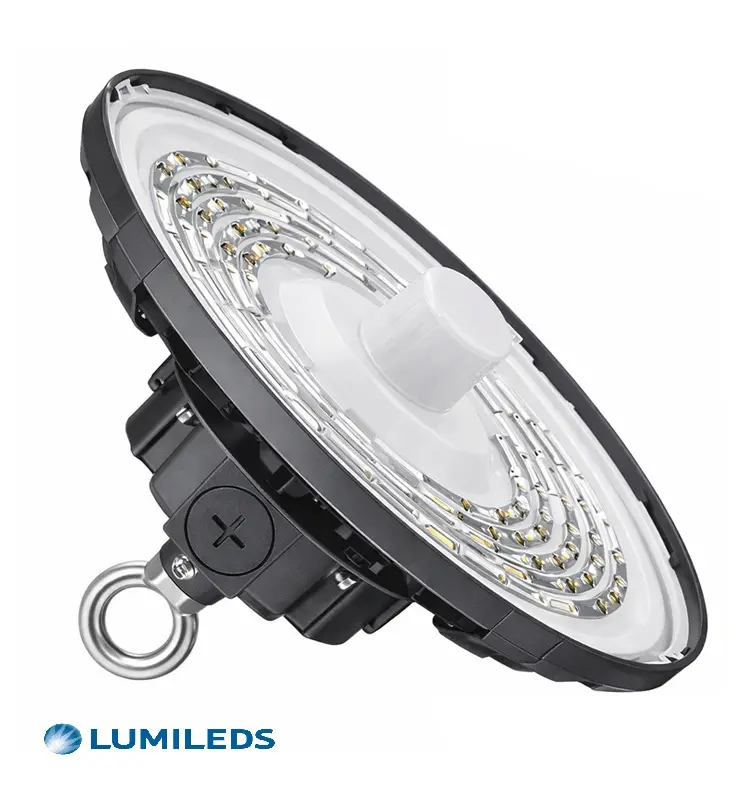
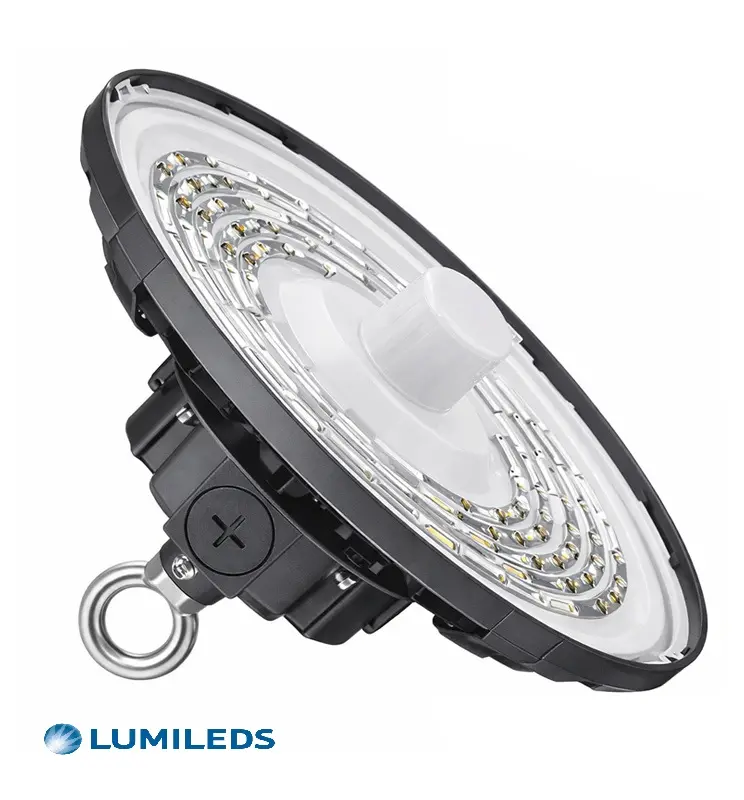
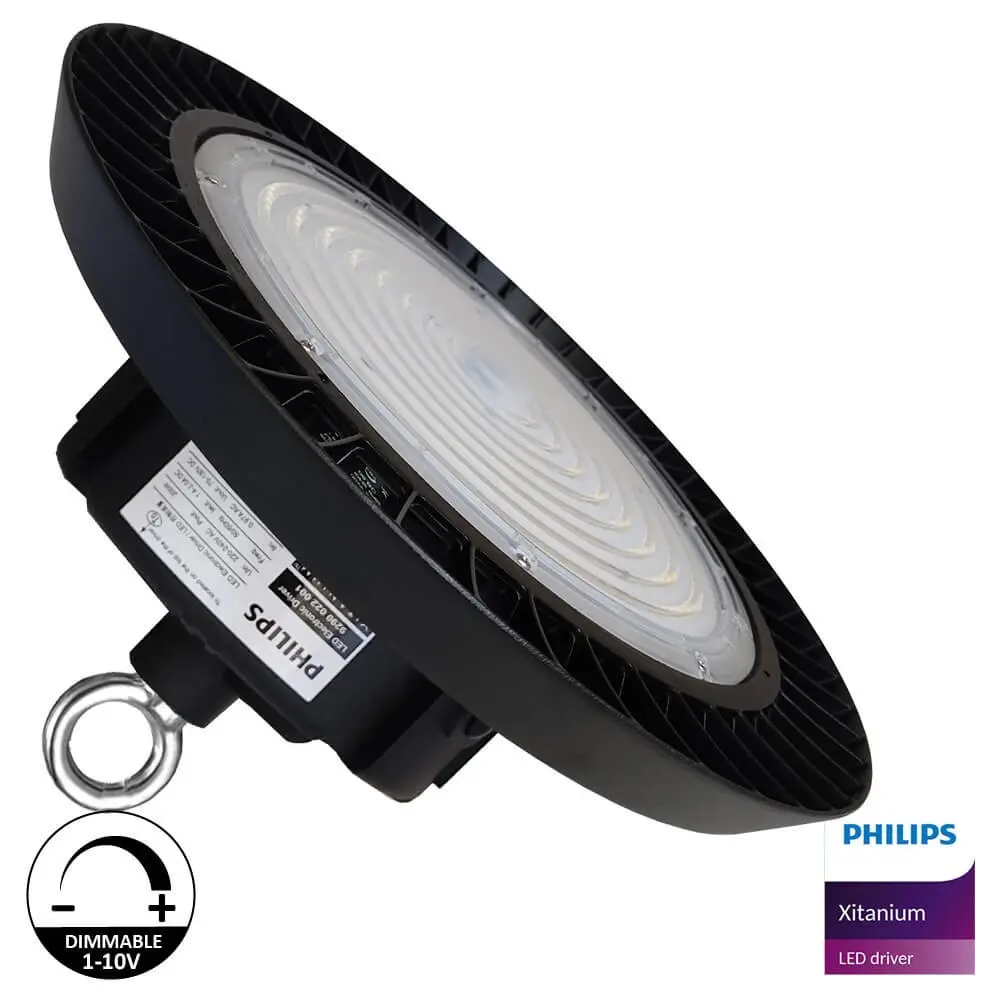
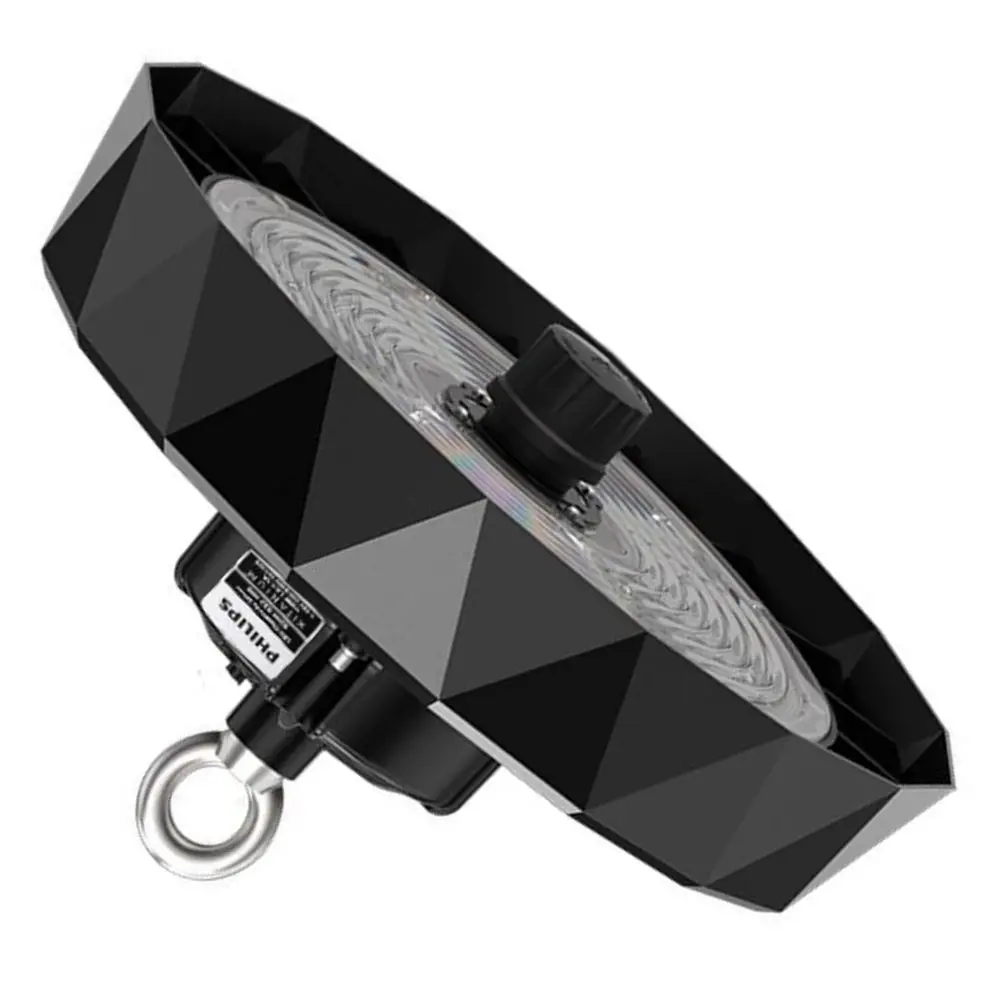
Dimmable LED high bay: every zone of the industrial building at the output it needs, and not a watt more
A dimmable LED high bay exists for a very specific reason that shows up on the energy bill: an industrial LED high bay that can only switch on and off charges you for the whole shift at full power. It makes no difference that the racking aisle is empty at three in the morning or that the loading bay shutter is down: the installation draws the same. What drives the annual running cost of an industrial building is not just the wattage printed on the box, but the hours each luminaire spends working at full load.
The metal halide installation you are about to replace allowed almost none of this: it took minutes to strike and ran at a single level, so control came down to the switch. With LED technology, the light output level becomes just another commissioning parameter, like the mounting height or the optic. And, like any parameter, it is decided before you buy.
We manufacture the LED high bay, so we know what goes inside every product and how far it can go: OSRAM, Bridgelux or Lumileds chips and Philips Xitanium or Sosen drivers, with an aluminium heat sink built into the housing, IP65 sealing and efficacies of between 160 and 200 lm/W. LED high bay control runs on a 1-10V signal, which is what its electronics understand, and the Zhaga radar sensor, the remote control and the Zigbee controller are all built on that basis.
What needs to be settled before anyone goes up to hang anything is whether that circuit will be dimmable, because the driver output cannot be changed afterwards. If you want to see it working in your own aisle before committing to the full order, order a sample unit with the sensor fitted. And if you are buying in volume, open a trade account: it unlocks wholesale pricing with volume discounts.
How low an industrial UFO LED high bay really dims: the driver sets it, and you choose it when you buy
The driver converts the mains supply into constant current for the LED chip and, along the way, determines whether that current can be reduced. With a control input, the unit reads an external signal and adjusts its output; without one, it always delivers the same, whatever is happening below. We fit Philips Xitanium or Sosen drivers because their curve is known and their behaviour at high temperature is documented, which is exactly what gets tested when a luminaire spends ten hours dimmed and another four at full output.
Dimming is not a software trick. It reduces the current reaching the emitter, the junction runs cooler and the service life of the whole unit is extended rather than shortened. That is why an installation running at staggered levels reaches the end of its cycle with more light output than an identical one kept at full power all the time.
There are three things worth keeping apart. Light output can indeed be controlled during operation, continuously, from the minimum the driver allows up to the high bay's maximum. Colour temperature cannot: it is set with the switch before the unit is hung, and there it stays. Nor does the beam angle change by itself: it is changed with the reflector.
What differs from one product to another is the dimming floor. Some units dim down to a very small percentage of rated output, while others stop much earlier; below that point the current is no longer stable and flicker appears. In a plant with machine vision or CCTV recording, that is not a cosmetic detail: flicker the eye barely notices shows up on video as a rolling band.
Luminous flux stability over the years depends on that pairing, emitter and driver, more than on the stated wattage. A high-performance LED high bay maintains the lumens it promises thousands of hours later; one that lives at its thermal limit loses them without telling anyone. On every product page we state which emitter and which driver the product uses, so ask us for the datasheets of the products you are considering and decide with both documents in front of you before finalising quantities.
1-10V, 0-10V and DALI control: choose the protocol now and move from standalone luminaires to zone-controlled LED lighting
With a 1-10V dimmable LED high bay, the control signal runs on a pair of wires separate from the power supply. You apply a voltage of between one and ten volts and the unit responds with the corresponding level. It is analogue, cheap to wire, and it carries a practical consequence worth being clear about before drawing up the wiring diagram: everything on the same pair runs at the same level. If you want the central aisle at one percentage and the loading bay at another, you need two pairs, not two commands.
This is where zoning comes in, the principle that organises any industrial LED lighting. A site is divided by use and by operating hours, never by the symmetry of the ceiling: loading bay, racking aisles, picking area, packing line, mezzanine offices. Each block has its own required lighting level and its own activity pattern, and separating them is what allows eighty per cent of the ceiling to be at rest at eleven at night, with only the areas where people are working running at full output.
DALI plays in a different league. It is a digital bus: each light point has its own address, is addressed individually and reports back its status, so grouping is changed from the software without touching the cabling again, and you know which unit has failed without scanning the ceiling. In return, it needs a gateway, addressing and someone who knows how to commission the bus. With in-house maintenance and a large number of points it pays off; in a building with three aisles, hardly ever.
That leaves 0-10V, the source of half the confusion on site. The Merrytek Zhaga radar motion sensor works on 0-10V, while the LED high bays have a 1-10V input: they are two different interfaces, even if they look similar on paper. Zero opens the door to switching off via the signal; one sets the minimum level the luminaire dims down to. When someone wires it up blind and then says the sensor does not switch off, the cause is usually right there. Tell us how many zones you want to control separately and we will come back with the control pairs you need and the dimmable high bays that go on each one, so your electrician only has to pull the cable once.
Zhaga radar motion sensor: lights only the aisle in use in warehouses and large retail spaces
The Zhaga socket on the top cover is there for exactly this: the sensor clips on top, facing the floor, without opening the sealed housing or compromising the seal. Because it is a standard, the part fits any LED high bay designed for it and can be replaced the day it fails without touching anything else.
What separates an installation that works from one that ends up with the sensor disconnected by the second month comes down to four settings, and all four are set during commissioning.
Mounting height takes precedence over the rest. The radar covers a cone, so at seven metres it sweeps a much smaller circle than at twelve, and the overlap between units changes completely with that difference. Sensitivity defines the actual detection diameter: turning it down is the first thing to do when the aisle faces a walkway you do not want to trigger. The hold time determines how many minutes the high level is maintained after the last detection, and setting it too short is the classic mistake, because the light drops just as the operative crouches down to read a label and stops moving. The standby level does the fine-tuning: instead of switching off completely, it leaves the zone at a low percentage, nobody walks in the dark and the return to full output is instant.
In factories and warehouses with uneven traffic, that combination is what cuts the most consumption from the night shift. An aisle that is walked twice an hour has no reason to be at full output for the other fifty-eight minutes.
Where the sensor adds little is where traffic never stops. A line that runs without interruption will keep it triggered all the time, and the result will be the same as not fitting one, with one more component that can fail. There, the decision is made by schedule and by level, and the LED high bay keeps conventional zone control. Sensors, remote controls and the controller can be ordered together with the high bays or later on, and they ship with the same lead time as the rest of the goods, so extending control in a zone next year does not mean scheduling another shutdown.
Zigbee controller and remote control: lock in scenes by shift and by floor in high-ceiling industrial environments
Going up twelve metres on an access platform to turn a potentiometer costs more than the adjustment itself. With the remote control you point from the floor, set the working level, the hold time and the sensitivity, confirm, and move on to the next LED high bay. In a high-ceiling industrial building, that is the difference between having the installation fine-tuned in a morning or leaving it as it came from the factory.
The Zigbee controller changes the scale of things. Instead of going unit by unit, you create groups and save scenes: morning shift with the whole ceiling at working level, night shift with the aisles at rest and the loading bay active, a cleaning scene at a low percentage, a stocktake scene at full output only in the relevant block. The network works as a mesh and each node relays the signal to the next, so it reaches corners where there is no direct line of sight from anywhere convenient.
Two precautions before committing to a scene layout. The nodes need a permanent power supply to sustain the mesh, so if a zone switch cuts the power at the end of the shift, that block drops off the network until someone brings it back. And scenes must be documented, even if it feels like paperwork: a configuration that only lives in the head of the person who set it up is lost at the first maintenance handover, and then everything goes back to full power permanently because nobody dares to touch anything.
Splitting by floor has its own logic. In a building with production downstairs and dispatch upstairs, operating hours hardly ever coincide, and putting both in the same group forces the more demanding one to set the level for both. Separating them costs one more scene and gives back every hour in which one of them is empty. If the building is being fitted out in phases, start with the floor that accumulates the most idle hours: the series is still coming off our production line, so the second phase is fitted with the same product and the ceiling does not end up with two different finishes. Order the controller with the high bays: it arrives with them and commissioning is done in a single session, without setting up the platform again.
Selectable wattage and switchable 4000K: the industrial UFO LED high bay is adjusted on the ground and saves you returning goods
The wattage selector works at a different stage of the process: not during operation, but at installation. Many of the high bays in our catalogue come in a multi-wattage version, with settings such as 200W-150W-100W, and the unit arrives preset to 200W. You move the selector before hanging it, and that same product delivers the setting the zone requires.
It solves a very specific on-site problem. The lighting calculation is done on the drawings and reality rarely matches it exactly: racking taller than planned, flooring darker than in the design, a picking area that needed more lux than anyone had assumed. With fixed wattage, correcting it means returning goods and waiting. With a selector, it takes five minutes per light point and installation carries on.
The colour temperature switch sits in the same housing and does the same for colour, with three positions. The middle one suits almost everything: 4000K neutral white light does not tire the eyes over long shifts, nor does it give that bluish cast that bothers many people at their workstation. Where there is quality control or colour sorting, the figure to look at is not colour temperature but colour rendering: below CRI 80, two similar products get confused and inspection goes wrong.
Combining both with dimming is what really brings order to a large site. At installation you set the output each zone needs while the LED high bay is still on the ground, you lock in the colour temperature, and from then on the daily level is handled by the sensor and the scenes. High output and efficiency are no longer competing goals once the unit is not forced to run at its maximum all the time. Order the multi-wattage version when the project has zones with different requirements: a single dimmable LED high bay product on the order, a single code on your shelf, and the correction made on site without returning goods.
Deep-body or slim industrial UFO LED high bay: the dimmable LED high bay format that handles continuous dimming
Continuous dimming does not punish a UFO LED high bay; it relieves it: less current, less heat in the heat sink, less thermal stress on the solder joints. The format, however, does change how the unit responds at the upper end of the range, which is what really puts the aluminium to the test.
The deep-fin housing, the one used for example on a 150W LED high bay in the range, has more heat-dissipation surface per watt than a compact format, and that shows when the stocktake scene keeps it at full output for three hours straight. The slim UFO format goes the other way: lower profile, less weight, it fits where the overhead crane clearance leaves no margin and it hangs with less hardware, at the cost of having less thermal mass. For mostly dimmed use with short peaks it is a sensible choice; for a building that runs at full output eight hours a day, the deep body ages better.
Wattage setting comes in through the same door. A higher-wattage UFO LED concentrates more heat over the same surface, so the higher up the range you work, the more the heat sink weighs in the decision. When efficacy ranges between 160 and 200 lm/W, the answer is often not to move up a setting but to narrow the beam angle: the same output, better placed. In the listing these settings appear as LED UFO 150W and LED UFO 200W, and choosing between them depends on the mounting height, not on dimming: what is decided here is the housing behind them and whether the circuit will be dimmable.
A maintenance note that applies to all three formats. Dust building up on the fins is what turns a correctly sized LED high bay into a hot one, and in dusty environments an annual clean of the heat sink preserves more luminous flux than any driver adjustment. If you are unsure between the deep body and the slim, send us the clear height under the structure and the hours the zone will run at full output: with those two figures we will settle the choice in a single email to uk@factorled.com.
120º optics, linear high bay and IP65 rating: the luminaire to specify for each industrial building when control is by zone
In industrial lighting, the beam angle is chosen by height, not by habit. At four or five metres, a wide beam spreads light without leaving patches and avoids the spotlight effect over people's heads; at ten or twelve, that same beam sends half the output against the sides of the racking and the lumens you paid for never reach the floor. The 60º reflector concentrates the beam along the axis of the aisle and carries it down to the first pallet level, which is where labels are read.
When someone asks for adjustable optics for a 200W LED high bay, what they are really after is the reflector. An adjustable beam angle is achieved with an accessory, by fitting or removing the cone, not through electronics. It is a two-minute change, done with the unit already hung, and it allows an entire aisle to be reconfigured when the warehouse layout changes, without touching a metre of cabling.
The linear format responds to a different geometry. In long, narrow aisles between high racking, an elongated fitting spreads light along the axis and leaves fewer dark areas between points than a concentrated light source, which translates into fewer units to reach the same lux on the working plane.
Ingress protection is the other filter. An IP65 LED high bay withstands dust and water jets, which is exactly what you find in an open loading bay, a wash-down area or a food processing plant cleaned with a hose. In a dry, air-conditioned interior, IP65 is not strictly essential, although maintenance benefits just the same: dust that does not get into the optic does not have to be cleaned out from inside. Reflectors can be ordered separately, so you can narrow the beam in an aisle later on without touching the rest of the installation. Tell us whether the zone is an open loading bay, a wash-down room or a dry, air-conditioned interior, and we will confirm the sealing rating and optic for each point before you place the order.
In brief: OSRAM industrial LED high bays, UFO with Lumileds chips and heavy-duty LED lamps
Does the chip make any difference when the installation runs dimmed?
Less than you might think. What determines behaviour at low levels is the control electronics, not the emitter: the dimming floor, the linearity of the curve and the absence of flicker all come from there. The chip decides other things, such as efficacy in lm/W, lumen maintenance over the hours or CRI, which is why we work with OSRAM, Bridgelux and Lumileds, who publish their curves and perform as their datasheets say. Each product page shows the SMD designation of the emitter, for example OSRAM SMD 3030 chip, along with the driver it uses.
Can I add the radar sensor to high bays that are already installed?
If the housing has a Zhaga socket, yes: it clips on top in a few minutes, without opening the housing or rewiring the circuit. Check the actual mounting height first, because the coverage diameter and the overlap you need between units depend on it. Where the installed unit does not have that socket, the sensible route is zone control from the distribution board, with the scenes already defined.
How much does consumption fall if I work with scenes and detection?
It depends on how many hours you currently run at full power without needing to, and you have that figure, not us. The mechanics are simple: when the level drops, the unit draws less current and the power consumed falls almost proportionally, so every hour an aisle spends at rest instead of at full output is saved almost entirely. A night shift with half the ceiling at standby level and detection in the aisles is usually the biggest saving available in an LED installation, optimising energy consumption without moving a single light point.
What warranty does it have and how soon can I have it on site?
Cover extends up to 6 years depending on the product and starts at 3 years; you will find the exact figure on each product page. For delivery, count on fast shipping: the estimate to your address is shown when you confirm the order, and only the Canary Islands, Ceuta and Melilla require prior contact and DUA customs processing. Shipping is calculated by weight, volume and zone, and you can see it in the basket before paying, which with goods like these is no small detail. When the order ships you receive an email with tracking; check the package on delivery, note it on the delivery note if it arrives damaged, and let us know as soon as you open the box if the damage is inside.
How do I buy at trade prices?
Fill in the registration form and send uk@factorled.com your company documents or your self-employed registration. That account unlocks tiered volume pricing, the option to edit the product listing with your own branding, blind shipping with no visible sender on the package and integration of the range into your online shop, with stock updated daily. A credit line with deferred payment is also available, subject to review of each application. And if you need to return something, that option exists under the terms of our returns policy: the RMA is requested from the customer area, the original box must come back intact with no stickers or tape on it, and nothing is shipped back until the request has been approved. Return shipping is at your expense.
Send us the floor plan with the area, the height and the use of each section and we will come back with the layout of light points, the wattage setting for each dimmable LED high bay and the control scheme that goes with it. You can reach us on 654 777 000 and 91 805 67 67, and also by chat on our website.
Más en LED High Bay