

Warehouse Lighting
15 products
New
Industrial LED High Bay 200W-150W-100W UFO ENDURANCE OSRAM CHIP DURIS E 2835
79,90 €
VAT included
Ref: ENDUR-HB200W
New
Industrial LED High Bay 150W-100W-80W UFO ENDURANCE OSRAM CHIP DURIS E 2835
69,80 €
VAT included
Ref: ENDUR-HB150W
New
Merrytek Remote Control for Zhaga Radar Sensor for UFO LED High Bay Lights | Ref. FL-MC079D99Z
48,87 €
VAT included
Ref: FLMH17
Motion Detector - Regulator for UFO Pendant Light with ZHAGA SWITCH
26,22 €
VAT included
Ref: 960004
Industrial LED High Bay 150W UFO FRANCE 3CCT 200Lm/W | Smart Motion Sensor | Sosen Dimmable 1-10V | OP 60º - 90º
106,48 €
VAT included
Ref: SENS150W-91292
Industrial LED High Bay 200W UFO FRANCE 3CCT 200Lm/W | Smart Motion Sensor | Sosen Dimmable 1-10V | OP 60º - 90º
129,47 €
VAT included
Ref: SENS200W-91293
Industrial LED High Bay 150W | UFO FRANCE 3CCT | SMD2835 Lumileds 200Lm/W | Zhaga Plug And Play | Sosen Dimmable 1-10V | 60º-90º
95,90 €
VAT included
Ref: HB150W-CCT-91292
Industrial LED High Bay 200W | UFO FRANCE 3CCT | SMD2835 Lumileds 200Lm/W | Zhaga Plug And Play | Sosen Dimmable 1-10V | 60º-90º
119,90 €
VAT included
Ref: HB200W-CCT-91293
Industrial LED High Bay 200W-160W-120W | UFO GERMANY | 3CCT | Philips Xitanium Driver | Dimmable 1-10V
95,90 €
VAT included
Ref: HBGER200W-CCT-91436
Industrial LED High Bay 120W-100W-80W | UFO GERMANY | 3CCT | Philips Xitanium Driver | Dimmable 1-10V
79,90 €
VAT included
Ref: HBGER100W-CCT-91435
Industrial LED High Bay 200W UFO - NEW TITAN CCT - CHIP LUMILEDS SMD 2835
59,42 €
VAT included
Ref: HB200W-CCT-91336
Industrial LED High Bay 150W UFO - NEW TITAN CCT - CHIP LUMILEDS SMD 2835
46,49 €
VAT included
Ref: HB150W-CCT-91335
200W High Bay LED UFO DIAMOND Philips Xitanium - Dimmable 1-10V - 170lm/w - IP65
97,02 €
VAT included
Ref: HBPHL200W
Reflector - 60º - High Bay LED 200W UFO ENDURANCE Osram Chip
16,71 €
VAT included
Ref: CV-HB200W-ENDUR
Reflector - 60º - High Bay LED 100W-150W UFO ENDURANCE Osram Chip
12,41 €
VAT included
Ref: CV-HB100W-150W-ENDUR
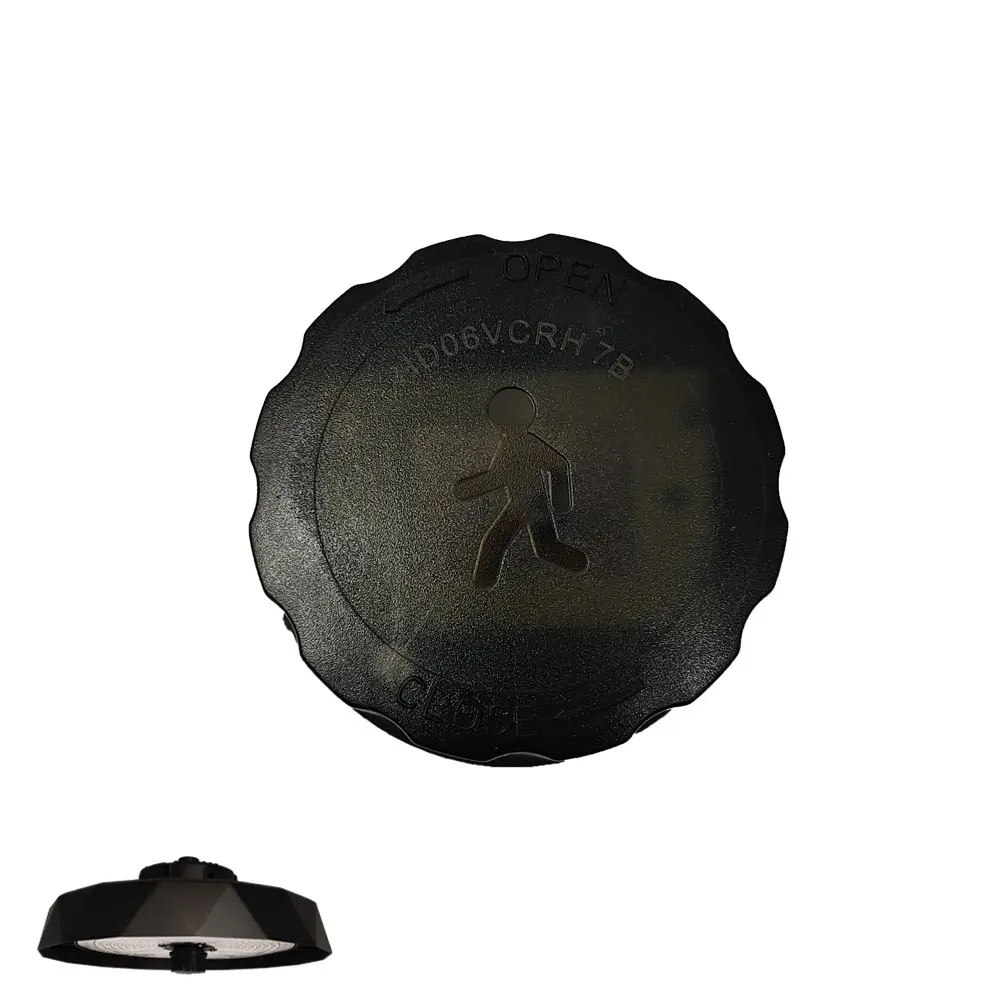
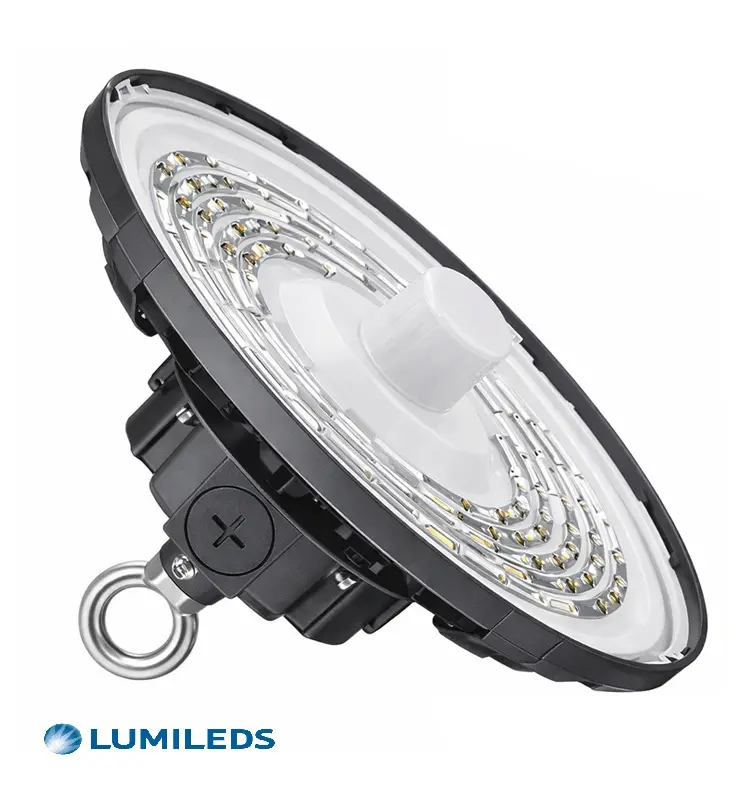
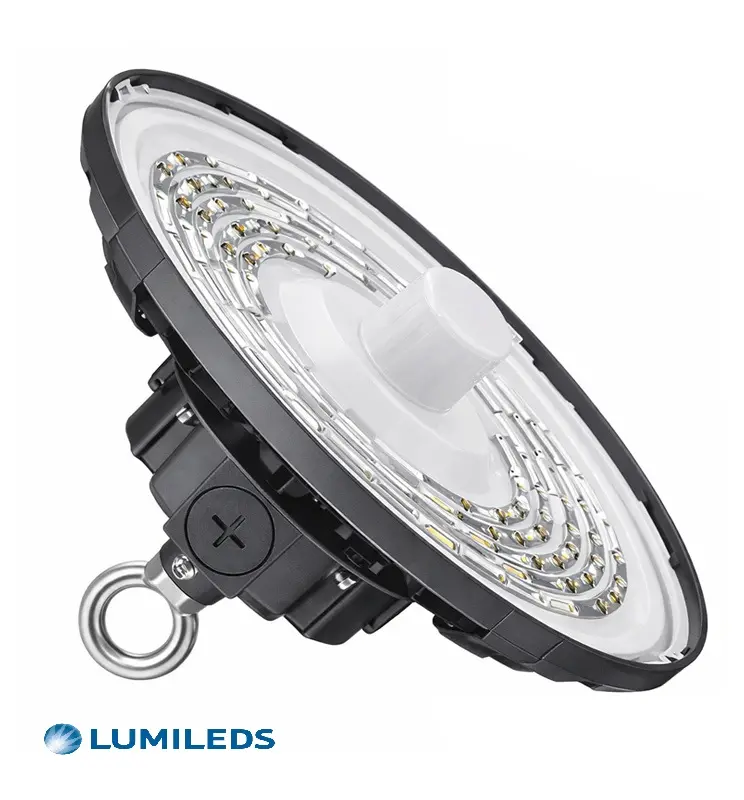
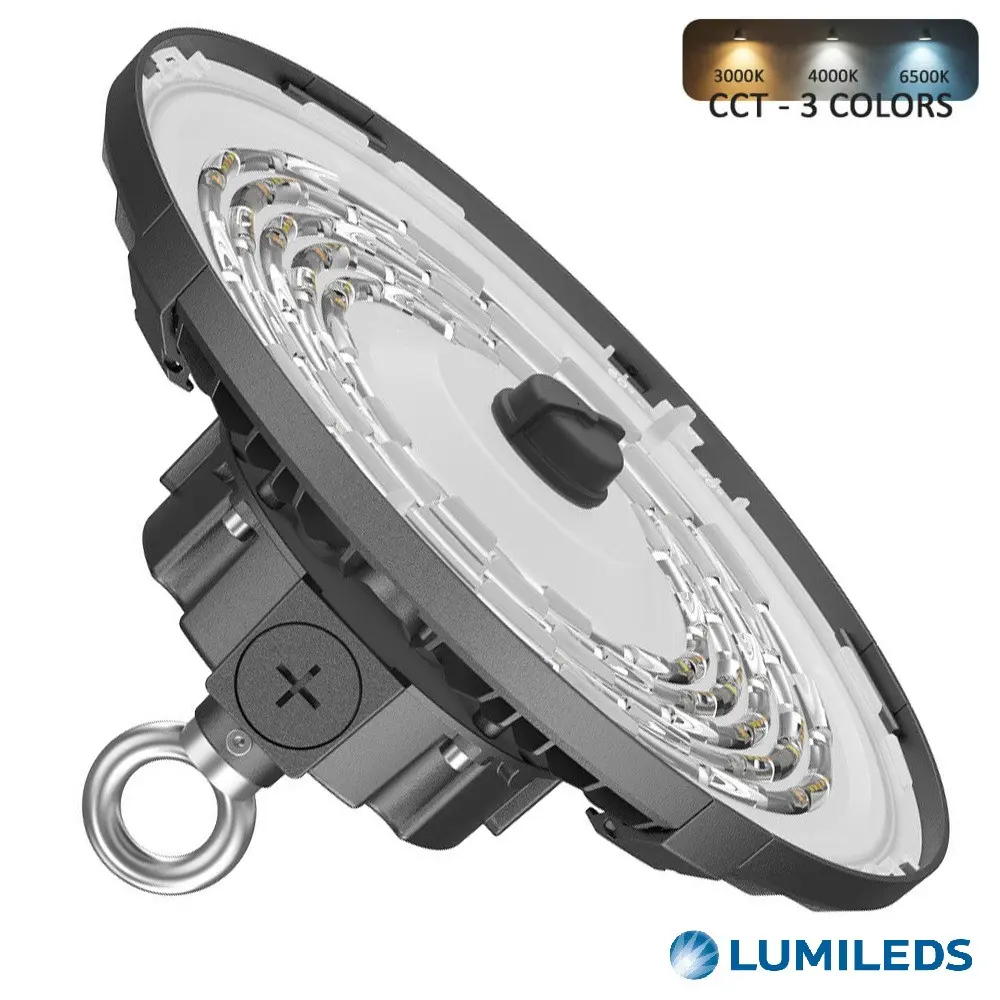
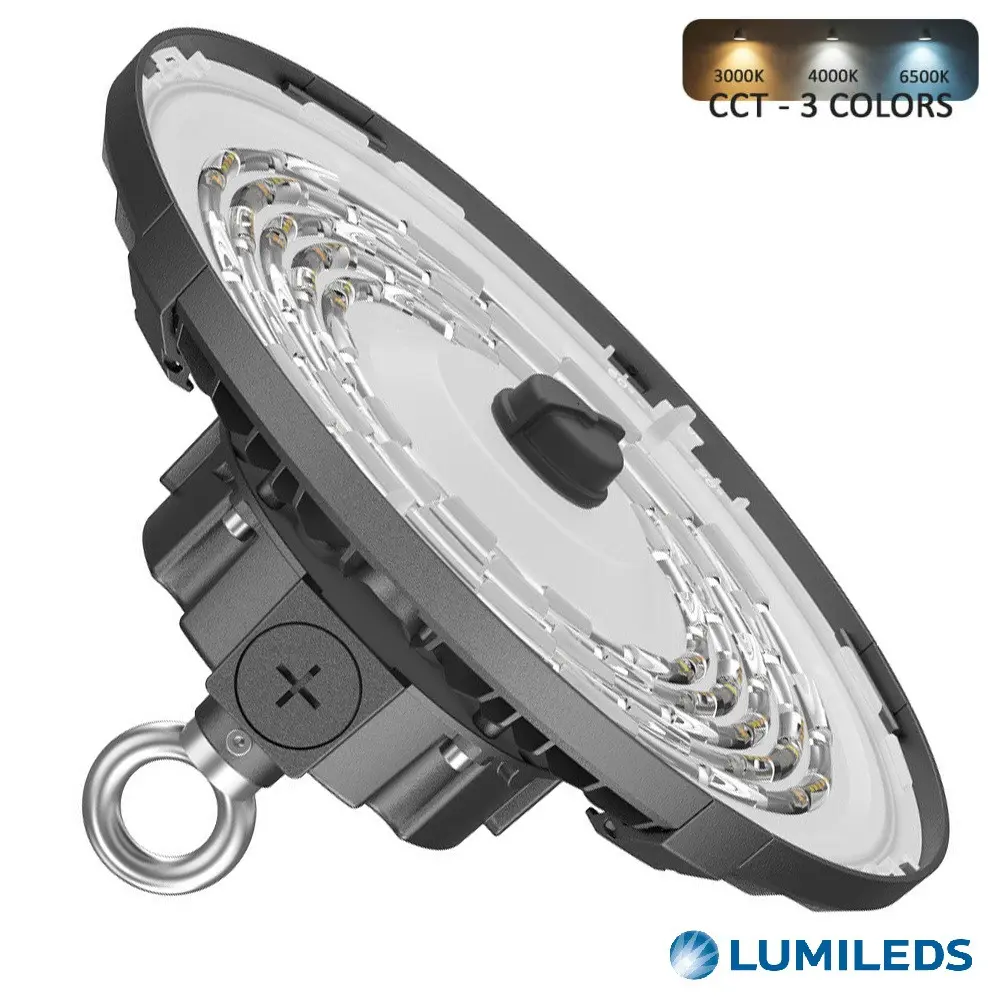
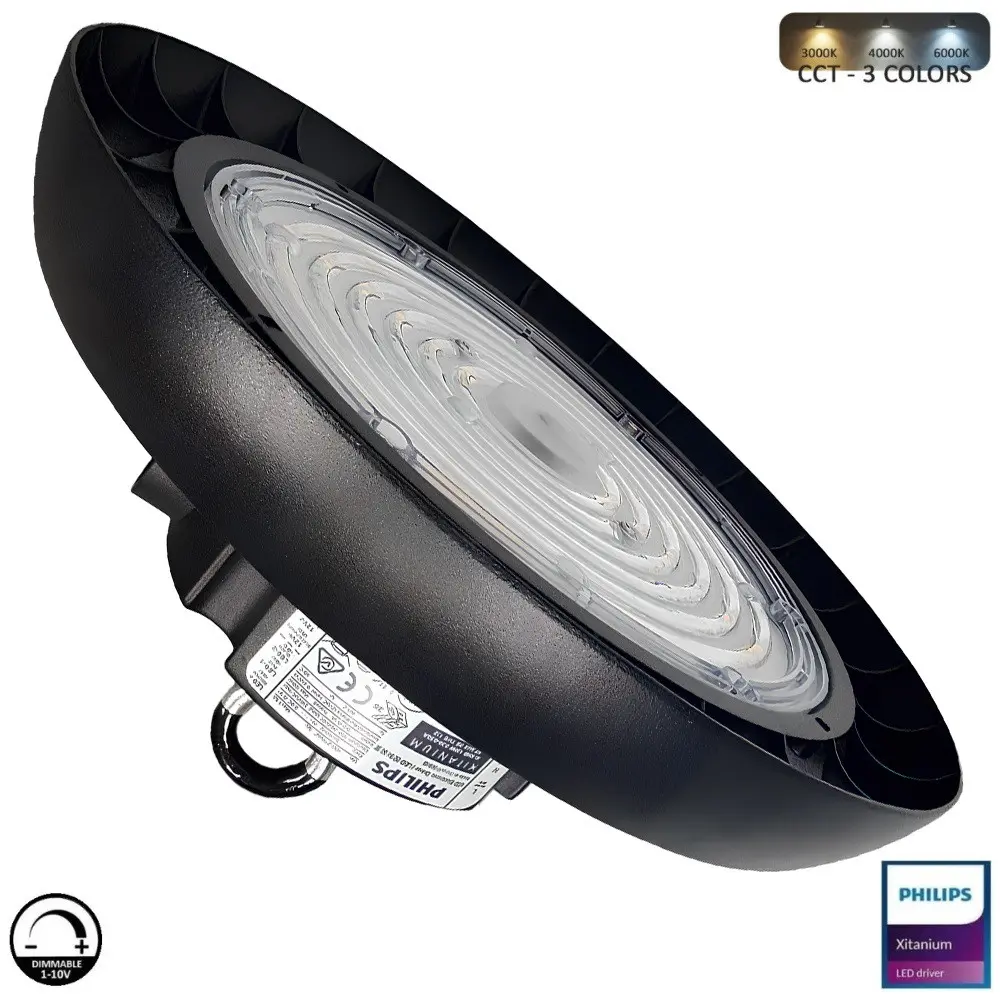
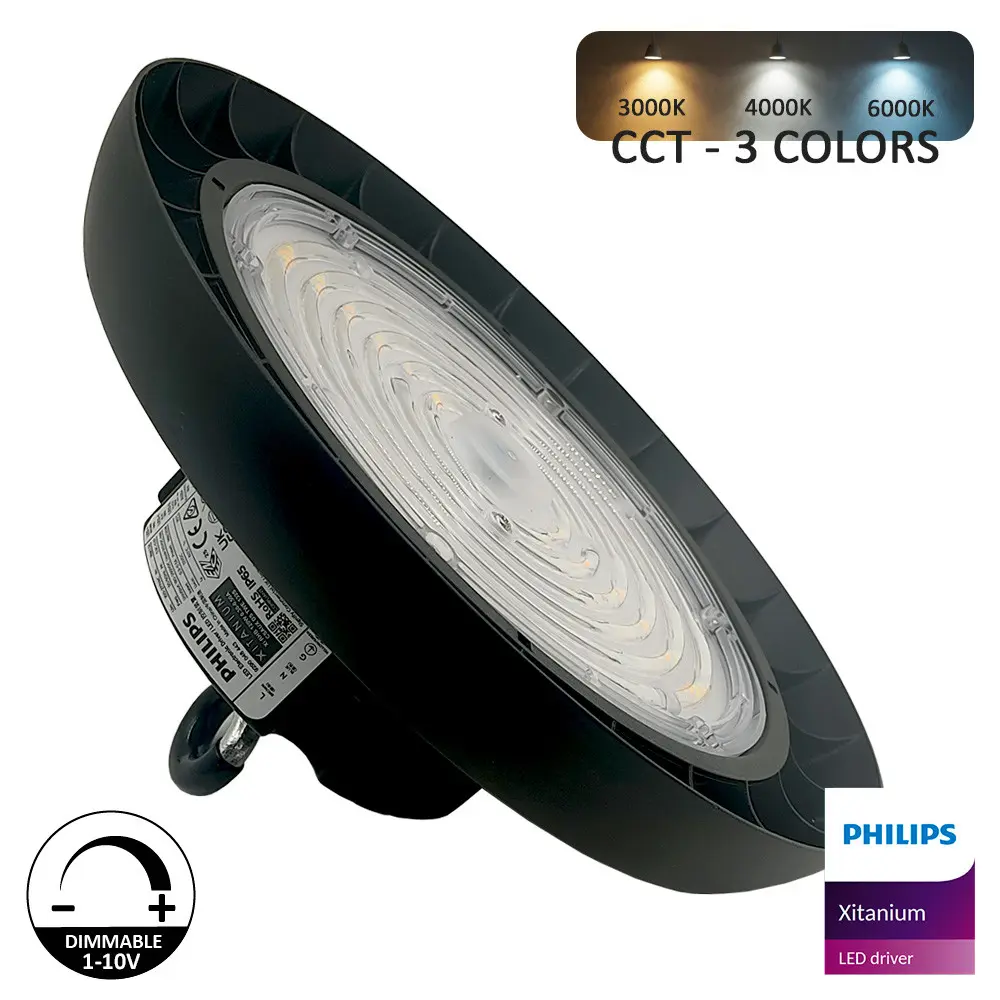
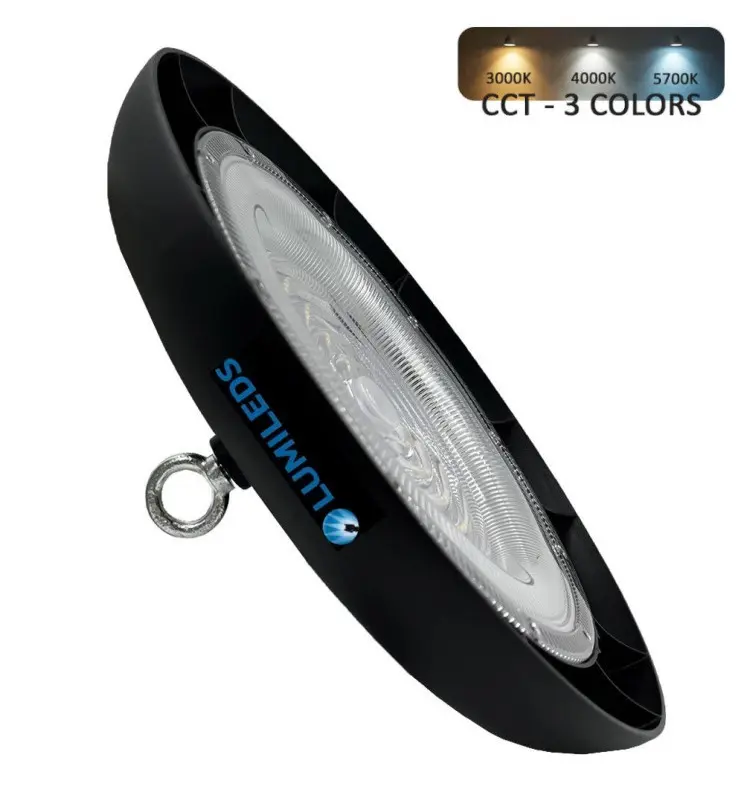
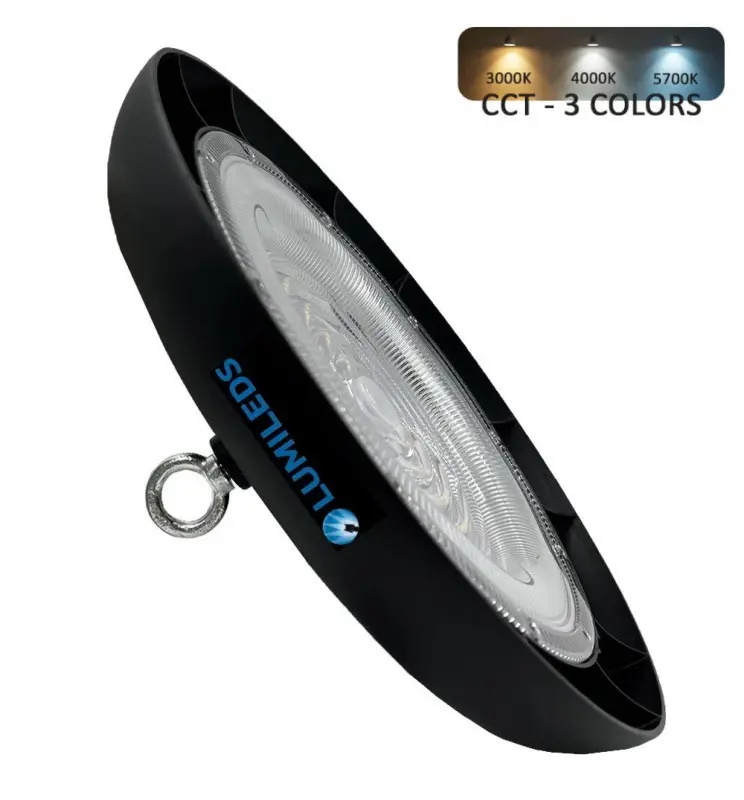
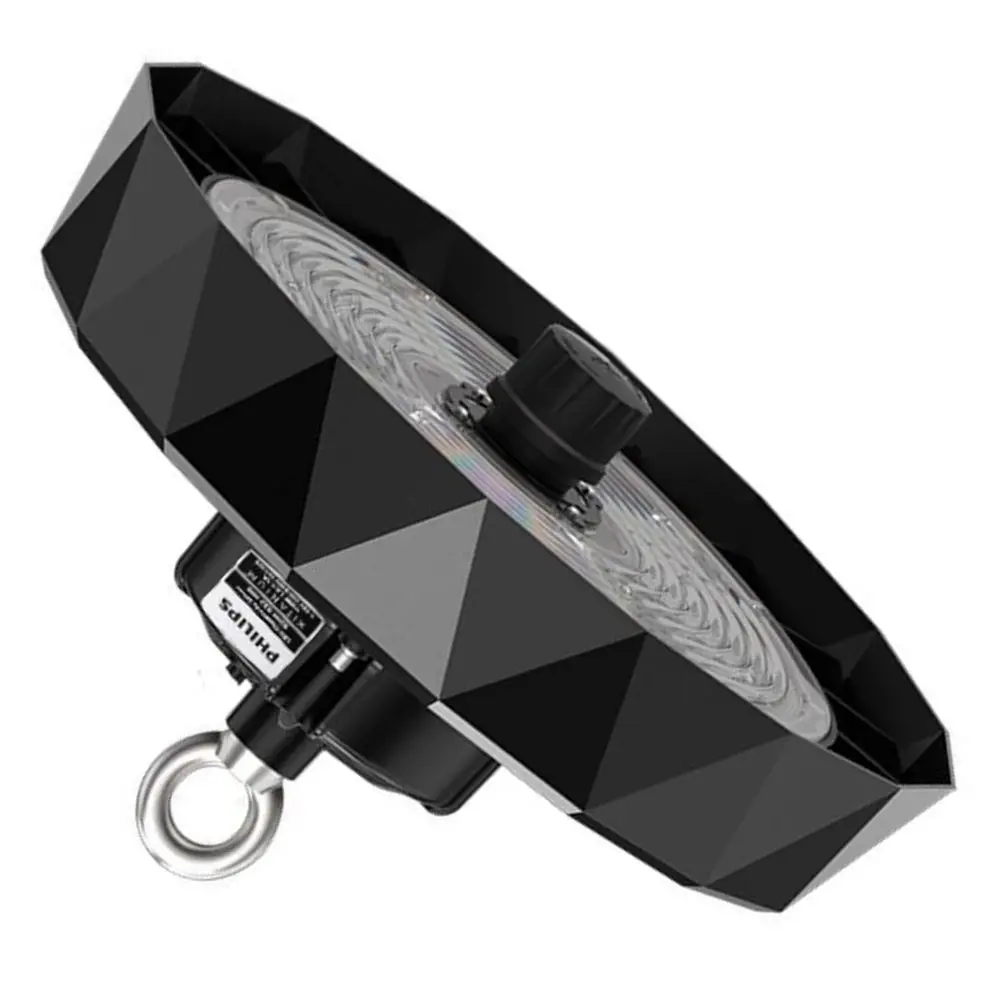
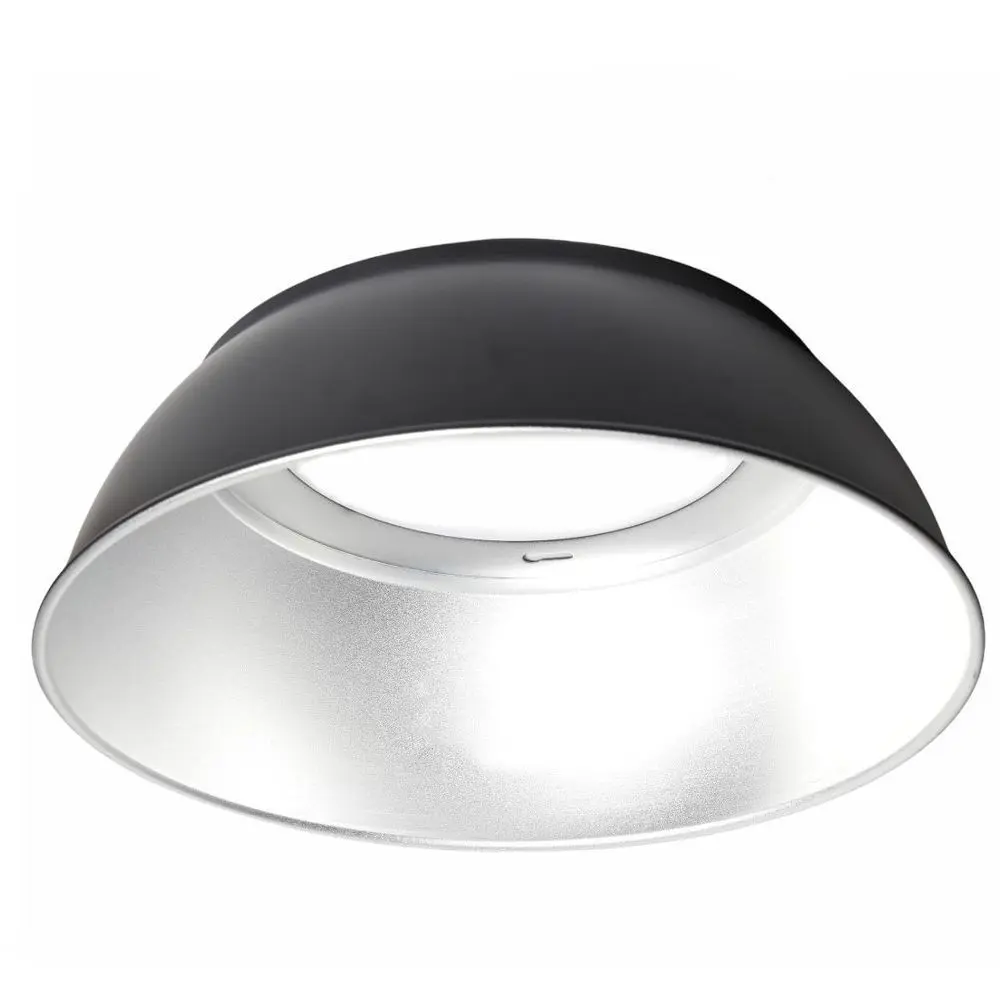
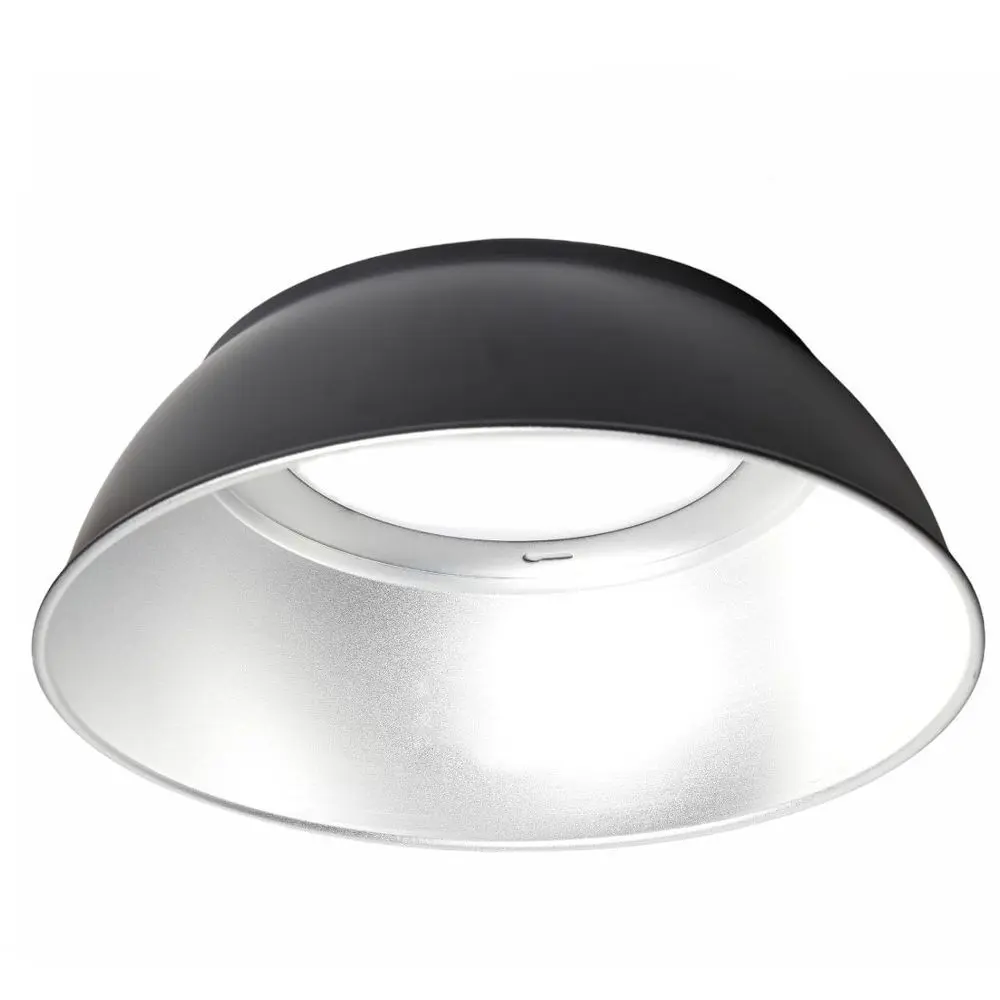
Warehouse lighting: the LED lighting we manufacture to light logistics warehouses in tall aisles, picking and cold stores
An order for warehouse lighting is nothing like one for an office. In a logistics building what has to be covered is almost never the whole floor: it is an aisle two or three metres wide, boxed in between two walls of goods that rise eight or twelve metres and absorb everything not aimed downwards. Move the racking half a metre and the whole layout stops working, and with it the number of units you had quoted.
We manufacture the luminaire we install, and that changes the conversation from the first minute. When we talk about lighting for warehouses we are not picking the least bad option from somebody else's catalogue: we adjust wattage, beam angle and colour temperature to the real gap between your racking. The lighting requirements of a dispatch platform and those of a store at minus eighteen degrees are nothing alike, and fitting the same reference in both works out expensive twice over.
There are three planes that are measured separately and that almost nobody separates. The aisle floor, where the machine circulates. The vertical face of the goods, which is where the labels are. And the station where the parcel is made up, which is where there is close-up reading. The first is solved with layout, the second with beam direction and the third with level. An installation that only looks after the first ends up with people raising their phone to label height to read a reference.
From there it is arithmetic: mounting height, aisle width, reflectance of the goods and operating hours per year. Send those four figures and the plan to uk@factorled.com: the answer comes back with the point layout, the wattage, the aperture and the colour temperature of every area. Without them what comes out is a number of units set by eye, and that number is paid for twice: in the order and in the access platform that has to be hired again to correct it.
The aisle width matters more than the wattage: good lighting in warehouses with tall racking
The aisle width and the height of the building decide almost everything else. In a conventional three-and-a-half-metre aisle, with racking at six, the line of fittings runs along the axis and with a wide spread. In a one-metre-eighty aisle served by a reach truck, that same wide spread throws half the flux against the goods on either side and leaves the floor below what circulation demands.
Depending on the mounting height the wattage changes, but the layout changes far more. At six metres, a row every four or five covers the run with no steps. At twelve metres, with that same spacing, weak patches appear exactly halfway between one point and the next. It is the defect you see the moment you walk in: a line that covers the aisle down the middle and leaves parts of it with shadows the eye reads as obstacles.
The lighting level is not measured at the ceiling. It is measured where the people are and where the load is. The amount of light reaching the bottom is what decides whether an operator sees a displaced pallet, a fork out of position or an oil patch before stepping on it. There warehouse lighting stops being a construction line item and becomes prevention: uniformity is what helps to avoid accidents, considerably more than the total installed wattage.
And uniformity is exactly what gets sacrificed when rows are spread further apart to use fewer units. The ratio between the weakest point of the aisle and the average is a figure that almost never appears in the offer and that explains why two installations with the same consumption are perceived so differently. An aisle with the correct average and a sunken minimum halfway along is perceived as dark even though the calculation adds up.
The luminaires that stand up to this scenario have two things in common. They dissipate well, because at the top of a building there are a good few more degrees than at floor level and heat is what eats into the driver's service life. And they allow the spread to be changed without changing the whole unit, which is what saves the day when the owner decides to reorganise the aisles. Both things come as standard in the range we manufacture, and that is what allows restocking years later with the same reference and not with a similar one that stands out from the floor. Ask for the technical data sheet at uk@factorled.com before closing quantities.
Narrow optics and LED technology: bringing the light down to the aisle floor instead of leaving it on the ceiling
A narrow aisle calls for a closed beam. With a 120º aperture the light goes out sideways, hits the goods on the first two levels and is spent before reaching the bottom. With 60º it comes straight down and reaches the floor with force. The same unit, with the same wattage and at the same height, produces a completely different result depending on whether it is fitted with a wider or narrower beam angle.
In industrial high bays we work with 60º, 90º and 120º, and the 60º reflector clips on and off the housing itself. That makes it possible to solve the open area with a wide spread and close the beam in the racking aisles without buying two different references. An LED high bay with the reflector fitted puts on the aisle floor what, left open, would be spread over the sides of the load. To light a twelve-metre-high aisle you do not need more wattage: you need more direction.
The other format that fits here is the linear LED luminaire installed in a continuous run along the axis. It spreads better lengthways, leaves no steps between one point and the next and on low ceilings avoids the spotlight effect on the load. The trade-off is that each run is tied to the racking: if you move the aisle tomorrow, the line stops being centred and has to be repositioned.
Underneath the photometry sits the construction, which is the part that decides whether the unit is still giving the same three years later. Aluminium body with a heatsink and IP65 sealing. In a racking building there is airborne dust, there is pressure cleaning in the food areas and there is humidity in the antechambers, and all of it gets in wherever it can. When the goods are wrapped in film or the floor is polished another effect appears: the light has to be diffused or the glare comes straight back into the operator's eyes.
Correct aisle lighting is achieved by closing the beam before adding units. That is why it is not sized by watts, but by useful lumens landing inside the aisle, which is a considerably smaller figure than the one on the data sheet. The rest is down to the type of luminaire chosen and the colour temperature, which is the next decision and the one that generates the most arguments on site. If the aperture is not clear on the plan, order a sample unit and install it in the most difficult aisle: it is settled in an afternoon and avoids correcting a whole order at twelve metres up.
The face of the racking decides the order: how to light a warehouse so that the labels up top can be read
Labels are not on the floor. They are at six, nine and twelve metres, stuck to the front of the pallet, and they are read from below or from the cab. A layout designed only for the floor leaves that vertical face half lit: the front darkens as it rises and the operator ends up reaching for a torch or bringing the pallet down to check the reference. That is minutes per movement, repeated hundreds of times a day.
The answer is not to raise the wattage. It is to spread the light so that part of the flux reaches the goods edge-on instead of falling vertically onto the empty aisle. With a closed beam on the axis you gain floor and lose the front face; with the line slightly off-centre, or with two rows closer together, you gain the front face. It is a layout decision, not a product one.
The figure that decides whether a label reads well is not the wattage either: it is the colour rendering index. With a low CRI, a code printed in grey on kraft cardboard loses contrast and the reader takes longer than it should. With CRI 80 or above it comes out first time. In food and textile installations, where there is also visual product control, that value weighs even more than in dry palletising.
Then there is glare, which in a tall aisle is a real problem and not a comfort detail. The operator looks upwards dozens of times per shift, and if the unit sits in their field of view with no brightness control you get fatigue, reading errors and the discomfort among workers that nobody connects to the installation. The unified glare rating is the number that describes this, and in tall racking aisles it is worth looking at before any other. A diffuser or a reflector that cuts the side glare avoids a whole shift of eye strain and improves visual comfort without touching a single watt.
Colour temperature rounds the matter off. The 3000 K warm white belongs to homes and hospitality; in a racking aisle it flattens contrast and makes everything look dirty. The 6000 K cool white gives a sense of sharpness, but it tires over long shifts and at stations with a lot of close reading. The 4000 K neutral white is what goes into most of these installations, and it is only raised when there is inspection or quality control involved. Aperture, CRI and tone are fixed at the moment of ordering and are not corrected afterwards without going back up with a platform: put them in writing in the email to uk@factorled.com and the material leaves the factory already settled.
Mark the areas of the distribution centre and the work zones come out with their reference: picking, loading apron and cold stores
With the aisle resolved there remains the other part of the calculation: the points where the goods change hands, each of which calls for its own answer.
Picking and order preparation. Here there is reading, counting, fine handling and sometimes labelling. It is the point that demands the highest level and the one most noticed when it fails, because a picking error is paid for downstream, at the end customer. The lighting of the preparation area is reinforced above what the aisle carries, with an even spread over the table and without the operator casting a shadow over what they are handling. Appropriate lighting at that point translates into an increase in productivity: fewer checks, fewer incidents and fewer trips back for the same reference.
Loading apron and docks. Here the building opens to the outside and the problem stops being the layout and becomes the adaptation of the eye: whoever is driving comes out of a closed aisle and into a doorway that on a summer afternoon has several times more light outside than in. What we ask for in that strip is an intermediate step of level, not more watts: an LED projector that brings the doorway closer to the interior and a wide-beam LED floodlight that does not leave the apron dark behind the lorry. In both cases the IP rating rules, because the open door lets water, dust and insects in. The dock itself is calculated as an area of its own: tell us how many bays you have and we close it separately within the same proposal.
Cold stores and antechambers. Cold does not punish LED, quite the opposite: it performs better at low temperature. What suffers is the seal, because of the condensation cycle every time the door opens, and the driver, which needs a declared working range for those temperatures. A housing that does not collect water on top and that can be cleaned in one pass is also worth having, because in a cold store maintenance is spaced far wider apart than in the rest of the building.
The LED warehouse lights we install in these working environments come from the same product family, and that is the real advantage of manufacturing: the same series covers the aisle, the dock and the antechamber with different apertures and different wattages. Lighting in a warehouse is rarely solved with a single product. It is a well-chosen, well-distributed family, and that approach is what ends up making each station's work easier without filling the spares store with references that bear no relation to one another. Mark the areas on the plan and we tell you which reference goes in each. And if you resell, or if you install it yourself, the trade account applies volume discounts across the whole range and provides the catalogue edited with your logo and your details.
One sensor per aisle: lighting control that switches on where the forklift goes
In a racking building there is surplus light for most of the shift. Not because it is oversized, but because the aisles are empty: with fourteen aisles and six machines, at any given moment there are eight aisles lit for nobody. That is the spend that is corrected without removing a single unit.
The correct approach is one detector per aisle, not one per building. Each row works as an independent zone: when nobody is passing through it stays at a background level that allows the aisle to be recognised from the head, and it goes up to full as soon as somebody enters. The movement sensor that solves this is radar and connects on top through a standardised Zhaga socket, without opening the unit and without touching its interior; it works at 0-10V and does not need direct line of sight, which in an aisle loaded to the top shelf is exactly what is needed. The high bays, for their part, are dimmed at 1-10V, which is the luminaire's own signal. The two figures coexist and each is in its place.
The background level is the piece almost nobody adjusts and the one that decides whether the setup works. Too low, and the operator waits for the start-up and ends up distrusting the automation. Too high, and it eats the margin. A background that lets the aisle be recognised at a glance and a short hold time is what consumes the least energy without anybody noticing that something is governing the installation.
A zone control system reduces energy costs far more than lowering the wattage of the units, because it acts on the hours and not on the watts. The greatest energy saving in a racking building does not come from installing fewer units: it comes from leaving switched off whatever nobody is using at that moment. Added to that is time-band dimming, which allows the whole installation to be brought down on the night shift, when there is only replenishment, and is another route to reducing energy consumption without leaving anybody in the dark.
One note that saves trouble: the lighting system is decided before buying, not afterwards. A unit without a dimmable driver does not accept dimming later on, it is replaced entirely; and adding the detector to a housing with no standardised socket means dismantling. If there is the slightest possibility of automating in the future, the 1-10V dimmable version is ordered from the very first order. Energy saving, moreover, is calculated with the real hours of each aisle, not with the building's opening hours: that distinction is what changes the number. Tell us how many aisles there are and how many machines circulate and we return the proposal with the dimmable version already included and one detector per zone. If you would rather close it by phone, call 654 777 000 with the plan in front of you.
Four scenarios and the reference that will still exist when aisle five opens: your type of warehouse and the lighting solutions that fit it
The usefulness of a warehouse is measured in how quickly an order goes out of the door, and the type of lighting it calls for depends on how it is laid out inside. Warehouse lights are not chosen by square metre, they are chosen by how the load is distributed. Four scenarios cover almost everything that comes our way.
Conventional palletising with a high ceiling. Racking from six to twelve metres, three-metre aisles and a counterbalanced truck. The high bay with a closed reflector on the axis rules. Warehouse luminaires of this profile are chosen on spread before wattage, and dimming compensates for the oversizing of the first months, when the building is not yet full.
Manual picking and light racking. Ceilings of four to six metres, plenty of people moving about and hand work. LED warehouse luminaires of this profile are usually continuous linear runs over the aisles, LED panels in the adjoining administrative area and surface ceiling fittings where there is no accessible plenum. The reinforcement goes over the preparation tables.
Narrow aisle served by a guided machine. One metre sixty or two wide and height above ten. It is the most demanding case of all: a very closed beam, a perfectly centred line and zone control as a requirement, because apart from maintenance nobody enters on foot.
Controlled temperature. Antechamber, chilled and freezer tunnel. Sealed housing, driver with a cold working range and the fewest possible gaskets. Cold store lights are also chosen with maintenance in mind: if somebody has to go up and replace a unit with the store running, every minute of open door costs.
Whatever the case, the LED solutions we propose come from the same range. We manufacture, and that means the reference you install today in aisle four still exists when you open aisle five. High-quality lighting is not the one with the flashiest data sheet: it is the one that three years from now is restocked with the same reference and leaves the row even, with no patches of tone. And that continuity is put in writing, because the factory backing starts at 3 years and extends up to 6 years depending on the product.
Send us the plan with floor area, heights, aisle width and use of each zone and we return the lighting scheme with wattage, quantity, layout and colour temperature. If the peak season is already on top of you and there is no way to close aisles, say so in the email to uk@factorled.com and the installation is planned in blocks of two or three aisles. To talk it over, dial 91 805 67 67; if mobile suits you better, 654 777 000.
Deduct daylight from the order: lighting a warehouse does not start at the switch
Many buildings have rooflights and do not take advantage of them, or take advantage of them the wrong way round. A well-placed rooflight provides, for a good part of the day, a source of light that costs nothing, and with 1-10V dimming that contribution is deducted on its own: the unit comes down when brightness enters from above and goes up when the sky closes in.
The problem appears when the contribution is uneven. A very bright strip of roof next to an aisle in shadow creates a contrast step that the eye takes time to resolve, and in a traffic area that is exactly what you do not want. Daylight is treated as one more zone of the control system, with its own sensor, and not as something already solved because it is free.
There is an effect noticed on the morning shift that appears on no spreadsheet: working with a contribution from the roof improves concentration and makes the shift easier to get through. It does not replace the installation, it complements it, and in summer it leaves whole hours in which the system works at minimum. What does not work is leaving it to the judgement of whoever walks past the panel. The sensor and the dimmable unit are ordered together: tell us whether the building has rooflights and the proposal comes out with the dimming included, instead of forcing you to replace units two years from now.
Warehouse lighting: the questions that come in before the lighting scheme is signed off
How many lux are needed in each area?
It depends on the work being done, not on the square metres. In reserve racking aisles, with no fixed workstation, it is usually sized at around 100 lux measured at floor level. When there is continuous movement of machines and people, the criterion rises to 150 lux. And at the point where the parcel is made up, documentation is read or labelling is done, you work with 200 lux or more, because there is close reading and fine handling. Always measure on the plane where the work is done, not at the ceiling, and ask for the uniformity as well as the average value. Tell us the use of each area and we return the target level together with the unit that reaches it with the fewest points.
Can I fit detectors without changing the luminaires I already have?
Only if the warehouse luminaires you already have installed carry a dimmable driver and a standardised socket on top. If they do, the radar detector clips on without opening the unit and without running new signal cable from the panel. If they do not, the route is to replace them with the dimmable version. That is why it is worth deciding at the initial order even if the automation is left for later: the difference between ordering the dimmable version and the fixed one is small at the moment of buying, and enormous when you have to go back up twelve metres with a hired platform.
What survives inside a cold store?
IP65 sealing, an aluminium body that does not collect water on top and a driver with a declared temperature range for cold working. The diode performs better at low temperatures; what suffers is the seal, because of the condensation cycle every time the door opens. Check the specific data sheet before closing the order, because not all references within the same range share a range. On cover, the floor is 3 years and the ceiling can reach up to 6 years, always depending on the product you install.
How soon will I have it and what if I run short of material halfway through the installation?
The pallet comes in through the same dock your goods go out of, so it is worth fitting the unloading into a gap in the schedule. The material leaves without delay, and the delivery estimate for your postcode is there when you confirm the order, which is exactly when it is worth booking the dock and the access platform. For the Canary Islands, Ceuta and Melilla the procedure is different: there is customs paperwork to process and a call beforehand prior to dispatch. The carriage cost is shown on screen before you pay, calculated on weight, volume and delivery zone, because a pallet of high bays and a box of detectors do not travel at the same price. When the order leaves our premises the email with the tracking number goes out. And if you run one unit short halfway through the installation, we manufacture: the reference is still alive and what arrives later keeps the tone and the spread of the first shipment.
And if something arrives damaged or I have units left over?
The check is done on the dock, with the carrier still there: if the package arrives knocked about, the note goes on the delivery note and only then is it signed, never the other way round. When the damage shows on opening, the notice has to go out straight away, not left until the end of the week. Returning by your own decision goes by another route, the one set out in our returns terms, and it comes with one requirement about the cardboard: that it comes back as it arrived, with no stickers or tape on it, and with manuals, accessories and its packaging inside. The return carriage is borne by the customer, and if any of that fails the amount refunded to you goes down. It is all handled with an RMA opened from your customer area, with no phone call, and the pallet does not move off the dock until the request is approved.
A quote for warehouse lighting is closed with the plan in front of you: send us floor area, heights and aisle width and we return the closed layout, with the wattage and the aperture of every area. Tell us too which aisles can be worked on and at what point in the shift, and the installation is ordered so that no aisle is left entirely out of action for the duration of the campaign. If you are going to equip several buildings, open the trade account with the registration form and your company documentation to uk@factorled.com: the volume tariff is active before the first order goes out.
Más en Industrial LED Lighting
- LED High Bay
- Industrial Warehouse Lighting
- Industrial Light Bulb
- Indoor Industrial Lighting
- Industrial Fluorescent Lamp
- Industrial LED Batten
- Industrial LED Panel
- Industrial LED Floodlights
- Industrial Ceiling Lights
- Industrial Streetlight
- Industrial Floodlights
- 150W Industrial LED Light Fixture
- 200W Industrial LED
- 400W Industrial Light Fixture
- Suspended Industrial Light Fixture
- Design Lighting